Body Follow Path
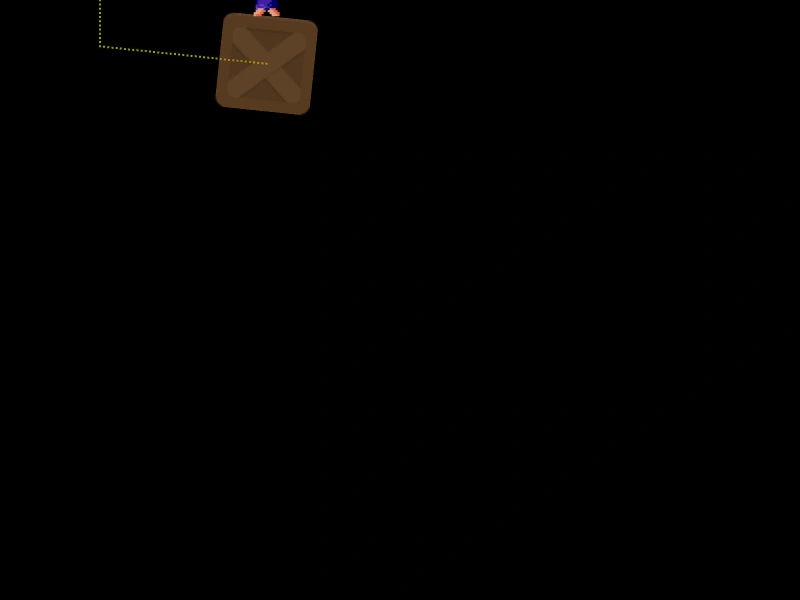
Demonstrates moving an Arcade Physics body along a complex path by calculating velocity from path tangents, allowing other physics objects to interact and collide with it.
800 × 600
class Example extends Phaser.Scene
{
    preload ()
    {
        this.load.setBaseURL('https://cdn.phaserfiles.com/v410');
        this.load.image('block', 'assets/sprites/block.png');
        this.load.image('lemming', 'assets/sprites/lemming.png');
    }

    create ()
    {
        // const path = this.createLoopPath();
        const path = this.createZigZagPath();

        const graphics = this.add.graphics({
            fillStyle: { color: 0xffff00, alpha: 0.6 },
            lineStyle: { width: 2, color: 0x0000ff, alpha: 0.6 }
        });

        const start = path.getStartPoint();
        const distance = path.getLength();
        const duration = 20000;
        const speed = distance / duration;
        const speedSec = 1000 * speed;
        const tSpeed = 1 / duration;
        const tSpeedSec = 1000 * tSpeed;

        let t = 0;

        console.log('distance (px)', distance);
        console.log('time (ms)', duration);
        console.log('speed (px/ms)', speed);
        console.log('speed (px/s)', speedSec);
        console.log('speed (t/ms)', tSpeed);
        console.log('speed (t/s)', tSpeedSec);

        const block = this.physics.add.image(start.x, start.y, 'block')
            .setImmovable(true)
            .setAlpha(0.5);

        const lemming = this.physics.add.image(block.x, block.y - 128, 'lemming')
            .setGravityY(30000);

        this.physics.add.collider(block, lemming);

        this.physics.world.on('worldstep', (delta) =>
        {
            t += delta * tSpeedSec;

            if (t > 1)
            {
                t -= 1;
                block.body.reset(start.x, start.y);
                graphics.clear();
                path.draw(graphics);
            }

            path.getTangent(t, block.body.velocity);
            block.body.velocity.scale(speedSec);
            block.setRotation(block.body.velocity.angle());
            graphics.fillPointShape(block.body.center, 2);
        });
    }

    createLoopPath ()
    {
        const path = new Phaser.Curves.Path(50, 500);

        path.splineTo([ 164, 446, 274, 542, 412, 457, 522, 541, 664, 464 ]);
        path.lineTo(700, 300);
        path.lineTo(600, 350);
        path.ellipseTo(200, 100, 100, 250, false, 0);
        path.cubicBezierTo(222, 119, 308, 107, 208, 368);
        path.ellipseTo(60, 60, 0, 360, true);

        return path;
    }

    createZigZagPath ()
    {
        const path = new Phaser.Curves.Path(100, -50);

        path.lineTo(100, 50);

        const max = 8;
        const h = 500 / max;

        for (let i = 0; i < max; i++)
        {
            if (i % 2 === 0)
            {
                path.lineTo(700, 50 + h * (i + 1));
            }
            else
            {
                path.lineTo(100, 50 + h * (i + 1));
            }
        }

        path.lineTo(100, 650);

        return path;
    }
}

const config = {
    scale: { mode: Phaser.Scale.FIT },
    type: Phaser.AUTO,
    width: 800,
    height: 600,
    parent: 'game-container',
    physics: {
        default: 'arcade',
        arcade: {
            debug: false,
            fps: 60,
            timeScale: 1
        }
    },
    scene: Example
};

const game = new Phaser.Game(config);
More in Arcade132 examples
 Body on a PathDemonstrates moving Arcade Physics bodies along a geometric path using an Ellipse curve and the getPoint method to update sprite positions while maintaining collision detection.
 Circular Collisions with a Static BodyDemonstrates multiple circular Arcade Physics bodies colliding and bouncing off a central static rectangular body.
 Circular Collisions with Static BodyDemonstrates how to use setCircle to define circular hitboxes for both dynamic physics groups and static images, featuring bounce physics and movement toward a central target.
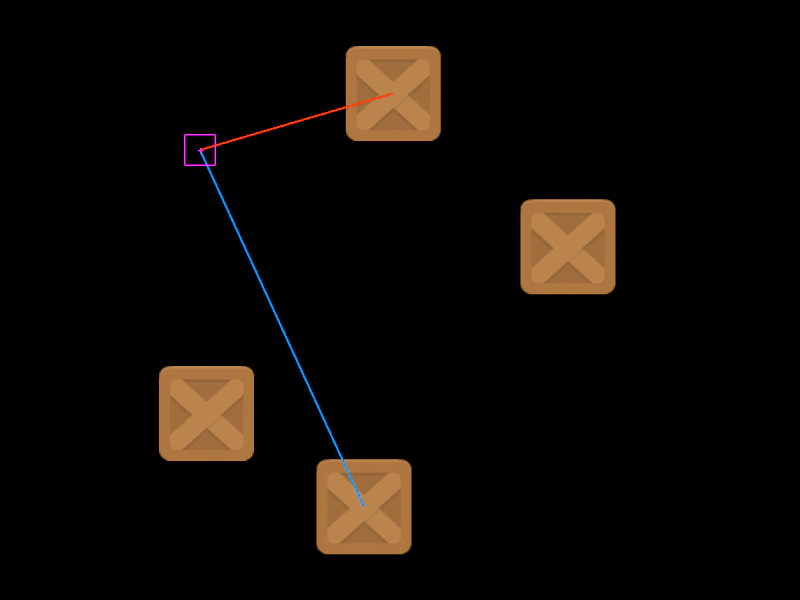 Closest and Furthest Physics BodiesIdentify the closest and furthest physics bodies relative to a specific source object using built-in Arcade Physics methods.