Matter Physics Compound Body from JSON
Demonstrates how to import complex collision shapes exported from Physics Editor and assemble them into a compound Matter.js body using JSON data and the PhysicsEditorParser.
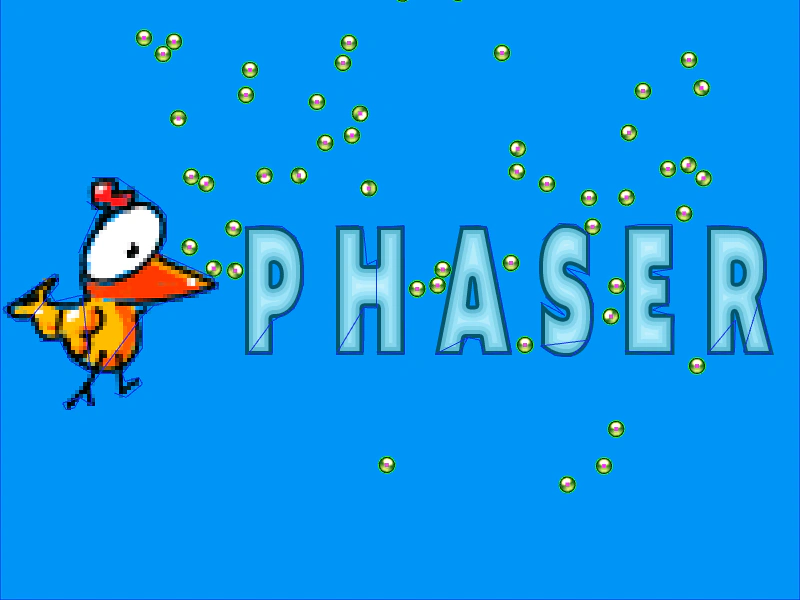
800 × 600
class Example extends Phaser.Scene
{
    preload ()
    {
        this.load.setBaseURL('https://cdn.phaserfiles.com/v410');
        this.load.image('ball', 'assets/sprites/green_ball.png');

        this.load.image('image', 'assets/physics/compound.png');

        this.load.json('shapes', 'assets/physics/compound.json');
    }

    create ()
    {
        this.matter.world.setBounds(0, 0, 800, 600, 32, true, true, false, true);

        const Body = Phaser.Physics.Matter.Matter.Body;
        const Bodies = Phaser.Physics.Matter.Matter.Bodies;
        const Composite = Phaser.Physics.Matter.Matter.Composite;
        const Parser = Phaser.Physics.Matter.PhysicsEditorParser;

        const shapes = this.cache.json.get('shapes');

        const composite = Composite.create();

        const parts = [ 'bird', 'p', 'h', 'a', 's', 'e', 'r' ];

        for (let i = 0; i < parts.length; i++)
        {
            const body = Body.create({ isStatic: true });

            Body.setParts(body, Parser.parseVertices(shapes[parts[i]].fixtures[0].vertices));

            Composite.addBody(composite, body);
        }

        /*
        var fixtures = shapes.logo.fixtures;

        for (var i = 0; i < fixtures.length; i++)
        {
            var body = Body.create({ isStatic: true });

            Body.setParts(body, parseVertices(fixtures[i].vertices));

            Composite.addBody(composite, body);
        }
        */

        Composite.translate(composite, { x: 0, y: 150 });

        this.matter.world.add(composite);

        this.add.image(400, 300, 'image');

        for (let i = 0; i < 64; i++)
        {
            const ball = this.matter.add.image(Phaser.Math.Between(100, 700), Phaser.Math.Between(-600, 0), 'ball');
            ball.setCircle();
            ball.setFriction(0.005);
            ball.setBounce(1);
        }
    }

    parseVertices (vertexSets, options)
    {
        const Matter = Phaser.Physics.Matter.Matter;

        let i, j, k, v, z;
        const parts = [];

        options = options || {};

        for (v = 0; v < vertexSets.length; v += 1)
        {
            parts.push(Matter.Body.create(Matter.Common.extend({
                position: Matter.Vertices.centre(vertexSets[v]),
                vertices: vertexSets[v]
            }, options)));
        }

        // flag coincident part edges
        const coincidentMaxDist = 5;

        for (i = 0; i < parts.length; i++)
        {
            const partA = parts[i];

            for (j = i + 1; j < parts.length; j++)
            {
                const partB = parts[j];

                if (Matter.Bounds.overlaps(partA.bounds, partB.bounds))
                {
                    const pav = partA.vertices,
                        pbv = partB.vertices;

                    // iterate vertices of both parts
                    for (k = 0; k < partA.vertices.length; k++)
                    {
                        for (z = 0; z < partB.vertices.length; z++)
                        {
                            // find distances between the vertices
                            const da = Matter.Vector.magnitudeSquared(Matter.Vector.sub(pav[(k + 1) % pav.length], pbv[z])),
                                db = Matter.Vector.magnitudeSquared(Matter.Vector.sub(pav[k], pbv[(z + 1) % pbv.length]));

                            // if both vertices are very close, consider the edge concident (internal)
                            if (da < coincidentMaxDist && db < coincidentMaxDist)
                            {
                                pav[k].isInternal = true;
                                pbv[z].isInternal = true;
                            }
                        }
                    }

                }
            }
        }

        return parts;
    }
}

const config = {
    scale: { mode: Phaser.Scale.FIT },
    type: Phaser.AUTO,
    width: 800,
    height: 600,
    backgroundColor: '#0094f7',
    parent: 'game-container',
    physics: {
        default: 'matter',
        matter: {
            debug: true
        }
    },
    scene: Example
};

const game = new Phaser.Game(config);
More in Matterjs67 examples
 Matter Physics Debug OptionsDemonstrates the extensive debug visualization features available in Matter.js, including the rendering of convex hulls, joint constraints, springs, velocity vectors, and sleep states.
 Matter Physics Drag FilterDemonstrates how to use collision filters with a mouse constraint to restrict which physics bodies can be dragged by the pointer.
 Matter Physics Simple BodyAn introduction to adding dynamic physics bodies and a static platform using the Matter.js physics engine.
 Matter Physics with Bitmap TextDemonstrates how to add a Matter.js physics body to a Bitmap Text object, allowing it to fall, bounce, and collide with other physical bodies.