Get Particle Emitter Bounds
Demonstrates how to calculate the bounding rectangle of a particle emitter, including both current active particle bounds and pre-calculating bounds over a specific time duration.
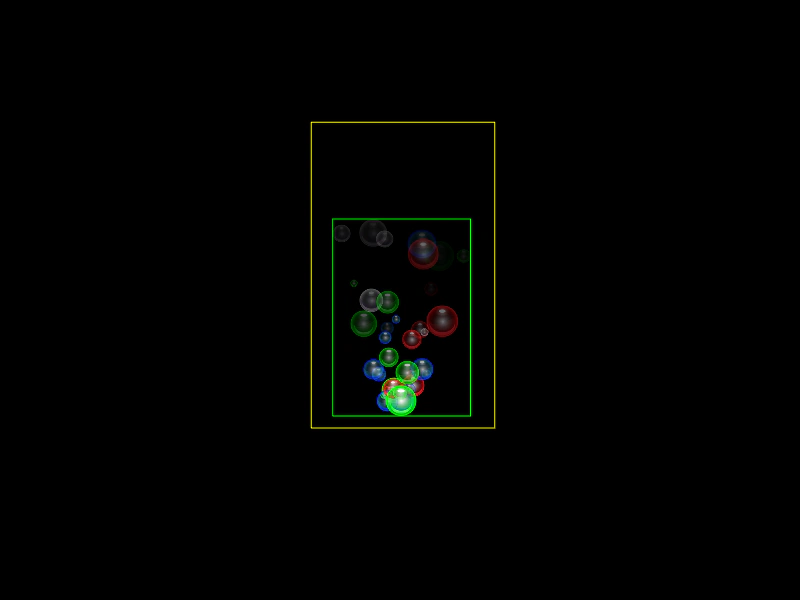
800 × 600
class Example extends Phaser.Scene
{
    preload ()
    {
        this.load.setBaseURL('https://cdn.phaserfiles.com/v410');
        this.load.atlas('bubbles', 'assets/particles/bubbles.png', 'assets/particles/bubbles.json');
    }

    create ()
    {
        this.emitter = this.add.particles(400, 400, 'bubbles', {
            frame: [ 'bluebubble', 'redbubble', 'greenbubble', 'silverbubble' ],
            scale: { min: 0.1, max: 0.5 },
            speed: { min: 20, max: 40 },
            alpha: { start: 1, end: 0 },
            lifespan: 2000,
            frequency: 50,
            gravityY: -90,
            particleBringToTop: false
        });

        this.g = this.add.graphics();

        this.bounds = this.emitter.getBounds(10, 6000);
    }

    update ()
    {
        this.g.clear();
        this.g.lineStyle(1, 0x00ff00);

        //  The current emitter bounds
        const vb = this.emitter.getBounds();

        this.g.strokeRectShape(vb);

        if (Phaser.Geom.Rectangle.ContainsRect(this.bounds, vb))
        {
            this.g.lineStyle(1, 0xffff00);
        }
        else
        {
            this.g.lineStyle(1, 0xff0000);
        }

        //  The pre-calculated emitter bounds
        this.g.strokeRectShape(this.bounds);
    }
}

const config = {
    scale: { mode: Phaser.Scale.FIT },
    type: Phaser.AUTO,
    width: 800,
    height: 600,
    backgroundColor: '#000',
    parent: 'game-container',
    scene: Example
};

const game = new Phaser.Game(config);
More in Particle Emitter44 examples
 Hold ParticleDemonstrates the hold property in a particle emitter, allowing particles to remain visible for a set duration after their active lifespan has completed.
 Move Particles to Dynamic TargetDemonstrates how to use onUpdate callbacks with particle moveTo properties to make particles track a moving target like the mouse pointer.
 Multiple Death ZonesLearn how to define multiple geometric shapes as death zones to instantly kill particles that enter those areas.
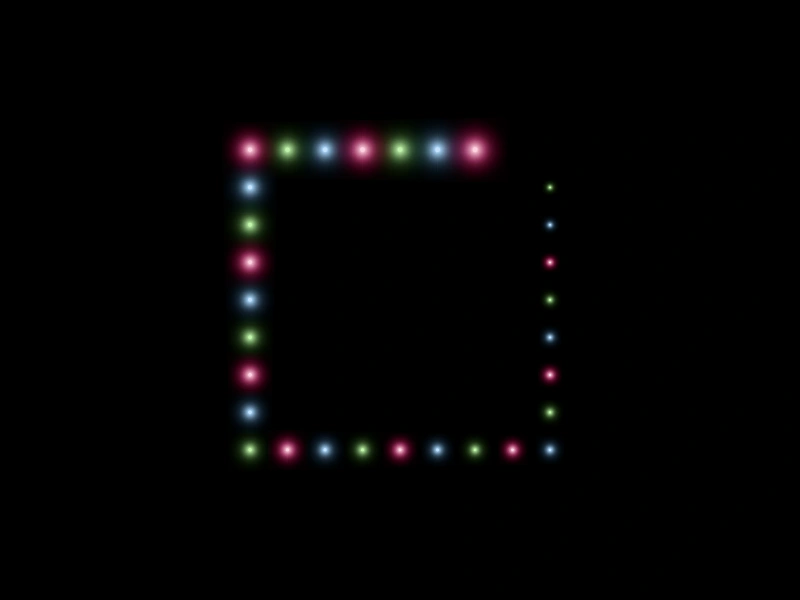 Multiple Edge Emit ZonesDemonstrates using multiple geometric shapes as edge emission zones for a single particle emitter, utilizing the total and quantity properties to control point distribution.