Matter Ghost Collisions
Demonstrates how to mitigate 'ghost collisions' at tile seams in Matter JS by comparing individual tile bodies with a single large convex body defined via Tiled object layers.
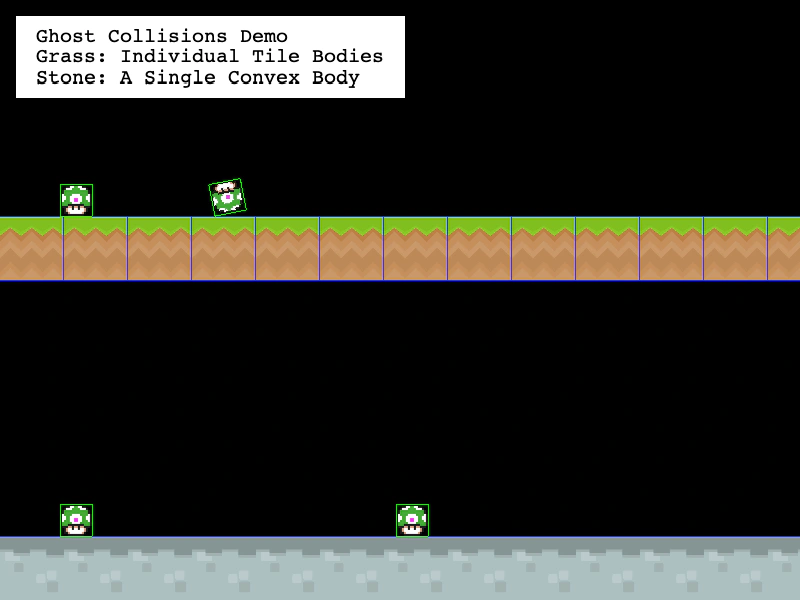
800 × 600
class Example extends Phaser.Scene
{
    map;
    cam;
    text;

    preload ()
    {
        this.load.setBaseURL('https://cdn.phaserfiles.com/v410');
        this.load.tilemapTiledJSON('map', 'assets/tilemaps/maps/matter-ghost-vertices.json');
        this.load.image('kenney_redux_64x64', 'assets/tilemaps/tiles/kenney_redux_64x64.png');
        this.load.image('ball', 'assets/sprites/mushroom-32x32.png');
    }

    create ()
    {
        this.map = this.make.tilemap({ key: 'map' });
        const tileset = this.map.addTilesetImage('kenney_redux_64x64');
        const layer = this.map.createLayer(0, tileset, 0, 0);

        // "Ghost collisions" can happen in physics engines when two colliding bodies are next to one
        // another, e.g. a player trying to walk over two neighboring ground tiles. The order in which
        // the collisions are resolved by the engine can cause "unrealistic" effects, e.g. the player
        // being stopping dead in their tracks on flat ground). See
        // http://www.iforce2d.net/b2dtut/ghost-vertices for more info. When working with tilemaps and
        // Matter, there are a couple ways to mitigate this issue:
        //  - Add chamfer to bodies, i.e. round the edges, or use circular bodies to reduce the impact
        //    of the ghost collisions.
        //  - Map out your level's hitboxes as as a few convex hulls instead of giving each tile a
        //    separate body. You can still use Tiled for this. Create an object layer, and fill it
        //    with shapes, convert those shapes to Matter bodies in Phaser (see below).
        //  - Use a library like hull.js (https://github.com/AndriiHeonia/hull) to automatically figure
        //    out convex hulls from your tiles.

        // Set up the grass tiles to have individual matter bodies.
        layer.setCollisionByProperty({ type: 'grass' });
        this.matter.world.convertTilemapLayer(layer);

        // The stone platform has been mapped as a single, long rectangle in Tiled. See
        // Phaser.Physics.Matter.TileBody#setFromTileCollision for how to parse other Tiled shapes.
        const rect = this.map.findObject('Collision', obj => obj.name === 'Stone Platform');
        this.matter.add.rectangle(
            rect.x + (rect.width / 2), rect.y + (rect.height / 2),
            rect.width, rect.height,
            { isStatic: true }
        );

        this.cam = this.cameras.main;
        this.cam.setBounds(0, 0, this.map.widthInPixels, this.map.heightInPixels);
        this.cam.setScroll(0, 700);

        this.time.addEvent({
            delay: 500,
            callback: function ()
            {
                const shroom1 = this.matter.add.image(10, 1200, 'ball');
                shroom1.setRectangle();
                shroom1.setFriction(0);
                shroom1.body.force.x = 0.05;
                this.time.addEvent({ delay: 2000, callback: this.destroyShroom.bind(this, shroom1) });

                const shroom2 = this.matter.add.image(10, 880, 'ball');
                shroom2.setRectangle();
                shroom2.setFriction(0);
                shroom2.body.force.x = 0.05;
                this.time.addEvent({ delay: 2000, callback: this.destroyShroom.bind(this, shroom2) });
            },
            callbackScope: this,
            loop: true
        });

        this.matter.world.setBounds(this.map.widthInPixels, this.map.heightInPixels);

        this.text = this.add.text(16, 16, 'Ghost Collisions Demo\nGrass: Individual Tile Bodies\nStone: A Single Convex Body', {
            fontSize: '20px',
            padding: { x: 20, y: 10 },
            backgroundColor: '#ffffff',
            fill: '#000000'
        });
        this.text.setScrollFactor(0);
    }

    destroyShroom (shroom)
    {
        this.matter.world.remove(shroom);
        shroom.destroy();
    }
}

const config = {
    scale: { mode: Phaser.Scale.FIT },
    type: Phaser.AUTO,
    width: 800,
    height: 600,
    backgroundColor: '#000000',
    parent: 'game-container',
    pixelArt: true,
    physics: {
        default: 'matter',
        matter: {
            gravity: { y: 1 },
            debug: true
        }
    },
    scene: Example
};

const game = new Phaser.Game(config);
More in Collision12 examples
 Matter Physics Platformer with Wall JumpingA comprehensive example of a Matter.js platformer featuring compound bodies and sensors for advanced collision detection. It demonstrates smoothed horizontal movement, wall jumping logic, and converting Tiled tilemaps into physical Matter bodies.
 Matter Physics Tilemap CollisionDemonstrates how to convert a Tilemap layer into Matter.js physics bodies, supporting both default rectangular bounds and custom collision shapes defined in Tiled.
 Matter Platformer with Dynamic Tile ModificationDemonstrates how to modify a Matter-enabled Tilemap at runtime, including updating existing tile collision shapes and adding new physics-enabled tiles to build a bridge.
 Matter Tilemap Collision DetectionDemonstrates how to convert a Tilemap layer into Matter.js physics bodies and detect collisions between sprites and specific tiles using body labels and custom Tiled properties.