Hash Stability
Compare the deterministic results of the Phaser Math Hash function against standard random values. This example shows how hashing provides consistent, repeatable values for the same input data.
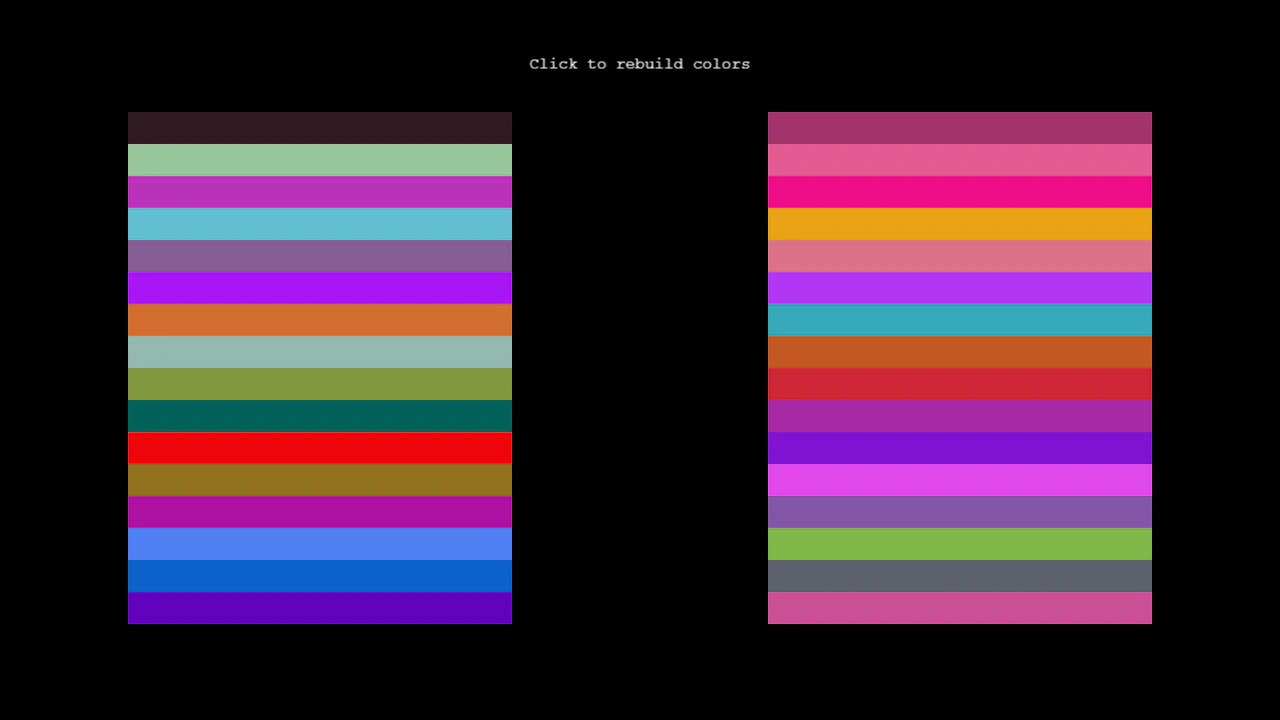
1280 × 720
class Example extends Phaser.Scene
{
    rects = [];

    create()
    {
        this.add.text(640, 64, 'Click to rebuild colors').setOrigin(0.5);

        this.populate();

        this.input.on('pointerdown', () => {
            for (const rect of this.rects)
            {
                rect.destroy();
            }
            this.populate();
        });
    }

    populate()
    {
        const color = new Phaser.Display.Color();

        for (let y = 128; y < 640; y += 32)
        {
            // Add random colors. They're always different.
            color.setGLTo(Math.random(), Math.random(), Math.random());
            const r1 = this.add.rectangle(320, y, 384, 32, color.color);
            this.rects.push(r1);

            // Add noise-derived colors. They're always the same.
            color.setGLTo(Phaser.Math.Hash(y), Phaser.Math.Hash(y + 1), Phaser.Math.Hash(y + 2));
            const r2 = this.add.rectangle(960, y, 384, 32, color.color);
            this.rects.push(r2);
        }
    }
}

const config = {
    scale: { mode: Phaser.Scale.FIT },
    type: Phaser.WEBGL,
    parent: 'game-container',
    width: 1280,
    height: 720,
    scene: Example
};

const game = new Phaser.Game(config);