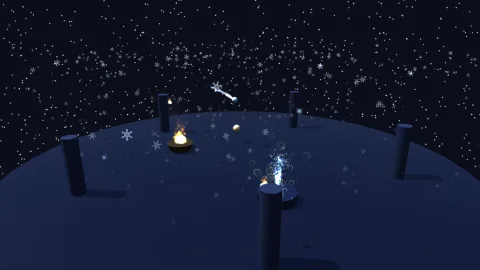

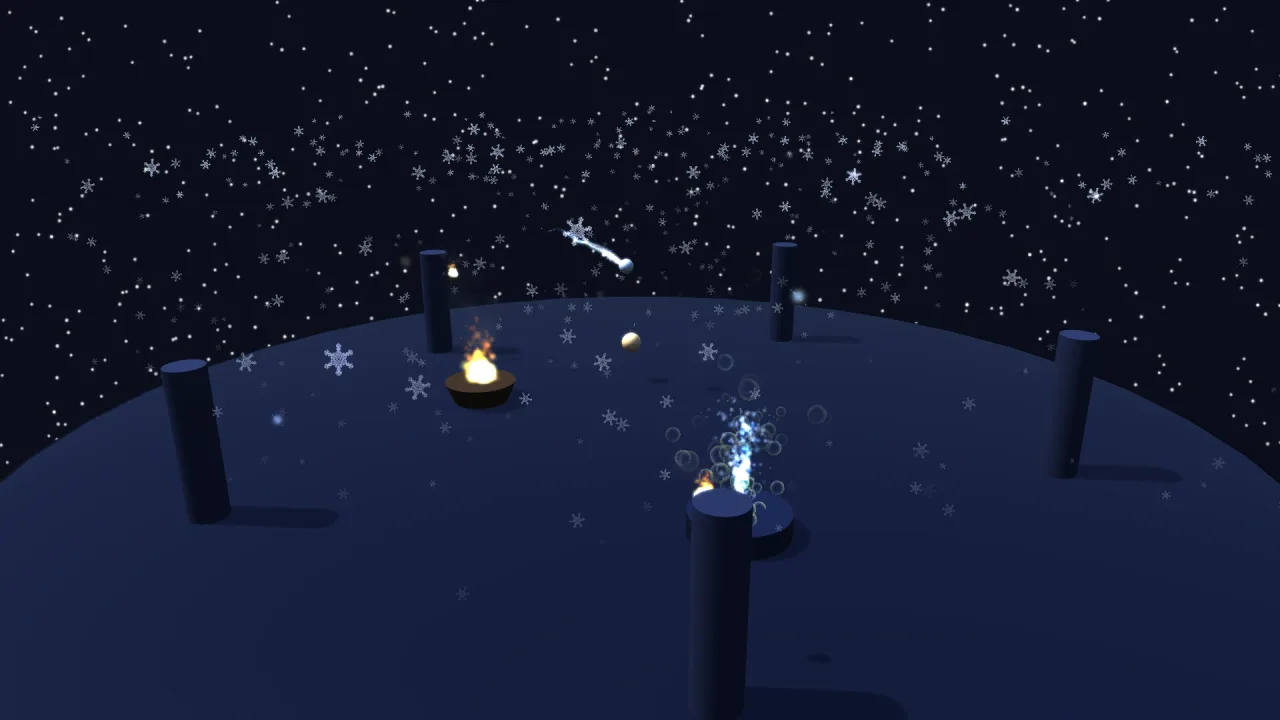
What it does
An emitter is an object in your world. It lives in a scene, can follow another object at an offset and sorts with everything else. Its live particles draw as quads through the same renderer as your meshes, one instanced draw for the whole emitter, so there is no second pipeline to set up, and they are sorted by distance from the camera across emitters, so smoke does not draw over the flame it rises from.
A particle can face the camera, stay upright like a flame, lie flat like a shockwave ring or stretch along its velocity like a spark. By default particles take the scene's lights, so a puff of smoke catches a lantern, and soft particles fade a large quad as it nears the geometry behind it, so smoke meets the floor without a hard line.
Every value that can vary is an op, the same vocabulary particles-2d uses: a constant, a random range, a pick, a
curve over the particle's life, keyframes or a callback. Particles are born in real 3D shapes or on a model's own
surface, sampled by area so a model's tiny faces do not get as many sparks as its flank, and they are pushed by
forces written as data. Effects, several emitters together, are data too: registered by the vfx3d-* packs or by
your game, then placed, aimed, scaled or attached to an object with one call.
Features
- Emitters as world objects — position, layer,
followwith anoffset, world or local space, and a yaw, pitch and roll that turn the emit zone and the launch direction. - Four facings —
camera,upright,velocitywith astretch, andflat, with normal or additive blending. - Lit and soft — particles take the scene's lights unless
lit: false, and fade softly into surfaces behind. - Ops for every value — constants, ranges, random picks, curves with easing, keyframes and callbacks, as in 2D.
- 3D emit zones — point, sphere, box, disc, cylinder, cone, ring, line, path and rect, filled by volume, surface or edge, with launch along the outward normal or in order round a path.
- Mesh surfaces —
game.particles3d.surfacebuilds an area-weighted sampler once, and it survives the object moving, turning and scaling. - Cone launch — a
directionand aspreadfill a cone evenly, from a jet to every way at once. - Forces as data — acceleration, drag, gusting wind, attract, vortex, orbit, curl noise and turbulence, plus
swayfor drifting snow andtwinkle, at its owntwinkleFreq, for fireflies. - Rate over distance — a moving emitter lays particles evenly along its path whatever the frame rate, and lays
none across a teleport or a move made with
jump(). - Bursts, death zones and sub-effects — timed bursts with a probability, zones that kill inside or outside,
killBelowY, and effects spawned on a particle's birth or death. - Effects by name —
game.particles3d.effectplaces, scales, aims or attaches a registered effect, andregisterVfx3dadds your own.
Good for
- 3D action and shooter games — muzzle flashes, sparks from a hit that die at the floor, blasts and debris.
- Driving games — exhaust aimed backwards from a car, and dust laid behind each wheel by the distance it rolls.
- Weather round the player — rain, snow, leaves and ash from
vfx3d-weatherthat follow the player. - Fantasy and RPG worlds — campfires and torches, spells that orbit or swirl, motes shed from a statue's surface.
- Atmosphere in a scene — steam from a kettle, mist, and embers or fireflies that twinkle.
Make it yours
Every emitter is an Emitter3dConfig, and every varying value in it can change over life or at random, so the same
pack makes a lazy smoke column and a violent blast. Effects take a position, a follow and offset, a scale that
sizes every speed, distance, zone and force together so the motion keeps its shape, a yaw, pitch and roll, a
layer and a timeScale. An emitter handle has live rate, emitting, timeScale and lit, so a fire can be
damped in play. You register your own effects with registerVfx3d, under names of their own, beside the ready-made
ones. The one pack option, maxEmitters, caps only the sub-effects particles spawn.
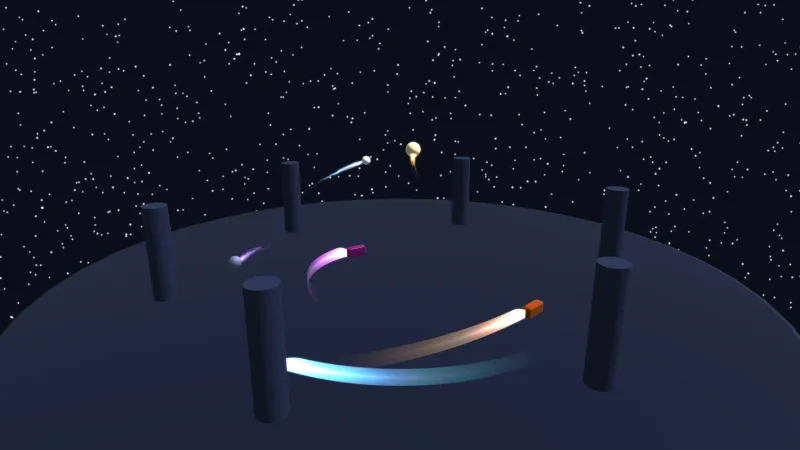
Two very different uses: a kept spark emitter with no rate, moved to each hit and fired with burst(40), its
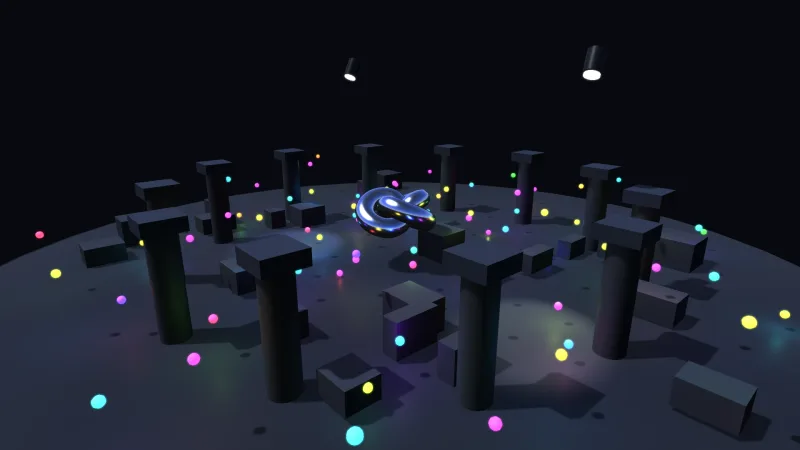
additive sparks stretched along their flight and killed at the floor; and a statue that sheds motes from its own
surface, launched along the surface normals and lit by the lamps around it.
A quick look
A kept emitter of sparks, moved to each hit and fired as a burst, and a ready-made campfire placed and scaled:
const sparks = game.particles3d.emitter({
    x: 0, y: 1, z: 0, rate: 0, max: 200,
    frame: 'particle:spark', blend: 'add', facing: 'velocity', stretch: 0.04, lit: false,
    lifespan: [0.3, 0.7], speed: [4, 9], angle: [0, 360], elevation: [20, 70],
    gravityY: -9.8, killBelowY: 0, size: 0.12, alpha: { start: 1, end: 0 }, color: ['#fff3c0', '#ff8a2a'],
});
sparks.emitter.moveTo(hit.x, hit.y, hit.z);
sparks.emitter.burst(40);
const fire = game.particles3d.effect('campfire', { x: 4, y: 0, z: -2, scale: 1.5 });
Works with
render-3d— required; the particles draw through the renderer that is already there.particle-texturesandcolor— required; the particle pictures the effects draw with, and the colour ramps.vfx3d-fire,vfx3d-smoke,vfx3d-explosion,vfx3d-magic,vfx3d-weather,vfx3d-lightning— ready-made effects by name.core-3d— includes this pack, so most 3D games have it already.particles-gpu-3d— for standing fields of tens of thousands to a million, simulated on the GPU.trails-3dfor ribbons behind moving things, andwisps-3dfor a standing smoke column without particles.particles-2d— the same op vocabulary for 2D games.
Good to know
- It simulates on the CPU, the right trade at a few thousand particles an emitter;
particles-gpu-3dreaches hundreds of thousands. - Particles are quads and cast no shadows: ribbons are
trails-3dand beams of lightbeams-3d. - Sorting is by each particle's centre, so two large quads that cross can still order oddly.
- An emitter's rotation turns its zone, its launch and a flat quad's plane only; gravity, force positions and death zones stay in world axes.
- A mesh emit zone samples the geometry it is given, so an animated or skinned model sheds particles from its bind pose.