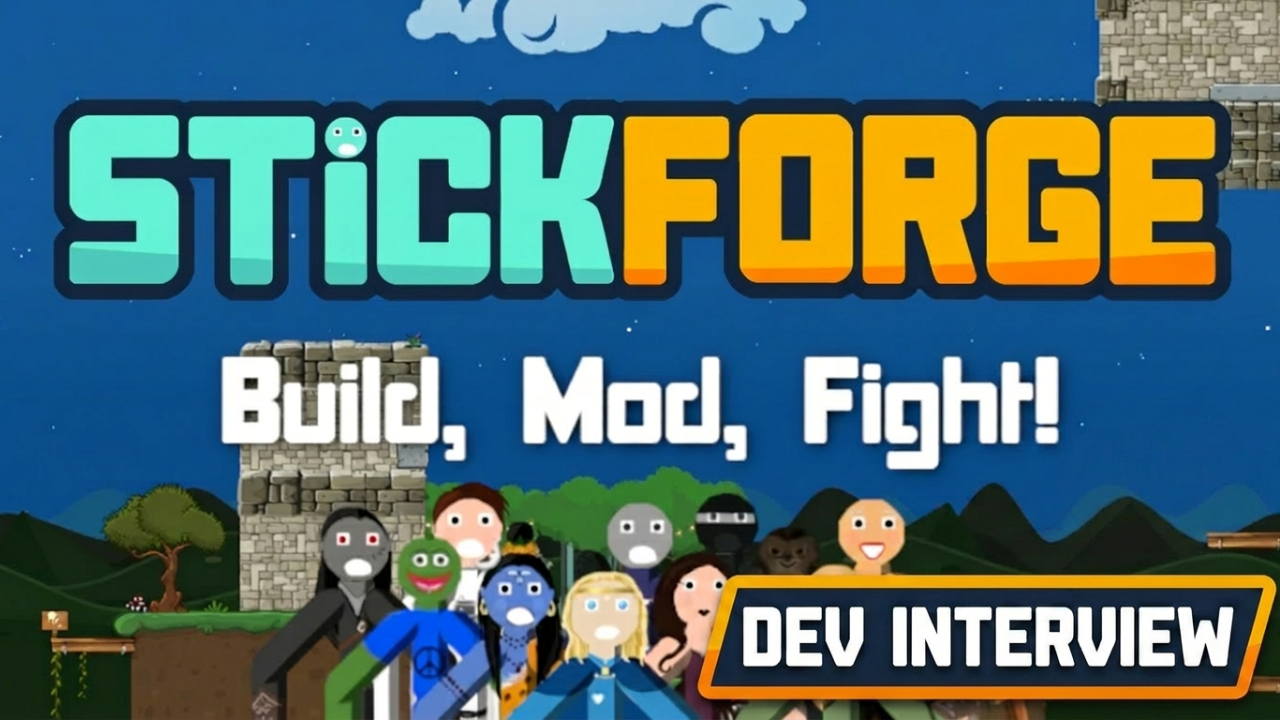
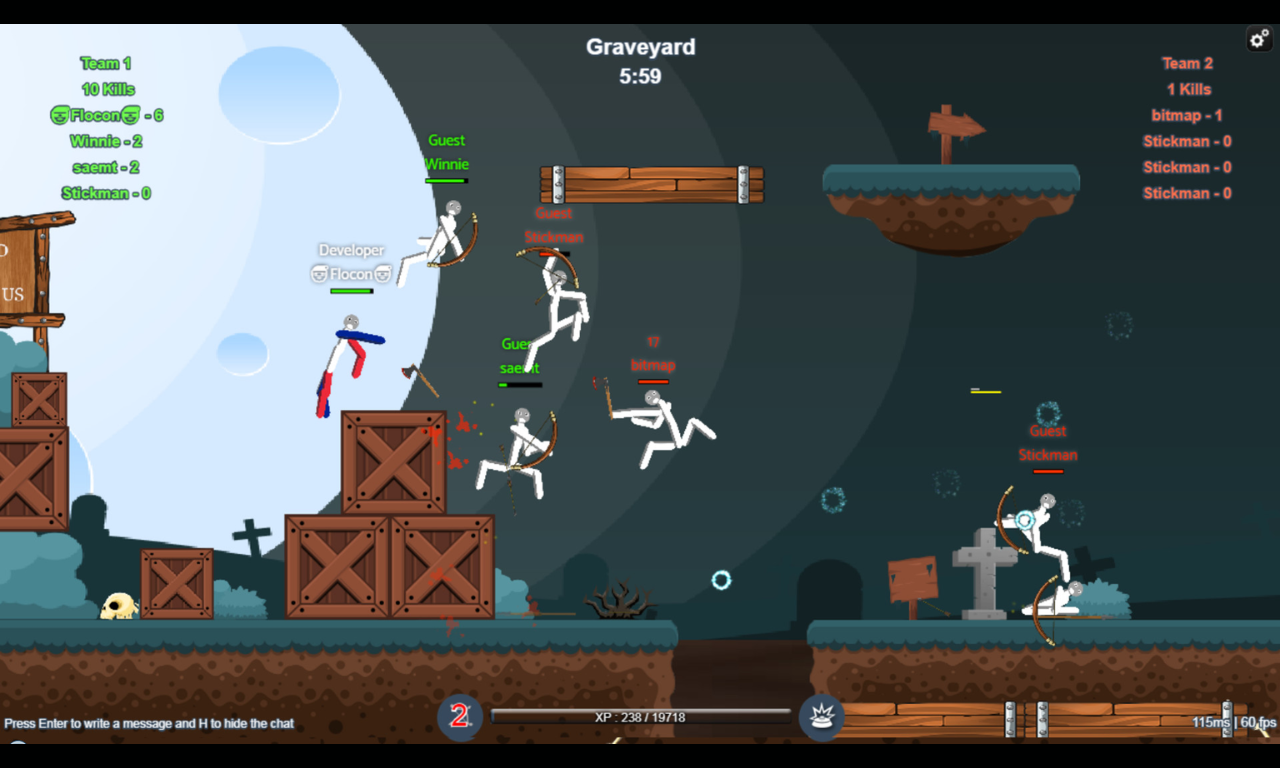
Ten years ago, a wobbly stickman took its first stumbling steps across a test map in someone's attic. That stickman became BattleStick, a physics-based multiplayer game built with Phaser that went on to attract over 4 million unique players. Now it has evolved into Stickforge, fully moddable, available on Steam, and just launched as a free web multiplayer version.
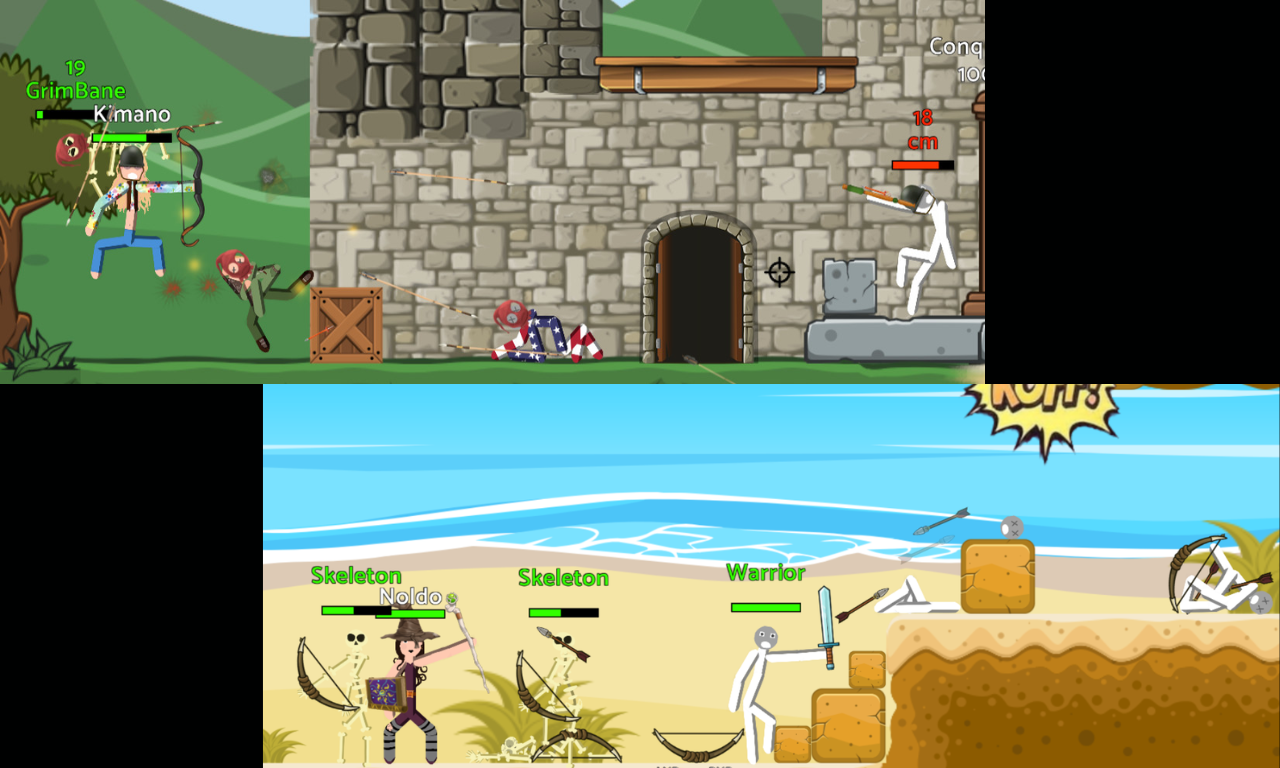
Stickforge is a game where, in their own words, "the laws of physics are more like guidelines." Fight and build with other players, create custom maps, weapons, skins and NPCs. And if you feel like programming an army of hostile rubber ducks, the modding system has you covered. Stickmen bounce, break, and occasionally explode. It's chaotic. It's great. The free web version is live at stickforge.com.
To celebrate the 10th anniversary of BattleStick, we sat down with Noldo, the developer, to talk about a decade of building with Phaser, the lessons learned from multiplayer physics, and what's coming next.
The Interview
Building a Phaser Multiplayer Game from Scratch
Q: BattleStick launched 10 years ago. How have you and your games evolved since that first release?
Stickforge is a childhood dream that has come true. What was an attic experiment (literally) turned into an awesome adventure: BattleStick. I remember the first unstable, wobbling stickman able to stand up, proudly roaming and stumbling through a test map.
As soon as I got the first playable version, I knew it would be a funny and exciting journey. These were the early versions of Phaser and I wasn't used to the tool yet, but I managed to create a multiplayer version of it. My colleagues and I gained some traction, and over the years more than 4M+ unique players had fun with the games. My wife started drawing stickman skins and making maps too. In the meantime, Phaser kept improving nonstop, including performance, so I was able to increase the multiplayer scale of the game. The game evolved over time, with graphics and physics improving.
BattleStick made me realize that anyone can have a big impact on other people's lives through their dreams, creations, and actions. I'm glad I was able to bring humor and joy to thousands of people, especially during difficult times like Covid.
Now, Stickforge is the final iteration of the BattleStick franchise, with some seasoned players who played the first game and a small but stable community.
"Phaser kept improving nonstop, including performance, so I was able to increase the multiplayer scale of the game."
"BattleStick made me realize that anyone can have a big impact on other people's lives through their dreams, creations, and actions."
Q: What do you know now about building games with Phaser that you wish you'd known back then?
I'm glad I first experimented using a POC to make sure the physics engine could handle all the stickman joints without trouble, but I should have stress-tested it more with additional stickmen and network load to better assess scalability. I didn't realize that physics in a web browser could be so resource-intensive. I also would have loved to know how to make sure tiles don't bleed when making maps!
I also didn't write a single test at the time for BattleStick, it was only an experiment that became popular. Now, with hindsight, I would also apply testing to the game client.
I also created some math functions and tools that I later discovered already existed in Phaser or became available shortly after. So before implementing a feature, it's best to check the documentation. It's basic development practice, but worth remembering, since many tools are now built into Phaser. The same applies to community add-ons and tools.
Q: Were there any moments during development where Phaser surprised you in a good way?
I would say it was a continuous surprise how well it worked with physics and game state management. I was also surprised by how easy it is to distribute the game on other platforms, like Steam, using Phaser + Electron. I was also very pleased to discuss things with Richard and receive support during the early development.
"I was also surprised by how easy it is to distribute the game on other platforms, like Steam, using Phaser + Electron."
Q: Stickforge lets players create their own maps, skins and scripts. How did you approach building that modding system?
Phaser is very flexible and allows resources to be loaded dynamically. It's also possible to display a progress bar, which is convenient for this type of community content. The cache system is also very efficient.
I wanted a highly modular solution for players, easy to understand while preserving the core gameplay of BattleStick. I'm used to working in TypeScript and JavaScript, and Phaser suits this well, so naturally the server and backend were written in the same language. This provided the best possible compatibility between the different parts of the project.
Since Phaser works well with tiles, I started using Tiled Map Editor from the beginning, which also allowed players to experiment with their own maps.
The integration of the modding system was almost seamless with Phaser: most of the effort was on the server side.
"The integration of the modding system was almost seamless with Phaser: most of the effort was on the server side."
Q: Physics-based multiplayer is notoriously hard to get right. What surprised you most during development?
Indeed, physics-based multiplayer can be challenging, especially for beginners. There are always trade-offs between simulation precision and performance. I had some early good results using Matter.js integrated with Phaser, as well as the initial versions of the Phaser P2 physics engine.
For the projectile trajectory system, to keep it simple, accurate, and synchronized between server and client, I had to revisit basic physics concepts, including ballistic motion equations. Instead of relying solely on a traditional physics engine, I ensured both the client and server used the same mathematical model.
Working with interpolation and lerping of physics bodies became part of the daily workflow, along with fine-tuning the engine and its parameters to ensure stability.
In the end, I was surprised at how physics combined with humorous SFX could be so entertaining and how much players enjoyed it!
I was surprised at how physics combined with humorous SFX could be so entertaining and how much players enjoyed it!
Stickforge Multiplayer: Steam, Web and Modding
Q: Stickforge is already on Steam. What motivated you to also launch a free online multiplayer version?
A few players told me, "I can't play it at school with friends anymore," and I remember that back in school, I would have loved to keep playing my favorite game (haha).
Actually, the web version doesn't offer everything the Steam version does (such as a dedicated server list), but it keeps things simple and straightforward for anyone who just wants to play instantly, especially for online gaming platforms.
Q: What can players create and mod in the free online version?
The modding aspect in the free version is limited. Currently, the free version reduces the time to play by directly connecting players to the official Stickforge Dedicated Server, which I also modify myself. When someone in the community comes up with an idea and it fits the game, I create the item or skin myself.
For full modding capabilities, the Steam version is required, which is compatible with the Steam Workshop.
Phaser Dev Tips for Multiplayer Games
Q: What tools or libraries, alongside Phaser, have been essential during development?
I've used Electron to package and distribute the game as a standalone executable. Since Phaser integrates naturally into an HTML stack, I also used Bootstrap for the UI styling.
For the real-time multiplayer component, I use Socket.IO with a Node.js backend. Earlier versions used MongoDB to centralize player data, but for Stickforge, everything is now stored per server as JSON.
For map design, I mainly use Tiled Map Editor along with GIMP, which I also use for most graphical assets.
The goal was to keep the stack simple to reduce overall complexity.
Q: What advice would you give to a dev starting a multiplayer game with Phaser for the first time?
For this one, I’ll provide a list based on my experience:
- Start simple and experiment with a POC. It allows you to test your game loop early and assess technical challenges.
- Use existing tools when possible, like Socket.IO instead of raw WebSockets, unless you have a valid reason.
- Establish a network protocol early: what you want to send to the client, what you don't, and which event names to use.
- Think about concurrency, performance, load balancing, attack vectors, bandwidth and reconnection strategies. Balance requirements against capabilities.
- Consider the target platform: are you building for web, mobile, or desktop?
- Test early prototypes with friends and family, then progressively increase the number of playtesters. Organize regular tests and take notes on what works and what doesn't.
- Read about SSL, Certificates and encryption.
- And most importantly: you must enjoy what you are doing. Multiplayer development can sometimes be very difficult. Don't get discouraged, follow your heart and build what you love. Also, beware of AI: understand what it does if you decide to use it.
Most importantly: you must enjoy what you are doing. Multiplayer development can sometimes be very difficult. Don't get discouraged, follow your heart and build what you love.
What's next for Stickforge?
Q: What's next for Stickforge?
Next steps focus on accessibility and gameplay depth.
Simplifying modding is a priority by integrating built-in tools directly into Stickforge using Phaser. The goal is to reduce friction so players can create maps, assets, and gameplay variations without relying on external software. This includes in-game editors and more guided modding workflows to make creation more approachable.
Another direction is expanding physics interactions. This involves more dynamic environments such as destructible terrain, as well as additional movement systems like animal mounts (horses, etc.). The aim is to deepen the sandbox aspect while maintaining readable and consistent controls.
There is also interest in exploring a broader RPG and exploration structure built around a central lobby. Instead of being limited to isolated matches, this would introduce a more persistent world feel, with progression, discovery and social interaction between sessions (and I always wanted to create an RPG!).
We are celebrating the 10th anniversary of BattleStick on June 6 at 5 pm CEST. Feel free to join the community on stickforge.com for a big party. I will also be taking questions on Discord.
Thank you for reading. I wish you great success in your future endeavors 🙂
The 10th anniversary celebration of BattleStick takes place on June 6 at 5 pm CEST on stickforge.com. Noldo will also be taking questions on Discord.
Play Stickforge
Free web version available now. Full version on Steam with modding support.