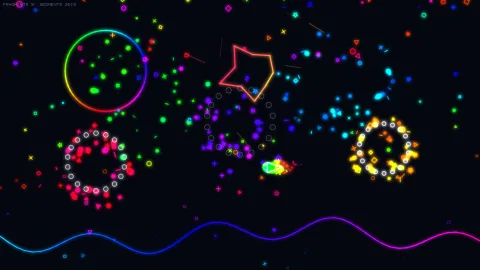

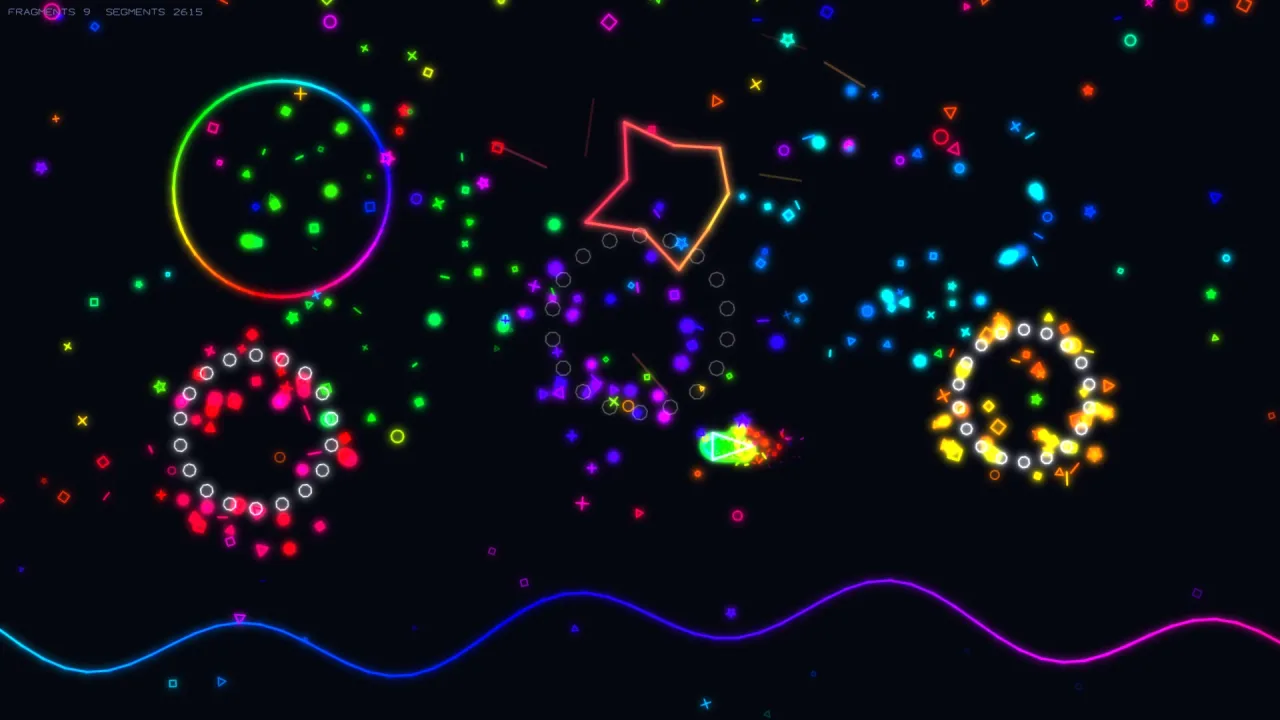
What it does
shatterPolygon turns a polygon into one fragment per edge, each with its own position, drift velocity, spin and
life. updateFragments advances the set by a time step, ages it and returns the survivors, so your array is the whole
state. fragmentSegments turns the live set into world-space segments for the line renderer, each carrying the
alpha its remaining life has reached, so a dying shard dims rather than blinking out.
How the fragments are drawn, their colour, width and glow, is left to the game: the pack hands back geometry, not
pixels. That makes it the tool for an outline that is not already a shape on the vector layer: a glyph, a procedural
burst, geometry from another system. For a retained shape that already exists on the layer, vector-2d's own
shape.shatter() re-parents the shape's segments with no new geometry and removes the shape when the last piece dies.
Features
- One fragment per edge — every side of the outline becomes its own drifting, spinning shard.
- A tunable burst —
speed(60 units a second by default),life(0.8 seconds) andspin(up to 2 radians a second) for each shatter. - Fade built in — every segment carries an alpha that falls from 1 to 0 as its fragment dies.
- Plain data — fragments are plain objects in an array you own, to append to, filter or drive however you like.
- Reproducible — pass the kernel's seeded random source as
rndand the same burst happens twice.
Good for
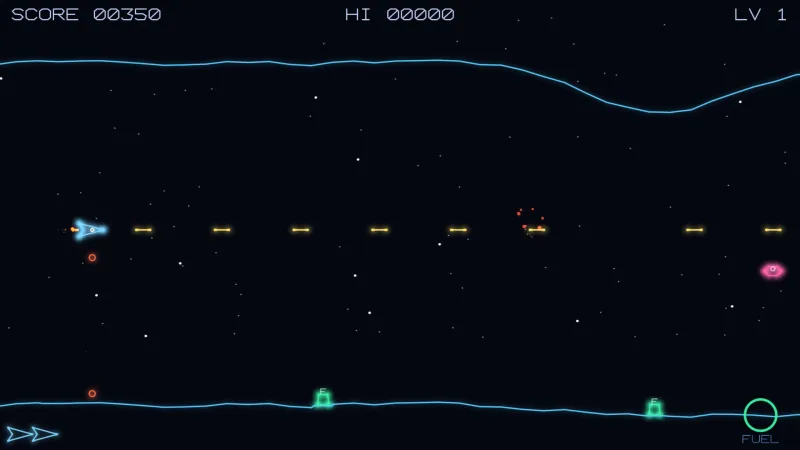
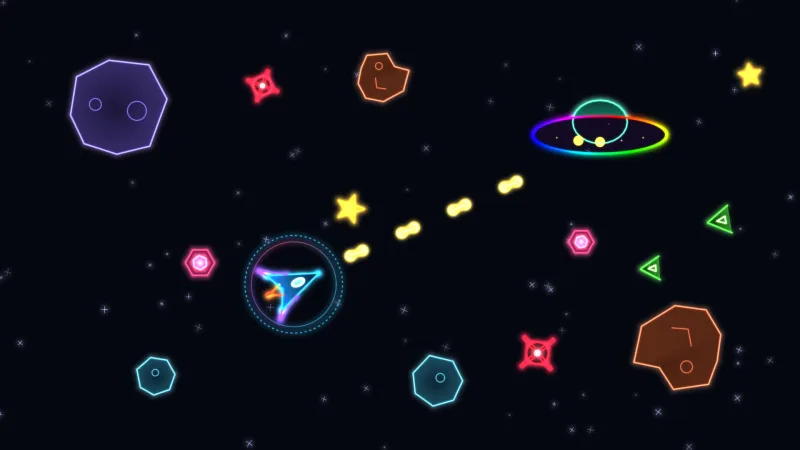
- Vector arcade shooters — rocks, ships and saucers breaking apart, in the style of Asteroids.
- Shields and barriers — a section of a shield breaking off when it is hit.
- Titles and text — a word built with the vector font shattering on a game-over screen.
- Procedural effects — a burst of lines from an outline made for the occasion.
Make it yours
Each shatter takes its own speed, life and spin, so a small rock can burst fast and briefly while a mothership
drifts apart slowly over seconds. Because the fragments are data, the game decides the rest: draw them thin and bright
with a glow, colour them by their alpha, change their velocities to add a pull, or skip some entirely. One game
appends each destroyed rock's shards to a single shared array and draws them all in one pass; another shatters the
strokes of its title with a seeded rnd, so its attract mode breaks the same way every time.
Works with
vector-2d— draws the segments, and has its ownshape.shatter()for shapes already on the layer.vector-font— words and titles whose strokes can be shattered.core-vector— includes this pack with the rest of the vector kit.
Good to know
- Pass world-space vertices: local ones shatter around the origin rather than around the thing.
- Leave out
rndand it usesMath.random, which is fine for decoration and wrong for anything a replay or a test must reproduce. - It draws nothing: how the fragments look is the game's decision.
- Fragments only drift, spin and fade; there is no gravity or collision on them.