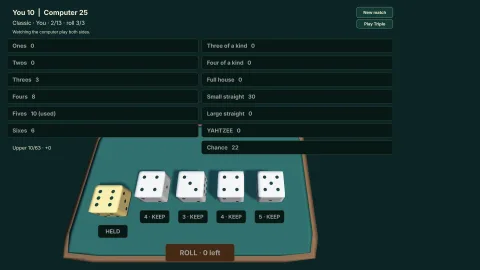

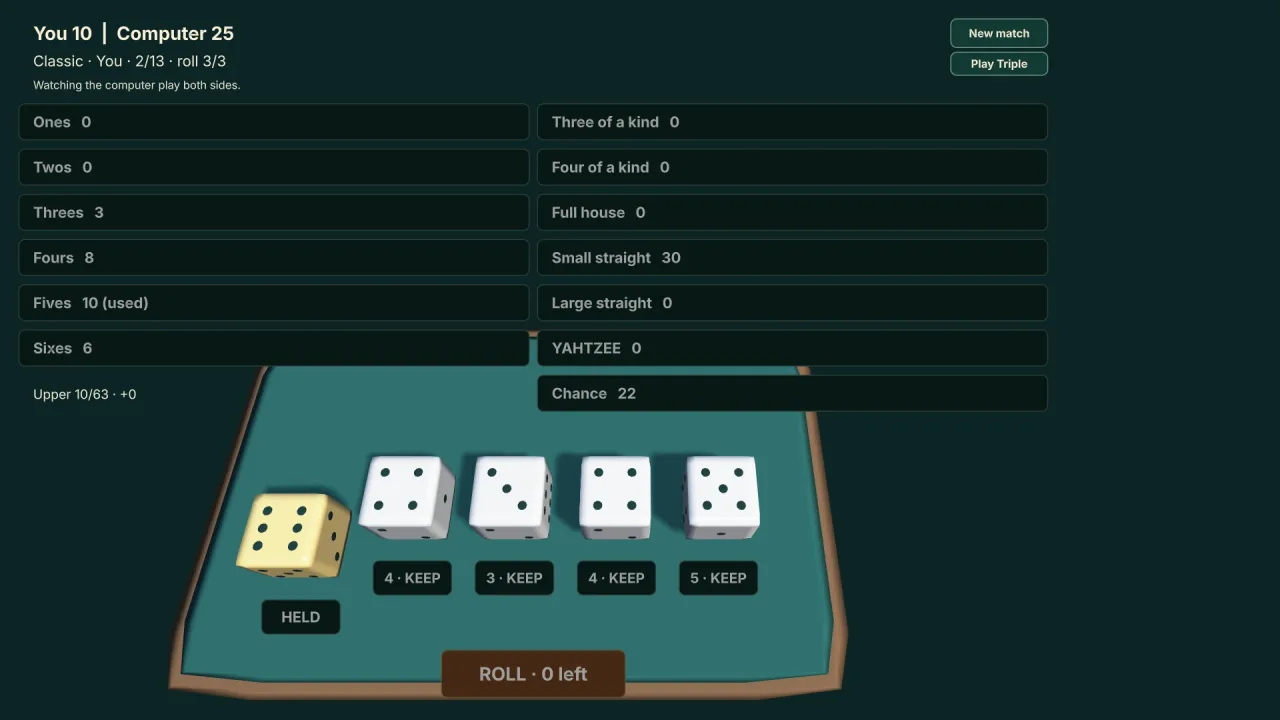
What it does
A match owns everything a turn involves. The player rolls up to three times, holding any dice between rolls, and may score after any roll by choosing an unused category. Scoring fills exactly one row and passes the dice to the next seat. The pack scores every category by the standard rules: three-of-a-kind, four-of-a-kind and chance as the dice total, a full house as exactly three plus two, straights from distinct values, and fifty for five of a kind. It adds the 35-point bonus at 63 in the upper section and 100 for every repeated five of a kind, and it applies the joker placement rules, including the case where the five-of-a-kind row was already scored as zero.
The triple variant gives each player three independent scorecards over one shared set of five dice. After any roll you may score on any unused row of any of your cards, and each card earns its own bonuses and applies its own joker restrictions. The grand total is the plain sum of the three cards, and the match ends when all 39 rows per player are filled.
The match exposes an observation of public information only: the dice, holds, scorecards, phase, current seat and a
preview of what every open category would score now. Hints and computer players work from that view and never see
the seed. The dice come from the dice-core pack as five standard six-sided dice, and the rules decide every roll
before any animation, so a presenter can tumble 3D dice to an outcome already known.
Features
- Complete scoring — thirteen categories, the upper bonus, repeated five-of-a-kind bonuses and the joker rules.
- Classic or triple — one scorecard per player, or three cards over one shared roll with a summed grand total.
- One to four players — solo score-chasing or local pass-and-play, with any seats played by the computer.
- Exact previews — every open category's score for the current dice, on every card, ready for a clickable scorecard.
- Advice and bots —
hintweighs all 31 ways to hold dice by sampling from visible information and returns roll, reroll with holds, or score;autoStepplays that advice with ordinary commands. - Three difficulty levels — easy, medium and hard change only how much the advice samples, never the dice or the scoring.
- Replayable saves — a snapshot is the options plus accepted commands, and restoring replays every rule rather than trusting stored scores.
- Standalone scoring helpers —
yahtzeeScore,yahtzeeScoringOptionsandyahtzeeTotalswork on any dice and card without a match.
Good for
- A classic dice score-chase, solo, chasing a personal best.
- Family pass-and-play for two to four players on one device.
- Playing against the computer, with three levels of opponent.
- A longer triple-card game, where every roll can go on any of three cards and planning across them matters.
- 3D dice presentation, since outcomes are decided first and the animation only shows them.
- Watchable replays, since a match's recorded commands replay it exactly, every chosen card included.
Make it yours
A match takes the variant, a seed, one to four player names, which seats are computer players, and the advice difficulty. The scoring helpers stand alone, so a different dice game can borrow the category scoring and bonus rules without the match.
Two materially different setups: a solo classic game with hints on at the hard level, for a player chasing a high score; and a four-seat triple game with one human and three computer players, each filling 39 rows across three cards.
A quick look
A triple game against the computer, a roll, a hold and a score:
const match = game.yahtzee.createYahtzee({ seed: 29, variant: 'triple',
    players: ['You', 'Computer'], bots: [1], difficulty: 'medium' });
match.apply({ kind: 'roll' });
match.apply({ kind: 'hold', index: 0, held: true });
const preview = match.observation().previews;
match.apply({ kind: 'score', category: 'chance', card: 2 });   // the third card
const grandTotals = match.observation().totals;
Works with
dice-core— required: the dice, holds and reproducible random state.save— to keep a match's snapshot between sessions.typographyandui— for scorecards, totals and buttons.world-3dandrender-3d— to roll the dice on a 3D table.
Good to know
- The rules are the standard thirteen categories on one or three cards: there are no custom categories, bonus rerolls or weighted triple totals.
- Advice plays the current turn well by a bounded heuristic, not the whole remaining game, and its estimates are samples, not exact probabilities.
- A match history holds at most 3,072 commands, and player names are at most 40 characters.
- Saves contain the seed, so they are for persistence and replay, never an input to hints; the pack is not a network match service.