
What it does
The volume is split into chunks, 16 blocks a side by default. Each chunk meshes into one vertex buffer holding only its exposed faces and draws in one call, so a solid chunk costs six faces of geometry rather than four thousand cubes' worth. Changing a block marks its own chunk for re-meshing, plus any neighbour whose faces the change uncovered, and nothing else: placing a block in the middle of a 128×48×128 world touches one chunk.
get, raycast, the mesher and the character body all read the same grid. That is what makes the block the player
points at exactly the block they can see; a renderer with its own copy of the world eventually disagrees with the
picker. A raycast returns the first solid block and the face it entered through, and that block plus the face's
normal is the empty cell to build into.
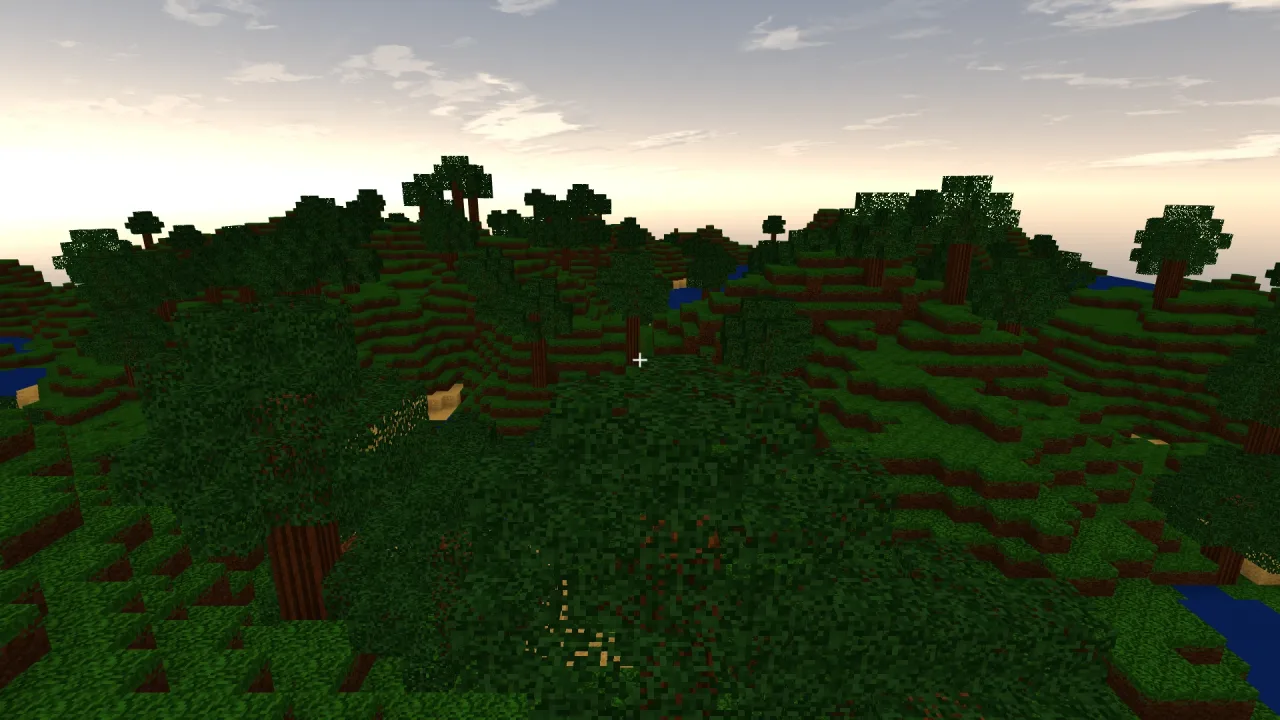
The look is the block-game look, done carefully. Ambient occlusion is baked into each corner from its neighbours, and the split of every face into triangles is chosen so flat ground shows no diagonal crease. Each face is lit at a fixed level for its direction, top brightest, bottom darkest, so a shaded side never goes black and a cave stays readable, while the renderer's sun colour and day and night still tint everything. Every block texture is a small pixel generator, baked from a seed into a texture array so distant mipmaps never bleed one block into the next.
Features
- Chunked exposed-face meshing — one buffer and one draw per chunk; interior faces are never built.
- Cheap edits —
setre-meshes only the touched chunk and the neighbours it uncovered, andremeshedandchunksDrawnreport what the last frame cost. - A block raycast —
raycastfinds the first solid block with the face normal it entered through; water is not solid, so you point straight through it. - Sixteen block types — grass, dirt, stone, cobble, sand, log, planks, leaves, water, snow, glass, brick, coal and gold ore, gravel and bedrock, with glass and leaves see-through and seam-free against themselves.
- Generated textures — every block's pixels made from a seed, at a resolution you choose, with no image files.
- Seeded landscapes —
landscapefills the world as anisland,flat,plains,hillsormountains, solid to bedrock, with a sea level and trees. - A character body — gravity, jumping, per-axis collision, automatic step-up over a one-block ledge, and substepping so nothing tunnels through a wall at speed.
- Mobs on the same rules —
agentaddswander,seek,fleeandidlesteering to the same body, so mobs and player agree on what is walkable. - Both renderers — WebGPU and WebGL2 draw the same volume, meshes and textures.
Good for
- Block-building sandboxes — a world to shape freely, block by block.
- Mining and digging games — the landscapes are solid to bedrock with coal and gold ore in the stone, and each dig costs one chunk.
- Survival games with mobs — creatures that wander, chase or run on the same body as the player.
- Island adventures — a seeded island with a sea and trees, the same every time from its seed.
- Destructible block levels — arenas and puzzles where removing a block opens a path or drops a character through the floor.
Make it yours
The world's size in blocks (default 128 × 48 × 128), the chunk size, the texture resolution (16 by default, the
classic look), the texture seed, world units per block, mipmaps and the culling distance are all options. Bigger
chunks mean fewer draws and dearer edits; smaller chunks the reverse. landscape takes the landform, its seed, the sea
level, whether to plant trees and how densely, and body takes the footprint, height, step height, gravity and jump
speed.
Two quite different games: a survival island, the default size filled with an island landscape and dense trees,
with a walking player and wandering mobs; and a small creative arena, a flat world with trees off and a finer
texture resolution, built block by block from a flying camera with rig-minecraft.
Works with
rig-minecraft— the block-game controls: mouse look, walking or flying, breaking and placing, applied to this pack's body.voxel-edit-3d— pointing at a block and changing it, built on the raycast's hit and normal.render-3dandworld-3d— required; it uses the renderer's camera, so fog, day and night and tone mapping match the rest of the scene.water-3d— a real sea with waves over the top of the block world.terrain-3d— smooth heightfield ground, when the player never digs.
Good to know
- The volume is bounded: there is no streaming and no infinite world, outside it is air, and a body that walks off the edge falls.
- Chunks are culled by distance, not by what the camera faces, so a large world still pays for the chunks behind you.
- Water is an ordinary block, with no waves and no refraction.
- It is for a volume of blocks, not for drawing a few cubes; spawning a box mesh in
world-3ddoes that better.