
What it does
There are two shapes of water. Grid waters, the sea, ocean, lake and pool presets, are a shared grid moved by
summed Gerstner waves, whose crests travel forward as well as up, gathering at the peaks and spreading in the
troughs, which is what the eye reads as water rather than cloth. The presets differ only in their wave tables and
colours. Ribbon waters are strips that follow a course over the terrain with the flow scrolling along them; steep
sections foam, so a waterfall is simply a stream whose course runs off a cliff.
Hand it your terrain's height function as ground and it bakes it once, which switches on the whole shore. Waves
shoal against the real beach and die away just before the waterline, the water parks below dry sand so the edge
glides in and out with the tide, and bands of surf march up the shallows along the depth contours, following any
coastline you give it.
heightAt is the exact wave the GPU draws, with the same swell, tide and shoaling, and it undoes the waves' sideways
drift, so it reports the water that is actually visible at a point. hullPose turns four samples at bow, stern, port
and starboard into a height, pitch and roll, and float applies that to an object every step while your game steers
it. A well, a dry box around a hull, presses the surface down inside it so waves never rise through the deck, and
stamps a foam wake that curves with the boat's real path and fades like froth. Seen from below, the surface shows the
sky through a window overhead and a mirror of the depths around it.
Features
- Five presets —
sea,ocean,lake,poolandstream, each a wave table and a palette. - Waves you can author — up to eight waves a body, each with a direction, amplitude, wavelength, speed and crest sharpness.
- Sea state and tide —
swellruns from glass at 0 to a storm of triple height at 1, live, andtideandtidePeriodmove the waterline. - Shores from your terrain —
groundgives shoaling waves, a waterline that follows the tide, and surf along the coast. - Streams and waterfalls — a
pathdownhill with awidthand aflowspeed. - Floating —
heightAt,normalAt,submerged,hullPoseandfloat, with length, beam, ride height, settling time, trim and heel. - Wells and wakes — up to four dry hull boxes a body, each with a foam wake of its own strength.
- Named tints —
caribbean,azure,temperate,emeraldandnorthsea, palette and optics in one. - Many bodies at once —
buildthe main body andaddlakes, pools and streams beside it, every option a live field. - Lit and reflected — it reflects the sky's environment map and takes the scene's point and spot lights, so a lighthouse beam lands on the sea.
- Both renderers — WebGPU and WebGL2, with the queries running headless from the simulation clock.
Good for
- Boat and sailing games — hulls that pitch and roll on the swell, with wakes that follow every turn.
- Jet-ski and powerboat racing — a squat at speed through
trim, and a ride height that rises with the swell. - Island and beach scenes — a tide that washes a real shoreline and surf that follows the coast.
- Open worlds with lakes and rivers — many bodies at once, with streams and waterfalls down the hills.
- Swimming and diving —
submergedtells the game when to swim, and the surface shows no crack as the camera crosses it. - Storms — raise
swelllive and the waves grow taller, sharper and faster together. - Games for WebGL2 devices — the same water where a WebGPU-only ocean cannot run.
Make it yours
The pack's options are the main body's: its preset, level, centre and extents, the wave table, the shallow, deep and
foam colours, opacity, ripple strength, how quickly depth turns the colour deep, the shore foam width, swell, tide and
its period, a tint, the ground function and the grid resolution. A ribbon adds its path, width and flow.
Every one of them is a live field on the body afterwards.
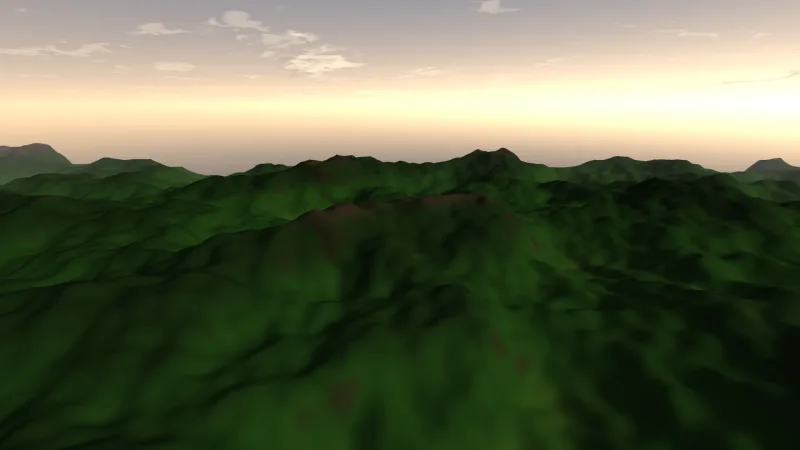
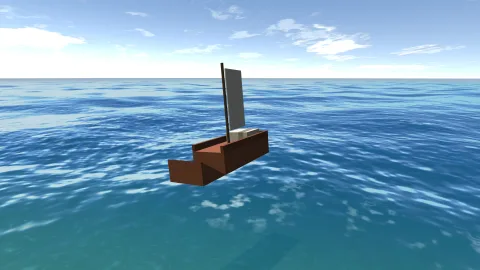
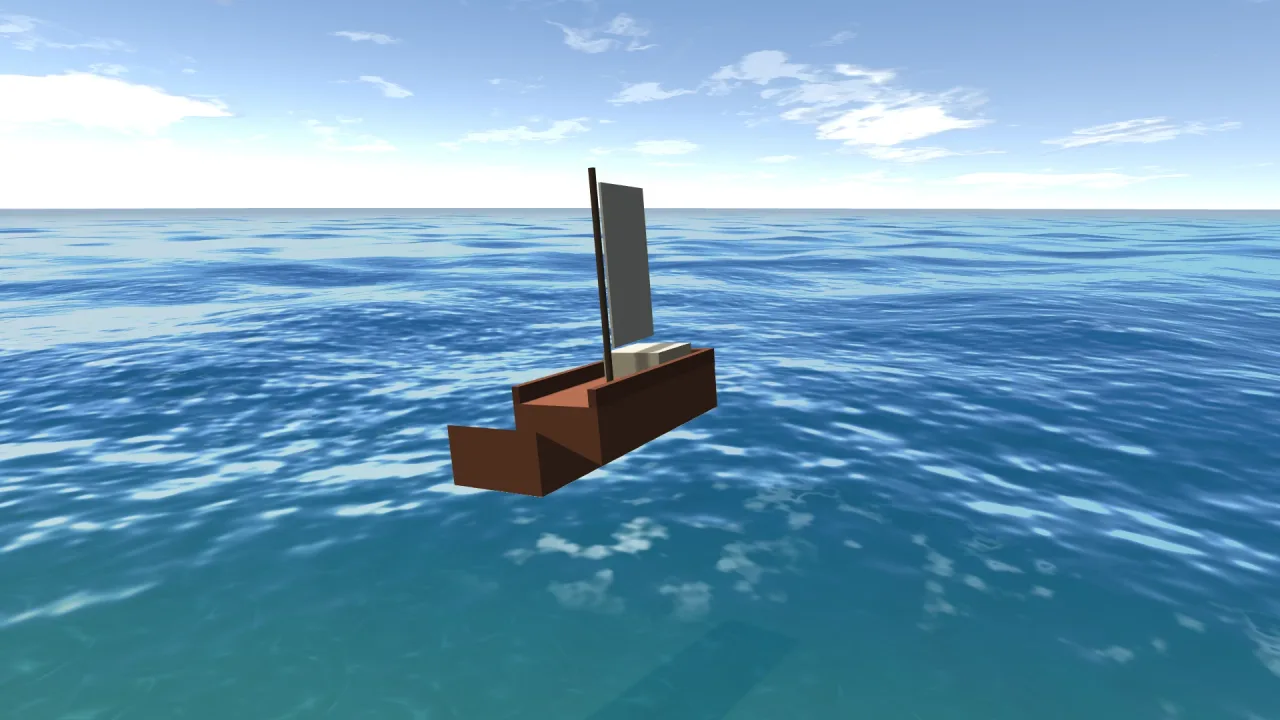
Two very different scenes: a stormy northsea whose swell climbs during a level, with a skiff floated on it, its trim
and ride height following the sea state and a well keeping its deck dry; and a calm mountain valley, an emerald
lake at the height of its basin, shoaling against the terrain, fed by a brook that runs down from the hills.
A quick look
A sea that shoals against the terrain, a stream, and a boat kept on the waves:
const ground = (x: number, z: number): number => game.terrain.heightAt(x, z);
const sea = game.water.build({ preset: 'sea', level: 0, size: 6000, tide: 1.6, ground });
const brook = game.water.add({ path: [[400, 22, -160], [430, 18, -60], [470, 2, 40]], width: 5, flow: 6 });
sea.swell = 0.8;
sea.setTint('northsea');
const skiff = game.world3d.spawn({ mesh: 'box', x: 0, z: 520, sx: 4, sy: 1.2, sz: 10 });
game.water.float(skiff, { length: 10, width: 4.4, offset: 0.7 });
const hull = sea.well({ w: 5, d: 11, floor: -1.2, wake: 0.8 });
Works with
terrain-3d— the ground its shores shoal against.underwater-3d— the view from below the surface: colour lost with depth, a waterline, caustics and fog.sky-3dorskymax— the environment map it reflects.rider-3d— to ride the swell with a footprint.render-3dandworld-3d— required; it draws against the renderer's depth.watermax— the alternative for a simulated FFT ocean on WebGPU only, at a much higher cost; compose one or the other, never both.
Good to know
- It reflects the sky, not the boats on it: there is no reflection of scene geometry, and no refraction beyond the depth-tinted colour.
floatfollows four height samples; it is not a buoyancy solver, so nothing sinks, drifts or feels a force.- Each body takes eight waves and four wells, and wakes are drawn for at most four wells a frame within 360 units of the camera.
- Streams answer their still level and are shallow decoration, not swimming water.
- The
groundbake runs once, on the first frame a body is drawn, and a body cannot be resized afterwards; build another.