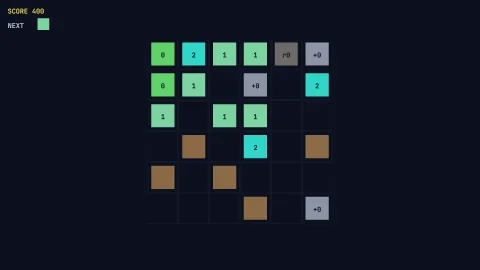

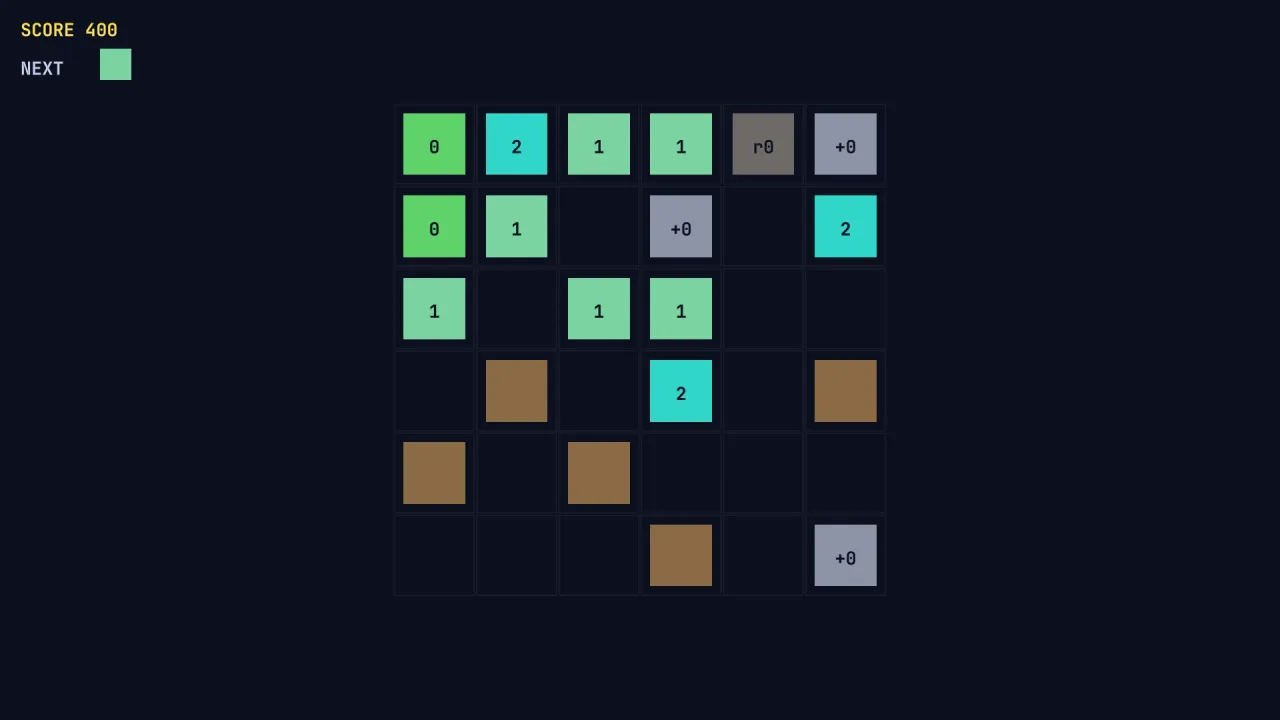
What it does
Each turn the player places the dealt item on an empty cell, or swaps it into the storage slot for later. When three or more connected blocks of the same chain and tier touch, they merge into one of the next tier at the cell where the item was placed, and merging repeats from there. The placement that turns three tufts of grass into a bush can make the bush that completes a tree, and so on up the chain. A merge of four or more scores extra.
Walkers each move to a random empty neighbour every turn. A group of touching walkers that cannot move becomes tombstones, which merge in a chain of their own. A wildcard becomes the neighbouring block that would merge into the highest tier, or a rock when nothing would. A bomb removes what it lands on, and a bombed walker leaves a tombstone. A generator drops one of its blocks beside itself every few turns until its charges run out.
Each turn resolves at once and returns a journal of steps in order: the place, what a wildcard became, what a bomb
removed, each merge with its points, walkers trapped, every walker's move, a generator's spawn and the game ending.
Your game plays the steps back with whatever animation it likes. findPlaces ranks every legal placement by the tier
it would make, which gives a hint button and an autoplayer for testing.
Features
- Cascading merges — three or more connected equals merge where the item was placed, and the result can merge again.
- Chains as data — each chain has a name, a number of tiers and the points each tier scores.
- Walkers and tombstones — roaming pieces that become a chain of their own when boxed in.
- Wildcards — placed as whatever would merge highest, or a rock.
- Bombs — remove whatever they land on.
- Generators — drop a block beside themselves every set number of turns, for a set number of charges.
- A storage slot — swap the deal for later.
- A journal of steps — every turn returns its steps in order, with merges, points and the top tier reached.
- Hints and autoplay —
findPlacesranks placements;autoplayplays a game out. - Deterministic — seeded deals, with snapshot and restore as plain data.
Good for
- Place-three-to-combine puzzles, in the style of Triple Town, with grass growing into castles.
- Merge-the-tiers city builders, where placing buildings upgrades a neighbourhood.
- Mobile merge puzzles with a dealt item each turn and a single storage slot.
- Themed reskins — potions, gems, creatures — with your own chains and scores.
- Strategy tests and balancing, played out by
autoplayfrom a seed.
Make it yours
The board can be any size from two by two up to 4,096 cells. Chains are defined per type, each with its tiers and the points per tier, and the default is a nine-tier grass chain from 5 to 500,000 points with tombstone and rock chains. The deal is a weighted table of blocks, walkers, wildcards, bombs and generators, each generator with its own interval and charges. You choose what a trapped walker and an unmatched wildcard become, the multiplier for merges of four or more, and any items already on the board at the start.
Two quite different games: the default six-by-six town, where grass climbs nine tiers and walkers threaten to box you in; and a calmer puzzle with no walkers in the deal, a short chain of potions on a larger board, and generators that seed low-tier potions beside themselves every few turns until they run dry.
A quick look
A six-by-six town with the default chains and deal, a turn played and presented, and the best next placement:
const town = game.placeMerge.createPlaceMerge({ cols: 6, rows: 6, seed: 3 });
const turn = town.place({ x: 2, y: 4 });
for (const step of turn.steps) await present(step);   // place, merge, walk, trapped, generatorSpawn…
const best = town.findPlaces()[0];                     // { at, merges, tier }
Works with
match3— for boards where tiles are swapped to match rather than placed.merge-workshop— for merging by dragging pairs together to fill orders.board— to place the grid's cells in the world and pick the cell under a tap.tweenandparticles-2d— to animate merges and walkers.
Good to know
- Walkers move at random among their open cells; walkers that jump anywhere on the board are not modelled.
- There is one storage slot.
- The default deal's weights are an estimate, not published rates; set your own for a tuned game.
- A chain's last tier never merges.