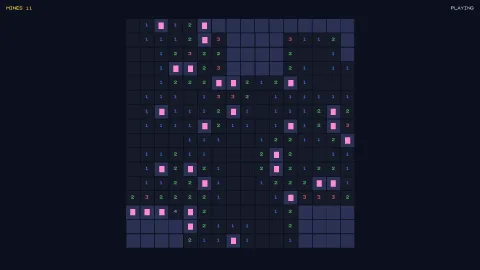

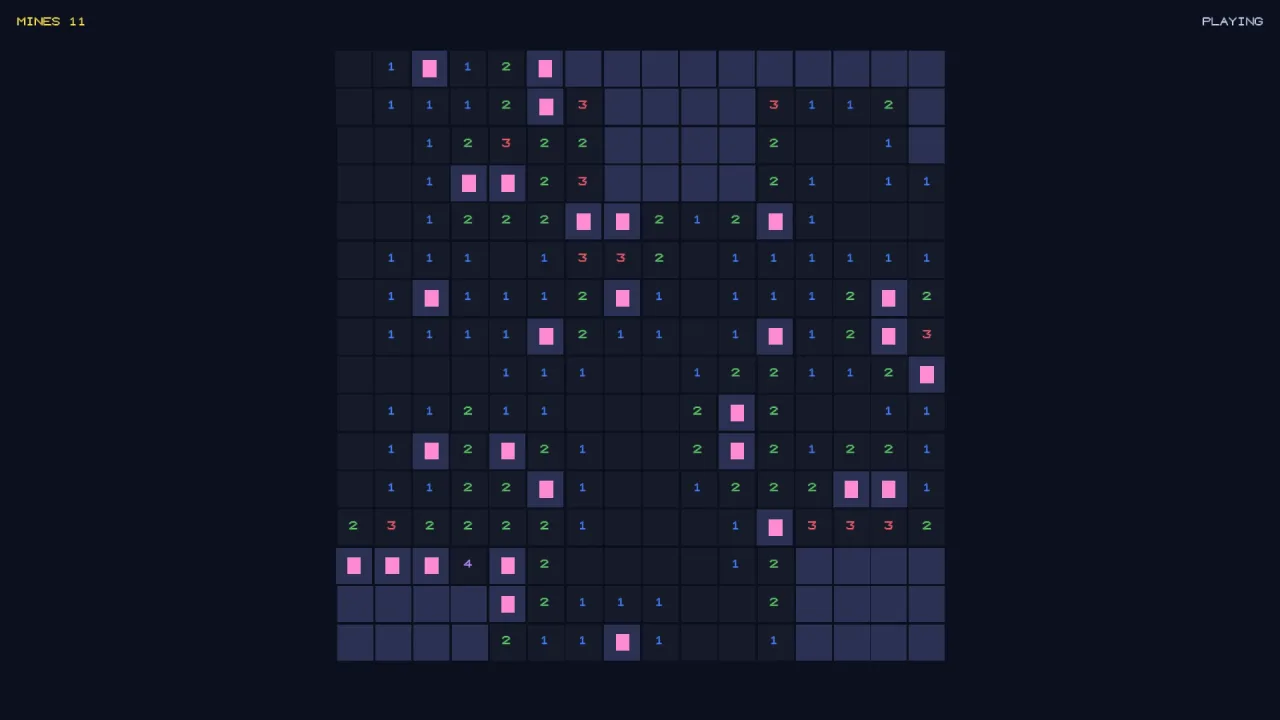
What it does
You create a field with its size and number of mines, and call reveal when the player opens a cell. The mines are
not laid until that first reveal, and then they are laid around it: by default the clicked cell and its whole 3×3
neighbourhood are clear, so the player starts with an opening rather than a coin flip.
Opening a cell with no mines around it floods outward. The result groups the revealed cells into waves by distance from the click, so your presenter can stagger them and the board opens like a ripple. Flags cycle through flag, question mark and hidden, and a flagged cell cannot be opened by mistake. Chording, clicking a number whose flags already match it, opens all its other neighbours at once. On a loss the result lists every mine and every wrong flag, for the reveal-everything screen.
The hint, hint, returns only what simple logic forces from the numbers, ignoring the player's flags: the remaining
neighbours of a number whose mines are all proved are safe, and when a number's unproved neighbours exactly make up its
count they are all mines. It repeats those rules until they prove nothing more, so a flag the numbers prove wrong
shows up as safe. step applies every move one hint finds, so looping it shows how far a board can be played without
guessing.
Features
- A safe first click — mines are laid after it, clear of the clicked cell or its whole 3×3 neighbourhood.
- Flood in waves — empty regions open outward, ring by ring, ready to animate.
- Flags and question marks — a three-way cycle, and flags block accidental reveals.
- Chording — open every remaining neighbour of a satisfied number in one click.
- Win and loss — a win test, and on a loss the mine that went off, every mine and every wrong flag.
- Forced-move hints —
hintlists cells logic proves safe and cells it proves are mines. - Auto-solve —
stepplays every move one hint forces, for no-guess checks and attract modes. - Deterministic — the same seed and first click lay the same board.
Good for
- Classic mine-sweeping puzzles, in the style of Minesweeper, at any board size and mine count.
- Sweeper-likes with a theme, such as digging for treasure or clearing a field, where the number rules stay the same.
- Teaching modes that show the player a cell they could have deduced.
- Daily boards, where a seed reproduces the same field for everyone.
- Any grid where opening a cell reveals information about its neighbours.
Make it yours
The field takes its columns, rows, mine count and seed, and whether the first click protects just that cell or its whole neighbourhood. That covers a beginner's small board with few mines, where the protected opening often clears a large area, and a large expert board with a dense field, where only the clicked cell is guaranteed safe and every deduction counts. What a cell looks like, and whether the board is mines, treasure or something else, is your presentation.
Works with
deduce— for other logic puzzles with exact hints: nonograms, light-toggling boards and colour floods.board— to place the grid's cells in the world and turn a tap into a cell.tween— to stagger the waves of a flood.
Good to know
- The board is laid on the first reveal, so before that every cell reports empty, because no mines exist yet.
- The hint uses single-cell logic only. It does not run the set-difference reasoning that solves harder late-game patterns, so a board it cannot finish may still be solvable by a person.
- The hint ignores the player's flags and
stepnever removes them, sostepcannot finish a board with a flag on a safe cell. - There is no no-guess board generator; use
stepto test how far a seed's board can be played by logic. - It is for still grids; a game with moving pieces needs another pack.