
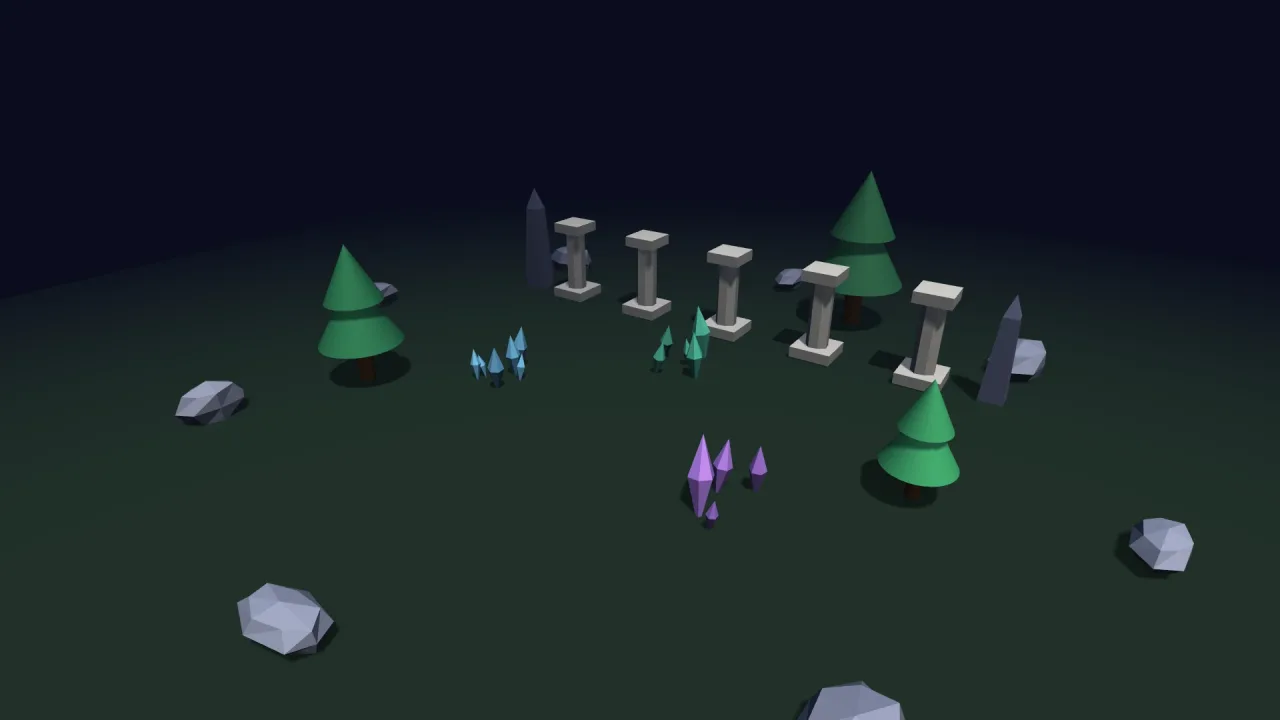
What it does
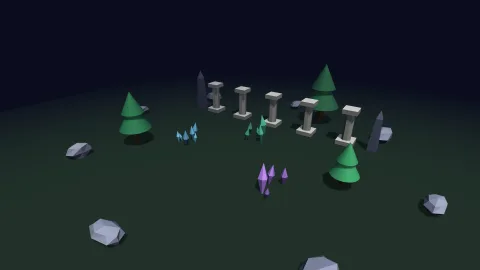
The four shapes are unit-sized, so their scale really is their size in world units, exactly as for every other mesh. Each is registered as one mesh the first time it is asked for: twenty crystals in a scene share one mesh and one instanced draw, and a game that never asks for a spire never builds one. Every face points outward by construction, so the shapes render correctly from any camera angle.
The composites are ordinary objects rather than baked meshes. tree returns its trunk and two canopy cones, so the
game can move them together, recolour the canopy or fell the tree. crystalCluster lays a scatter of tilted crystals
round a point, and the same seed always lays the same stones.
Features
- Four shapes —
crystal,rock,pillarandspire, each spawned with the world's own spec for position, scale, colour and rotation, with a default colour of its own. - One mesh per shape — built on first use and shared, so many copies cost one instanced draw.
- Trees —
treetakes a position, a scale and leaf and trunk colours, and returns its three parts. - Crystal clusters —
crystalClustertakes a position, a count, a colour and a seed, and lays the same scatter every time. - Vertex builders —
crystalVertsand the others are plain exports, for a build step or a test.
Good for
- Prototypes and jams in 3D, where the scene needs landmarks before there are models.
- Cave and crystal levels, with clusters that differ by seed from level to level.
- Ruins and temples, with columns, obelisks and boulders.
- Low-poly outdoor scenes, with seeded forests of simple trees.
Make it yours
A shape takes the same spawn spec as any world object, so it can be stretched, tinted and turned like any mesh. A tree's scale and two colours change its look, and a cluster's count, colour and seed change its layout. Two different uses: a crystal cave lit in blues, where every chamber has its own seeded cluster of a dozen shards and a few grey boulders; and a ruined courtyard of tall pale pillars and dark spires, ringed by trees with autumn-coloured canopies.
Works with
world-3d— the 3D world the shapes are spawned into.geometry-3d— the primitives the tree's trunk and canopy come from, and a mesh builder for shapes of your own.model-files-3d— loads real models once you have them.forest-3d— for whole forests of trees placed over terrain.
Good to know
- Four shapes and two composites: it is scene dressing, not a modelling kit.
geometry-3dbuilds primitives and carves solids when a shape needs more. - The tree is built from the world's cylinder and cone, so a game that has not composed
geometry-3dcannot make one. - The shapes are flat-shaded and low-poly by design.