
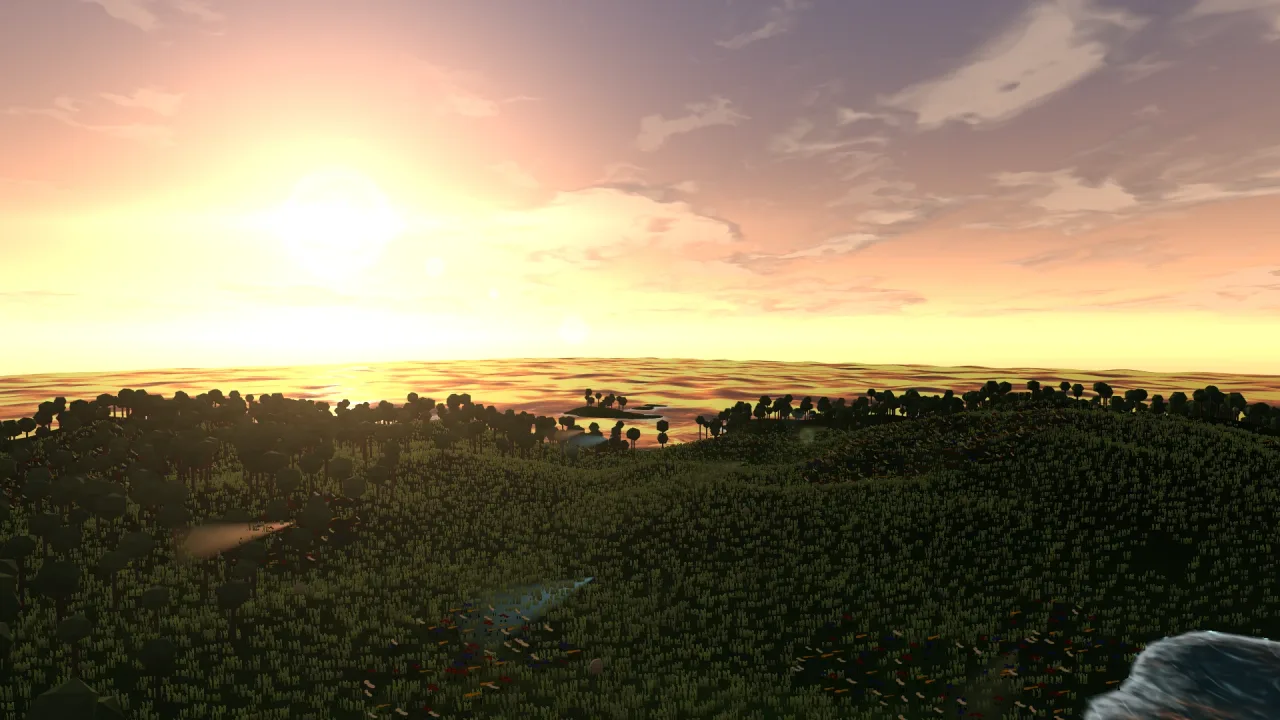
What it does
Eight procedural elements are drawn in one instanced, additive draw. Three sit on the sun itself; the rest are ghost discs walking down the axis, through the screen centre and out the other side, as the internal reflections of a real lens do. It draws last, over everything including the particles, because a flare lives on the lens rather than in the world.
Occlusion is physical rather than a flag. The flare reads the opaque depth in a small grid around the sun's own pixel and takes the fraction that is sky, so a hill or a building moving across the sun collapses the whole chain smoothly instead of popping it off. It follows the sun position the renderer publishes, which already fades at the frame edges and carries the sun's own colour and intensity, so sunset warms the flare and night puts it out without your code telling it to.
Features
- Eight elements — a core glow, an anamorphic streak, a halo ring and five ghost discs along the sun's axis.
- No assets — every element is procedural, in one additive draw.
- Smooth occlusion — depth sampled round the sun dims the flare as things pass in front of it.
- Live controls —
game.flare.strengthandenabled, andvisibleto tell whether it is drawing.
Good for
- Flight and racing games — flying or driving toward a low sun.
- Open-world and exploration games — a sun that flares as the player turns toward it and vanishes behind a ridge.
- Day-night cycles — a flare that warms at sunset and goes out at night by itself.
- Cinematic outdoor scenes — with god rays, so the air and the lens both answer the sun.
Make it yours
Two options, strength (overall brightness, default 1) and enabled, set in the manifest or live on game.flare.
A flight game can run it full strength beside god rays for a bright, filmic sun; a quieter exploration game can turn
strength well down for a hint of a lens, or switch it off where the camera is meant to be an eye.
A quick look
{ "id": "flare-3d", "options": { "strength": 0.8 } }game.flare.strength = 1.2; // live
game.flare.enabled = false; // off entirelyWorks with
render-3d— required; it publishes the sun's position, colour and visibility.core-3dbrings it.god-rays-3d— the light in the air, beside the flare on the lens.sky-3d— a day cycle that moves and colours the sun, and so the flare.
Good to know
- One flare, on the sun: a lamp, a muzzle flash or a headlight does not make one.
- The chain is fixed: eight pieces with set sizes, colours and positions, not a configurable stack or a texture of aperture shapes.
- A very thin occluder, such as a wire or a railing, barely dims it, and translucent things do not occlude it at all.