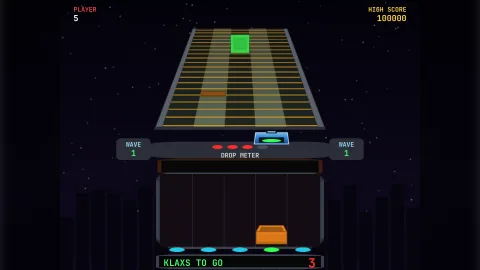

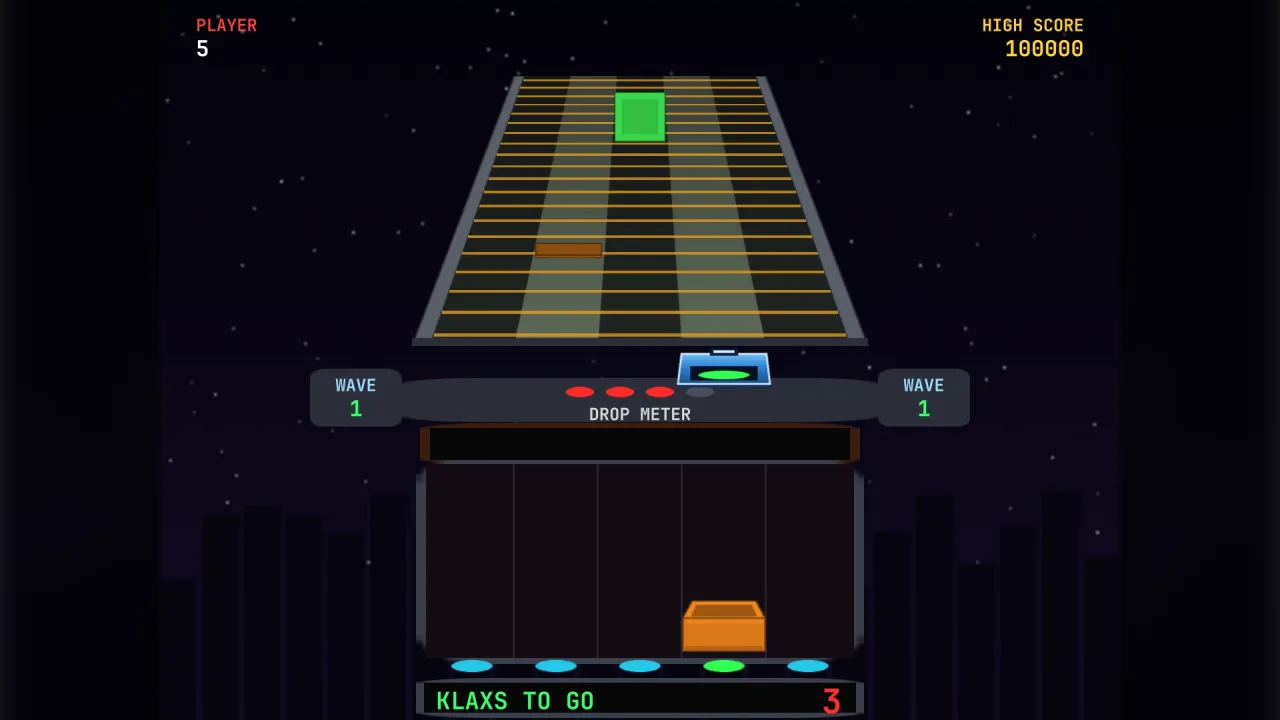
What it does
Tiles appear at the top of a conveyor of lanes and tumble end over end toward the player, one step at a time, faster the longer a wave lasts. The paddle slides between lanes: a tap moves one lane and a hold slides. A tile reaching the paddle's lane is caught, up to the paddle's capacity; any other tile falls and fills a slot of the drop meter. The player flips the top tile into the bin column under the paddle, throws it back up the belt to buy time, or pulls down to hurry the nearest tile or every tile.
The bin fills from the bottom. When it settles, the pack finds every line of at least the minimum length of one colour, vertical, horizontal or diagonal, with wild tiles matching every colour, so one wild can complete lines of different colours at once. Each line scores from a table by its direction and length, and a set of lines is multiplied by the cascade or by its own size. Lines flash, vanish and let the tiles above fall, which can chain, and tiles placed during a clear are checked after it, so quick stacking builds longer lines.
Each wave has a goal, such as a number of lines of any kind, of one direction, a points total or a number of tiles,
or no goal at all for an endless game. Waves end with a tally of bonuses, warp screens let the player skip ahead
for a bigger bonus, and a pattern warp jumps further when two diagonals cross. You call steer, drop, throwBack
and accelerate, step with tick, and present the events and state. Tile ids last from conveyor to paddle to bin,
and the conveyor state gives each tile's depth and tumble angle for a pseudo-3D belt.
Features
- A tumbling conveyor — any number of lanes and steps, with a pace that quickens through a wave and a cap on tiles in play.
- A paddle stack — a tap-or-hold paddle of set capacity, with buffered drops, throw-backs and pull-down speed-ups.
- A line finder —
findLinesreports every line of one colour in any enabled direction, typed by direction and length, with wild tiles. - Scoring tables — points per direction and length, points per tile placed, and a cascade or per-set multiplier.
- Wave goals — lines of any kind, horizontals, diagonals, verticals, points, tiles or endless.
- Wave-end bonuses — for each empty bin cell, each tile left unplaced and each point over a points goal.
- Warps — select screens that skip waves for a bonus, and pattern warps for crossed diagonals.
- Authored waves — a starting bin, a fixed tile sequence and what happens after it, beside generated colours.
- Difficulty and continues — easy, normal and arcade speed tables, and continues that retry a wave.
- Deterministic — seeded colours, fixed 120 Hz steps, and snapshot and restore.
Good for
- Conveyor catch-and-stack arcade games, in the style of Klax, with its waves, goals and warps.
- Endless score-attack variants with a single wave whose pace keeps climbing.
- Conveyor sorting puzzles with authored levels, a fixed sequence of tiles and a fail state when the bin fills.
- Hybrid puzzles that feed caught tiles into a falling-block well instead of the bin.
- Two-player versus games, two games side by side trading lines as attacks.
- Any column grid that scores lines of N with wild tiles, through the line and scoring helpers alone.
Make it yours
Every field of the configuration is public, and the presets are plain objects you can change. The geometry is any number of lanes by any bin depth, the conveyor's steps and the paddle's capacity and speed. The line rules are the minimum length, the directions that count, the scoring table and the multiplier. Waves come from a table or a generator, with any goal, colour count, wild rate, pace and preload, and the structure around them is yours: warps or none, pattern warps, the drop meter, whether a full bin ends the game, the pull-down mode and the throw-back.
The two presets are materially different games. The classic preset, after the 1989 arcade game, has five lanes, a paddle of five, a five-by-five bin, lines of three in every direction scored by the arcade's table with a cascade multiplier, 100 waves of rising goals and warp screens. The endless seven-lane preset has a seven-by-six bin, a paddle of three, lines of four or more that count only across and down, one flat table with a per-set multiplier and no chains, every tile sped up by a pull, and one endless wave whose pace climbs for five minutes.
A quick look
The classic preset, started at wave 1, steered, played and scored:
const cs = game.catchStack;
const klax = cs.createCatchStack(cs.klaxPreset({ difficulty: 'normal', seed: 7 }));
klax.choose(0);                 // the warp screen: start at wave 1
klax.steer(-1);                 // a tap moves one lane, a hold slides
klax.drop();                    // flip the top paddle tile into the column below
klax.throwBack();               // or throw it back up the conveyor
for (const e of klax.tick(dt)) if (e.kind === 'klax') showPoints(e.klax.total, e.klax.multiplier);
Works with
typography— for the score, the goal meter and the banners.controls-touch— on-screen buttons for steering, dropping, throwing back and pulling down.versus-garbage— to turn lines into attacks in a two-player game.faller— for falling-piece games, or to receive caught tiles in a well.grab-throw-columns— for games that grab runs from columns and throw them back up.
Good to know
- Lanes and bin columns are the same count, because the paddle drops into the column under it.
- Lanes and rows run from 1 to 64; an invalid configuration throws and names the field.
- Tiles in one lane do not collide; spawning avoids a lane whose top is occupied.
- The arcade's wave table and pace were never published, so the classic preset keeps every documented point and fills the rest with an estimate; all of it is configuration.
- Two-player play is two games side by side; the attract demo, sound and backgrounds are your presentation.