
What it does
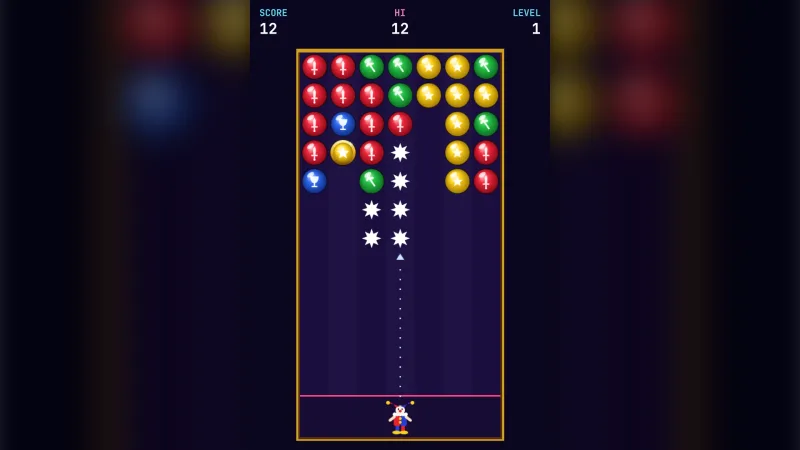
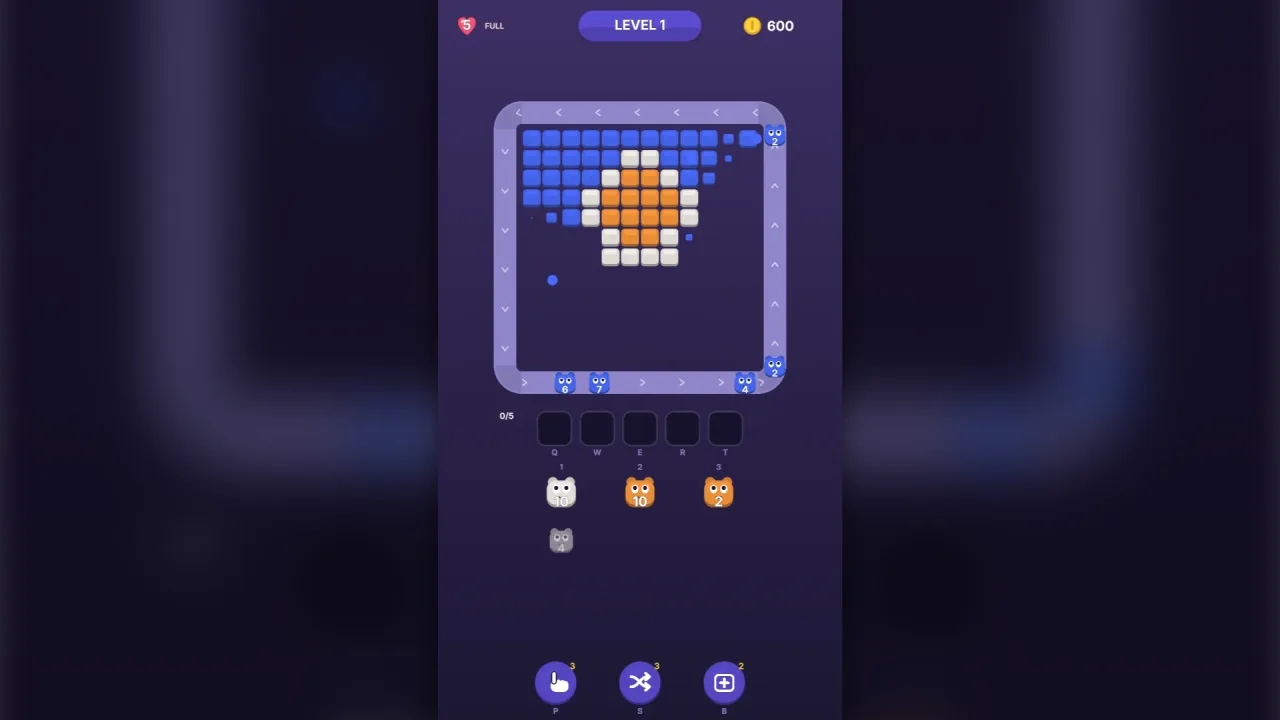
A picture is made of coloured cubes. Shooters wait below it in columns, each with a colour and a number of shots, and only a column's front shooter can be sent. A sent shooter takes a tray at the gate and rides a belt round the picture. At every row and column it passes it fires inward at the outermost cube and lands the shot only if that cube is its colour, so the picture peels from the outside in. It leaves when its shots run out; if it comes round with shots left it takes a bench slot to be sent again, and a return to a full bench loses.
The belt moves in fixed steps and every shot is decided as a shooter passes a station, so the same taps at the same steps give the same game at any frame rate, and a saved state picks up exactly where it stopped. Your presenter reads the riders, their positions and the events (a shot, a cube cleared, a shooter spent or back on the bench) and animates them however it likes.
The generator splits each colour's cubes into shooters, finds an order that clears the picture one shooter at a time, deals it into the columns, then moves shooters within their columns until the solving player needs as much of the bench as the difficulty asks. Every level comes with the winning taps, replayed before it is returned.
Features
- Belt round the picture — stations level with every row and column, a gate on any corner, either direction, firing from all four sides or only some.
- Trays and bench — a cap on shooters out at once, bench slots for the ones that come back, and a clear loss when the bench is full.
- Two lines of fire — only the outermost cube when it matches, or the nearest cube of the shooter's colour.
- Tough cubes and bursts — cubes that take several hits, and shooters that fire more than once per station.
- Linked pairs — shooters that must be at the front together and go out together.
- Boosters and a continue — send any shooter from deep in a column, shuffle the queue, add bench slots or trays, and play on after a loss with an extra slot.
- Seeded pictures — mirrored figures with outlines, patches, rings and stripes, or your own from rows of letters.
- Graded levels with a proof — easy to expert by bench pressure, checked by replaying the solution.
- Hints and a solving player — the next shooter worth sending, or which one to send round empty to dig.
Good for
- A Pixel Flow style puzzle — the belt, five trays and five bench slots are the defaults.
- Yarn, wool or sand themed sorts — the same rules under a different skin.
- A daily puzzle — the same seed gives everyone the same level and the same proof.
- A hybrid-casual campaign — hundreds of graded levels from seeds, with
level-sagafor the map and lives. - A teaching or self-play bot — hints, laps you can preview and a player that finishes levels for tests.
Make it yours
Board size, colours, picture style, columns, shot counts, trays, bench, belt speed and spacing, gate corner and direction, firing sides, line of fire, bursts, tough cubes and links are all configuration. A classic level is a square figure, four columns, the full belt and the outermost-cube rule; a quite different one is a tall striped board, two columns, a belt that fires only from the bottom and the right, the nearest-match rule and bursts of two.
A quick look
Generate a level, tap the first shooter that can go, and run the belt each frame.
const level = conveyorSort.generateConveyorSort({ seed: 7, width: 24, height: 24, colors: 5, difficulty: 'hard' });
const play = conveyorSort.createConveyorSort(level.config);
play.launch(play.available()[0].id);
for (const e of play.advance(dt)) if (e.type === 'shot' && e.cleared) popCube(e.x, e.y);
Works with
level-saga— the level map, lives, boosters and events around it.placer— for placing block pieces to clear lines instead.container-sortandboarding-queue— for pouring and boarding sorts.
Good to know
- It is headless: it draws nothing, so your presenter owns the look and the animation of each shot.
- The rules are reconstructed from how the published game plays; timings such as belt speed are estimates you can set.
- Difficulty is graded by how much of the bench the built-in player needs, a proxy for how hard people find it.
- Generate a large level ahead of when it is needed: a 64 by 64 picture can take a few hundred milliseconds.