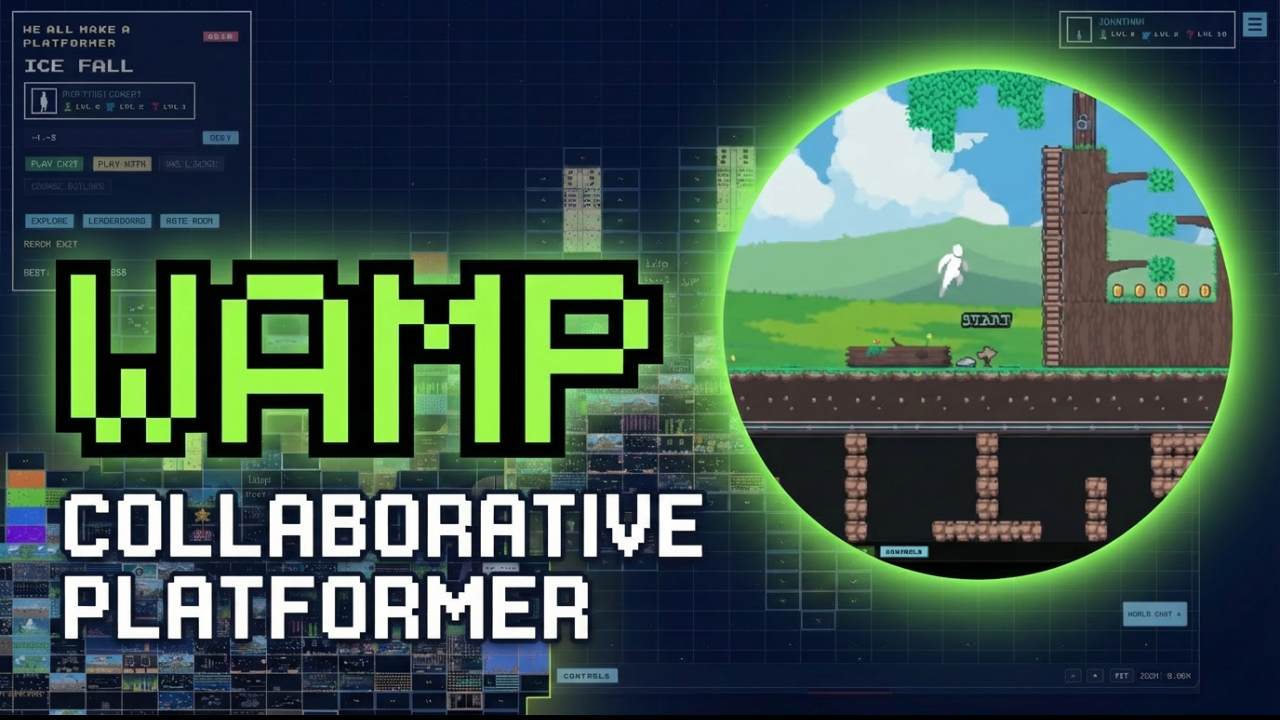
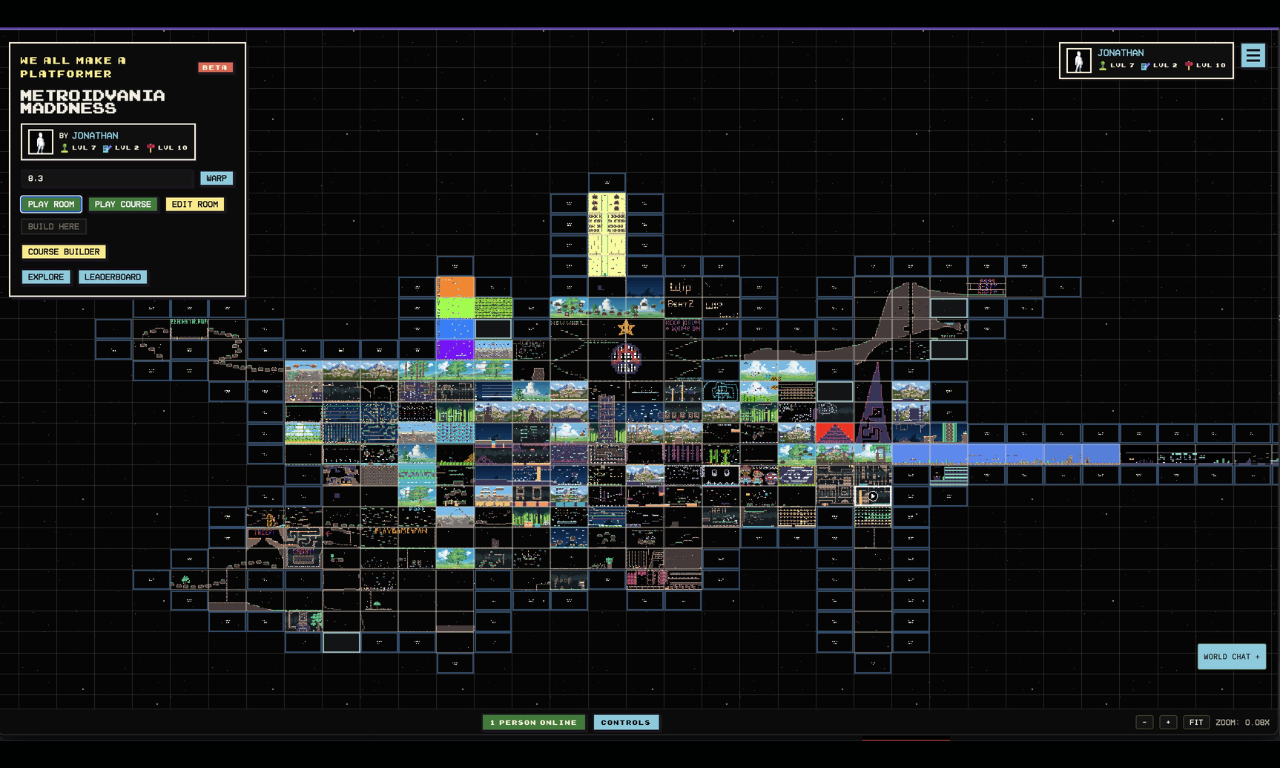
What if a platformer had no single author? That's the question behind WAMP, a browser-based game created by Jonathan Mann (songadaymann), with pixel art by Pixel Guru and executive produced by C.Y. (@CXY). The concept is simple: a shared overworld where every room is a platforming challenge built by a real player.
What is WAMP?
WAMP stands for We All Make A Platformer. The overworld is a grid, and every cell is a room waiting to be claimed. Orange rooms are open. Pick one, fire up the editor, build your challenge, and publish it. From that moment, it's part of the shared world, and anyone can play it.
Building your room
The editor follows a three-step flow: lay your terrain, set the mood, then define the goal. Backgrounds range from Dark Forest and Mountains to Cave, Desert, and Aurora. A layer system lets you place tiles behind the player, on the main collision layer, or in front, a small detail that opens up real visual storytelling.
Goal types completely change how a player experiences your room: Reach Exit, Collect Target, Defeat All, Checkpoint Sprint, or Survival. The same terrain can feel like an entirely different game depending on what you ask the player to do.
Rooms, courses, and progression
Builders can chain two to four adjacent rooms into a course for longer, more structured challenges. Progression runs on three parallel XP tracks: Builder XP from others completing your rooms, Player XP from beating challenges yourself, and Curator XP from rating levels you finish.
Open to contributors
Pixel artists can submit assets directly. Terrain works on a 16x16 grid, props come in standard sizes, and backgrounds are layered PNGs for the parallax system. Developers get a public API and a skill.md file that lets AI agents inspect the world and build rooms programmatically.
Try it now
WAMP is in beta. The best way to understand it is to open it, pick an orange room, and see how long it takes before you have an idea for a level.