
What it does
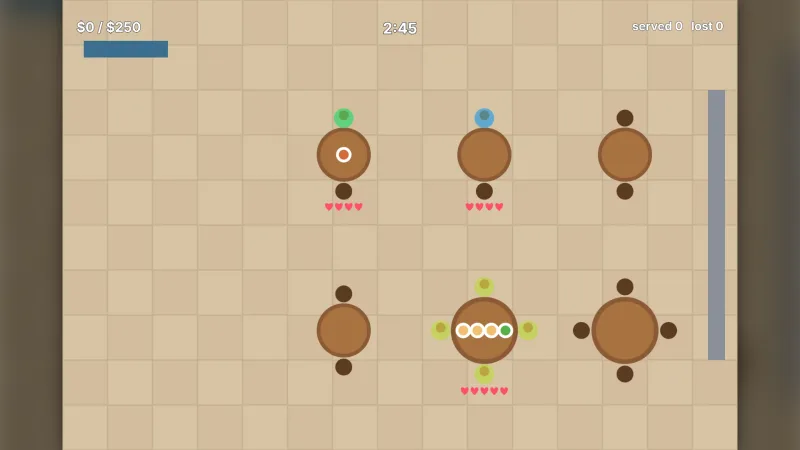
createKitchen opens a kitchen and its shift. Customers, from the customers pack, take free places at the counter
by themselves, order as they reach it, and pay as their last dish is served. Your game turns the player's clicks into
four actions: cook starts something in a free slot of a station, toPlate moves an ingredient from a bin or a
cooked slot onto a plate, serve hands a finished plate or a ready item to a waiting customer, and trash throws
away a plate's stack or a burnt slot.
Stations are where the pressure comes from. Each cooks one thing per slot for a set time. Some burn what is left in the slot too long; some pass what they make on to a holder of a few, freeing the slot, the way fries go to a tray; some start again by themselves while there is room. A dish is either one thing served as it is, fries or a cola, or a stack built on a plate in order, a bun, a patty, then cheese. The kitchen only accepts what makes a plate's stack the start of some dish, so a wrong ingredient is refused rather than quietly ruining an order.
step advances the shift and drain returns what happened: cook, cooked, burnt, plate with the dish it
makes, trash, and the customers' own arrivals, lost hearts, payments and the end of the shift. view gives copies
of everything to draw, snapshot and restore save the whole kitchen as plain JSON, and
createKitchenAutopilot is a cook that always does the most urgent thing.
Features
- Stations with slots — each makes one thing, several at once, in a set time.
- Burning — a cooked item left past its time burns and must be thrown away.
- Holders and self-running stations — output that moves to a tray or rack, and machines that restart on their own.
- Bins — ingredients ready at once, with no cooking.
- Dishes built in order — a base and layers on a plate, or a single item served as it is, with prices and how often each is ordered.
- Plates that refuse mistakes — only stacks that can still become a dish are allowed.
- Customers at a counter — patience in hearts, orders, payment and the shift's goal, from
customers. - Two kitchens built in — a burger joint and a café.
- A cook autopilot — throws out what burnt, serves the least patient, builds plates and keeps stations busy.
- Validation and saves —
validateKitchenlists every fault, andsnapshotandrestoresave as JSON.
Good for
- Burger and fast-food counters — a grill that burns, a fryer and a drinks machine, with stacked burgers.
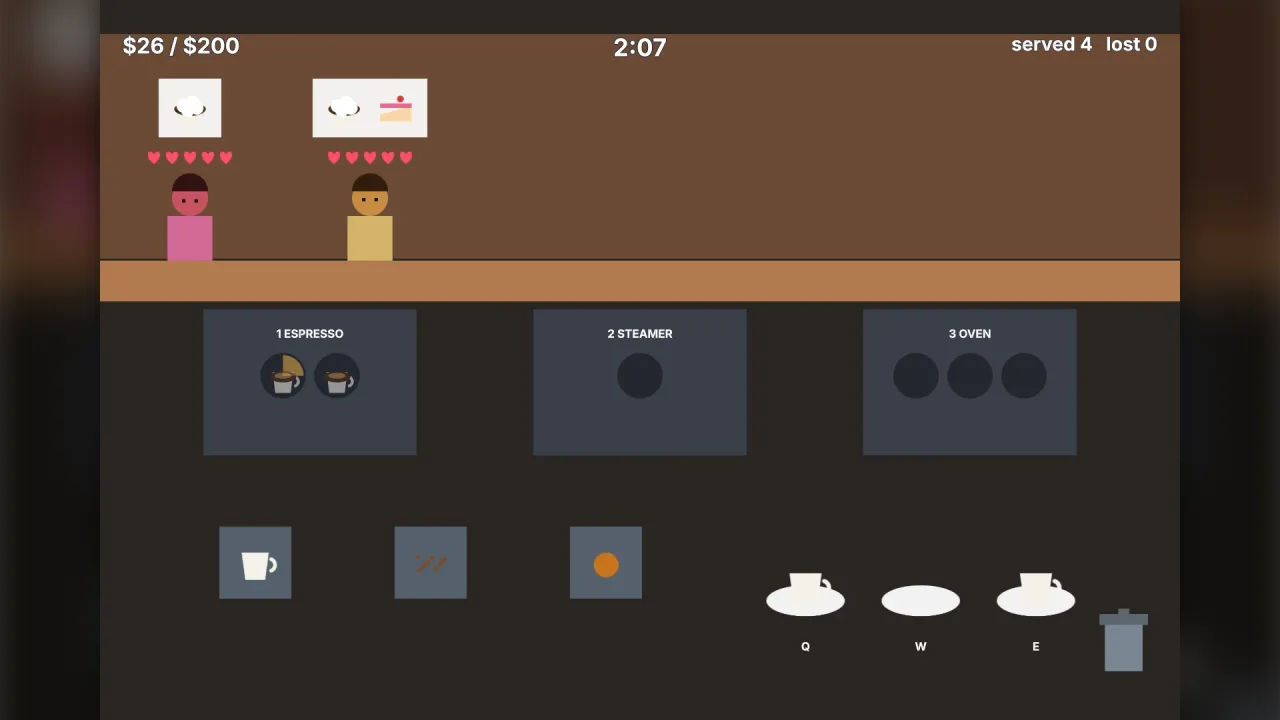
- Coffee shops and cafés — espresso and steamed milk built into cups, cakes from the oven.
- Time-management cooking sagas — a new kitchen per level, with more stations, slots and dishes.
- Casual mobile games — tap a station, tap a plate, tap a customer.
- Attract modes and balancing — the autopilot plays whole shifts to show the game and test its difficulty.
Make it yours
A kitchen is { stations, bins, dishes }. Each station names what it makes, its slots, its cooking time, and
optionally a burn time, a holder size and whether it runs by itself. Each dish has a price, a weight for how often it
is ordered, and either a single item or a base and layers. The options choose the kitchen, the number of plates, the
places at the counter and a seed, and service passes the customers' options through: guest kinds, arrivals, shift
length and the money goal.
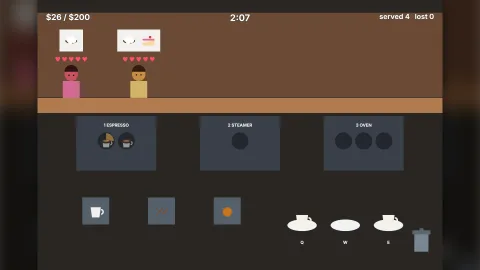
The built-in burger joint is a grill of four slots that burns, a fryer with a tray, a self-running soda machine, and bins of buns, cheese, lettuce and tomato for five dishes up to a four-layer deluxe. The café is a different game on the same rules: an espresso machine and a milk steamer that both burn, an oven with a holder, and cups built up into espresso, latte and mocha. A sandwich bar or a juice stand would be new data, not new code.
A quick look
A burger joint with three plates and four places, and a burger made and served:
const k = game.cookingCounter.create({ kitchen: game.cookingCounter.burger, plates: 3, spots: 4 });
k.cook('grill');
k.toPlate(0, { bin: 'bun' });
k.toPlate(0, { station: 'grill' });   // once the patty is cooked
k.serve(partyId, { plate: 0 });
Works with
customers— required; the guests, their orders, patience and money.walk-serve— for a server walking round a dining room rather than cooking at a counter.tweenandparticles-2d— to animate the cooking, the plates and the happy or angry customers.
Good to know
- One cook's hands: every action happens at once where the player clicks, with no walking between stations.
- Ingredients never run out, and upgrades and several counters are not modelled.
- The pack draws nothing; your game presents the stations, plates and customers from its state and events.