
The pack
vectorHit
function vectorHit(): Pack<{ vecHit: VecHitApi }>The vector-hit pack. Pure maths, so it needs no backend and runs headless.
Helpers
arcHit
function arcHit( cx: number, cy: number, r: number, from: number, to: number, px: number, py: number, tol = 6, ): booleanIs (px, py) ON an arc — within tol of the radius AND inside the sweep?
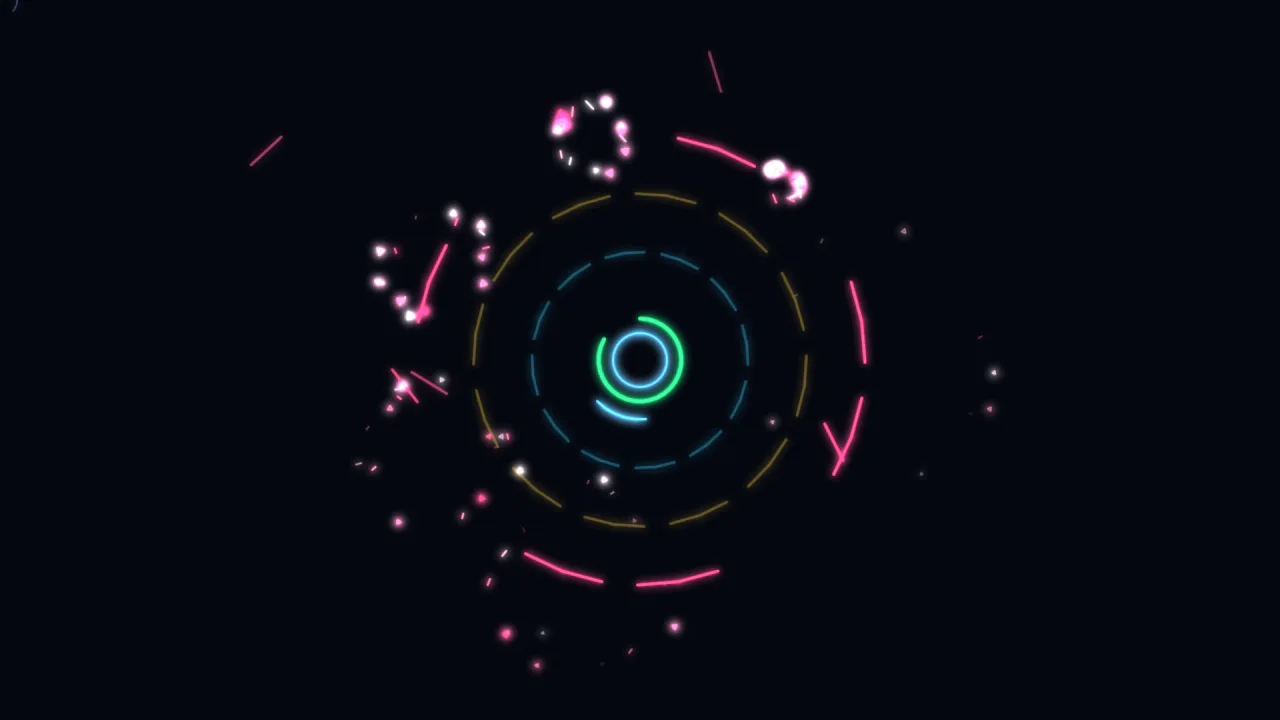
The hit test segmented rings need: a shot only kills the shield section it
actually crossed. Test in the ring's LOCAL space — subtract the centre and
rotate the point by -ring.rot first, so a spinning ring needs no
per-section bookkeeping.
circleHit
function circleHit(aPos: Vec2, aRadius: number, bPos: Vec2, bRadius: number): booleanCheap bounding-circle overlap — the pragmatic default hit test for vector games.
distToPath
function distToPath(px: number, py: number, pts: readonly VecPt[], closed = false): numberShortest distance from (px, py) to the path — the test a STROKE needs.
An open polyline has no interior, so "did I click the line" is a proximity question, not a containment one. Closed paths include the closing edge.
Returns Infinity for an empty path and 0 for a single point at (px, py).
pointInPath
function pointInPath(px: number, py: number, pts: readonly VecPt[]): booleanIs (px, py) INSIDE the closed path pts? Even-odd ray crossing.
Correct for concave outlines and self-intersections, which matters here
because generatePolygon produces exactly that — a lumpy asteroid is not
convex and a convex-hull test would grab empty space beside it.
The path is treated as closed whether or not the last point repeats the
first: the j = i++ walk always includes the closing edge.
pointInPolygon
function pointInPolygon(point: Vec2, worldPoly: Vec2[]): booleanRay-casting (even-odd) point-in-polygon test. worldPoly MUST be in world
space — call transformVerts first. Handles convex AND concave simple
polygons of either winding.
polylineSegments
function polylineSegments(points: Vec2[]): Segment[]Turn a terrain polyline (or any open path) into wall segments for sweepVsSegments.
resolveSurface
function resolveSurface(vel: Vec2, normal: Vec2, opts: SurfaceResponse = {}): Vec2The general surface-collision response. Splits the velocity into normal and
tangential parts against the outward unit normal: the normal part bounces
back scaled by restitution; the tangential part is scaled by (1 - friction).
bounceThreshold suppresses the bounce below a minimum approach speed so a
resting body settles instead of jittering.
surfaceFriction
function surfaceFriction( vel: Vec2, normal: Vec2, coefficient: number, dt: number, gravityDir: Vec2 = { x: 0, y: 1 }, ): Vec2Continuous ground friction for a grounded body — damps the velocity ALONG the surface, scaled by how flat it is (≈ cos of the slope): full on flat ground, less on a steep slope, none on a wall. Call each frame while grounded.
sweepVsSegments
function sweepVsSegments(prev: Vec2, cur: Vec2, segments: Segment[]): SweepHit | nullSweep a moving point's path (prev → cur) against static wall segments and return the EARLIEST contact, or null. The core anti-tunnel test for bodies vs line geometry (terrain, cave walls).
Functions
segmentIntersection
function segmentIntersection(p1: Vec2, p2: Vec2, p3: Vec2, p4: Vec2): Vec2 | nullIntersection point of segment p1→p2 with segment p3→p4, or null if they don't cross within both spans.
Types
Segment
interface SegmentA wall segment from a to b — terrain pieces, cave walls, arena edges.
a: Vec2— The start point of the wall segment.b: Vec2— The end point of the wall segment.
SurfaceResponse
interface SurfaceResponseTuning for resolveSurface — how a body bounces, scrubs, and settles on contact.
restitution?: number— 0 = no bounce (pure slide), 1 = full elastic bounce. Default 0.friction?: number— 0 = frictionless, 1 = grip (kills tangential speed on contact). Default 0.bounceThreshold?: number— Only bounce if the approach speed exceeds this — below it the body SETTLES. Default 0.
SweepHit
interface SweepHitThe earliest contact a swept point made: where, which segment, how far along the path (0..1).
point: Vec2— The contact point, in world units.index: number— The index of the segment that was hit.t: number— How far along the swept path the contact is, 0..1.
Vec2
interface Vec2A 2D point or vector. Plain data, so anything can produce one.
x: number— Horizontal coordinate in world units; grows to the right.y: number— Vertical coordinate in world units; grows downwards (the 2D world is Y-down).
VecHitApi
type VecHitApi = typeof kitgame.vecHit — every function this pack carries, as one namespace.
VecPt
type VecPt = Vec2A point on a path — the same shape, named for what it is used as.