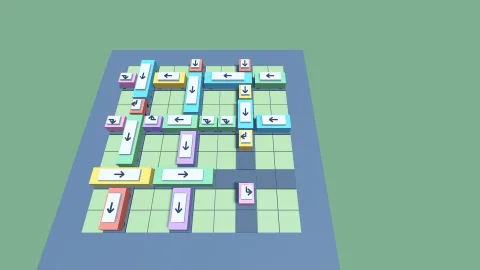

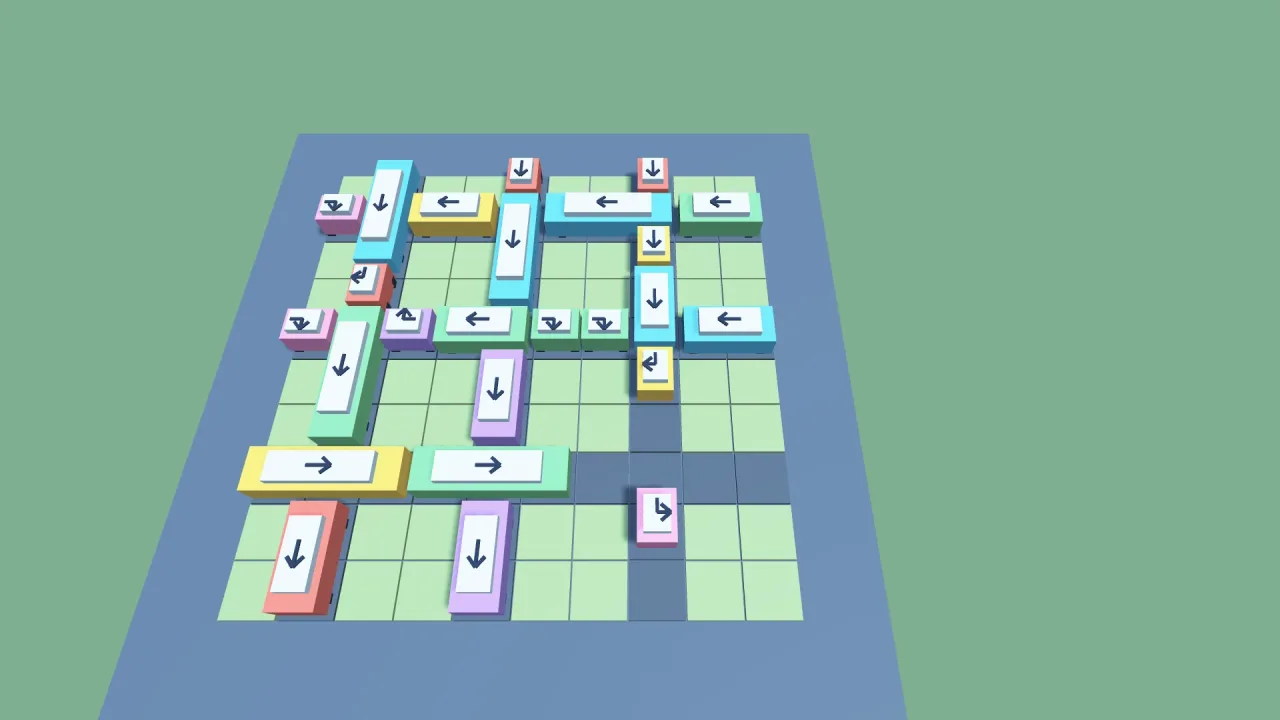
The pack
trafficRelease
function trafficRelease(): Pack<{ trafficRelease: TrafficReleaseApi }>Install pure rules; no renderer, DOM or simulation hook is required.
Helpers
createTrafficRelease
const createTrafficRelease = (config: TrafficConfig, solution?: TrafficAction[])=> …Create a traffic puzzle. Throws on a configuration it refuses (out-of-range sizes, overlaps, a route that does not start at its piece, jumps or does not leave the board) or a solution that does not replay to a win.
generateTrafficRelease
function generateTrafficRelease(options: TrafficGenerateOptions): TrafficLevelGenerate a seeded level whose solution is replayed before it is returned. Candidates are tried until one has at most maxInitialChoices open routes and a blocking chain at least minDependencyDepth long; throws generation: no ... level met ... when attempts run out, and on out-of-range options.
straightTrafficRoute
function straightTrafficRoute(cells: Voxel[], direction: Voxel, bounds: Pick<TrafficConfig, 'width' | 'height' | 'depth'>, id = 'exit'): TrafficRouteA straight route for cells: one step at a time along direction (a unit axis such as { x: 1, y: 0, z: 0 }) until wholly outside bounds. Throws on any other direction or a route longer than 64 steps.
Classes
TrafficRelease
class TrafficReleaseA traffic puzzle's rules, with undo, redo and a solver. Get one from createTrafficRelease.
constructor(config: TrafficConfig, solution: TrafficAction[] = [])get config(): TrafficConfig— A copy of the configuration.get state(): TrafficState— A copy of the current state.get solved(): boolean— True when every piece has left the board.get lost(): boolean— True whenmaxMistakesblocked releases have been made with pieces still on the board. A release-only puzzle has no other way to lose.cells(id: string): Voxel[]— The cells pieceidcovers now (part way along its route if it is moving); empty once it has left or for an unknown id.hazardCells(): { id: string; cells: Voxel[]; }[]— Where each hazard is at the current tick.inspect(id: string, route: string): TrafficClearance— What stands in the way of pieceidleaving byroutenow, step by step; changes nothing.preview(a: TrafficAction): ActionResult<TrafficEvent>— Whatapplywould return fora, without playing it; never costs a mistake.apply(a: TrafficAction): ActionResult<TrafficEvent>— Play a move. Returns{ valid: true, events }, or{ valid: false, reason, events: [] }with a reason:blocked,reserved-lane,hazard,already-moving,unknown-piece,unknown-routeormistake-limit. A blocked release counts as a mistake (and goes in the history) whenmaxMistakesis set.legalActions(): TrafficAction[]— Every release that is clear now, then{ type: 'tick' }while the puzzle is unsolved.solve(maxStates = 20000): SearchResult<TrafficAction>— A winning continuation, without changing anything: the rest of the creation certificate when it still applies, otherwise a greedy plan (release the first clear piece, else wait a tick). Greedy is exact here: a piece that leaves never blocks anything again, so no release can spoil the puzzle.unsolvableafter 120 idle ticks or at the mistake limit;budget-exhaustedaftermaxStatessteps (default 20,000).undo(): boolean— Take back the last move (a tick, a release or a mistake); false when there is none.redo(): boolean— Replay the move last taken back; false when there is none.reset(): void— Return to the start and clear the undo and redo history.
Types
TrafficAction
type TrafficAction = { type: 'release'; id: string; route: string; } | { type: 'tick'; }A move: release piece id along its route route, or let one tick of time pass (moving pieces advance a step, hazards a phase).
TrafficClearance
interface TrafficClearanceWhat stands in a route's way, from inspect.
clear: boolean— True when nothing does: the piece can be released by this route now.blockers: { /** A parked \piece`, a `wall`, a moving piece's `reservation` or a `hazard` at the tick of that step. / kind: 'piece' | 'wall' | 'reservation' | 'hazard'; /* The blocking piece's or hazard's id; `'wall'` for a wall. / id: string; /* The cell where it blocks. / cell: Voxel; /* The route step (footprint index) that meets it. */ frame: number; }[]` — Everything in the way, by route step.swept: Voxel[]— Every cell the route sweeps, corners of turns included: what a presenter highlights.
TrafficConfig
interface TrafficConfigA level: the board's size, the pieces and their routes, and optional walls, hazards and a mistake limit.
width: number— Cells across, 1 to 24.height: number— Cells deep (rows of a flat board), 1 to 24.depth: number— Cells high, 1 to 24; 1 for a flat board.pieces: TrafficPiece[]— The pieces, 1 to 256, with unique ids and no shared cells.walls?: Voxel[]— Cells that are always blocked (barriers, kerbs); inside the board and on no piece.hazards?: TrafficHazard[]— Moving obstacles, checked against each route step at the tick it would happen.maxMistakes?: number— Blocked release attempts allowed before the level is lost, 0 to 100; 0 (the default) means no limit.
TrafficDifficulty
type TrafficDifficulty = 'easy' | 'medium' | 'hard' | 'very-hard'Generator tier: a larger board and, from medium up, fewer open routes and longer chains of blockers.
TrafficEvent
type TrafficEvent = { type: 'released' | 'departed'; id: string; } | { type: 'tick'; tick: number; } | { type: 'mistake'; reason: string; }What a move did: a piece was released or has departed (left the board), a tick passed, or a blocked release cost a mistake.
TrafficGenerateOptions
interface TrafficGenerateOptionsWhat generateTrafficRelease takes; everything but seed has a default.
seed: number— Unsigned 32-bit seed (0 included); the same options give the same level.difficulty?: TrafficDifficulty— Tier; default'medium'.preset?: TrafficPreset— What to build; default'parking'.layout?: TrafficLayout— The shape filled; default'rectangle'(flat) or'cube'(voxels).size?: number— Board side in cells: 2 to 12 flat (default 4, 6, 8, 10 by tier; parking adds a one-cell border) or 2 to 6 for voxels (default 2, 3, 4, 5).density?: number— Share of the shape's places that get a piece, 0.35 to 1; default 1.hazards?: boolean— Flat presets: add a pedestrian just off the left edge of rowfloor(size / 2), there for 2 ticks in every 6, so a car leaving that way must wait for a gap; default false.maxMistakes?: number— Blocked releases allowed before the level is lost, 0 to 100; default 0 (no limit).attempts?: number— Candidate levels to try before throwing, 1 to 1,000; default 40.maxInitialChoices?: number— Most pieces that may be clear at the start, 1 to 256; default by tier (streets 256, 5, 3, 3; voxels 256, 5, 3, 2, and 6 for a diamond; parking 256).minDependencyDepth?: number— Least length of the longest chain of pieces blocking one another, 1 to 256; default by tier (1, 4, 7, 10; parking 1).
TrafficHazard
interface TrafficHazardA moving obstacle (a pedestrian, a train) that repeats: at tick t it covers phases[t % phases.length].
id: string— Unique non-empty id.phases: Voxel[][]— 1 to 30 phases of cells it covers; an empty phase is a safe moment to cross. All hazards together repeat within 120 ticks.
TrafficLayout
type TrafficLayout = 'rectangle' | 'courtyard' | 'staggered' | 'cube' | 'pyramid' | 'arch' | 'diamond'The shape filled: rectangle, courtyard (a hole in the middle) or staggered (a notched edge) for flat presets; cube, pyramid, arch or diamond for voxels.
TrafficLevel
interface TrafficLevelA generated level: its configuration, a winning solution and what was measured.
seed: number— The seed asked for (the accepted candidate may have been drawn from a later one, but this seed reproduces it).difficulty: TrafficDifficulty— The tier asked for.parameters: Required<Omit<TrafficGenerateOptions, 'attempts' | 'maxInitialChoices' | 'minDependencyDepth'>>— The settings used, defaults filled in.config: TrafficConfig— The level, ready forcreateTrafficRelease.solution: TrafficAction[]— A replay-checked winning sequence of releases and ticks.metrics: { /** Pieces on the board. */ pieces: number; /** Pieces clear to leave at the start. */ initialChoices: number; /** Pieces with no clear route at the start. */ blockedPieces: number; /** Longest chain of pieces each blocking the next along the solution's routes. */ dependencyDepth: number; /** Solution routes that turn a corner (streets). */ turningRoutes: number; /** Whether the level met the targets below; always true for a returned level. */ difficultyTargetMet: boolean; /** The open-route target the level met. */ maxInitialChoices?: number; /** The chain-depth target the level met. */ minDependencyDepth?: number; }— The level's structure; none of it claims a shortest plan or a human difficulty.
TrafficMotion
interface TrafficMotionA piece on its way out.
id: string— The piece's id.route: string— The route it took.frame: number— Which of the route's footprints it is on now.reserved: Voxel[]— Every cell its route sweeps, held until it is off the board, so nothing else may cross its path.
TrafficPiece
interface TrafficPieceA car, block or voxel with the routes it can leave by.
id: string— Unique non-empty id.key?: string— Optional colour or kind for the presenter (and forboarding-queue's buses); the rules ignore it.cells: Voxel[]— The cells it covers, 1 to 64, inside the board and on no other piece or wall.routes: TrafficRoute[]— Its ways out, at least one. Releasing takes one of them whole.
TrafficPreset
type TrafficPreset = 'parking' | 'streets' | 'voxels'What generateTrafficRelease builds: streets (Traffic Escape: cars on a road grid, some turning), voxels (Tap Away: a block of cubes, each leaving along one of six axes) or parking (a walled lot whose cars can leave either way along their axis; Bus Out's lot).
TrafficReleaseApi
type TrafficReleaseApi = typeof kit & { /** Same seeded generator off-thread; frame-delivered results require a started game. */ generateTrafficReleaseAsync(options?: kit.TrafficGenerateOptions, job?: { signal?: AbortSignal }): Promise<kit.TrafficLevel>; }Public headless traffic release puzzles helpers.
TrafficRoute
interface TrafficRouteOne way out for a piece: its footprint at every step, from where it stands to wholly off the board.
id: string— Non-empty id, unique among the piece's routes; actions name it.frames: Voxel[][]— 2 to 65 footprints. The first is the piece'scells; each next one keeps the same cells in the same order, each moved at most two steps (so a turn can pivot); the last lies wholly outside the board.
TrafficState
interface TrafficStateWhere a traffic puzzle stands.
remaining: string[]— Ids of the pieces still on the board, moving ones included.moving: TrafficMotion[]— The pieces on their way out.departed: string[]— Ids of the pieces that have left, in order.tick: number— Ticks played.moves: number— Releases played.mistakes: number— Blocked releases counted againstmaxMistakes.
Voxel
interface VoxelA cell, in whole numbers from -64 to 64: x across, y the board's depth (rows on a flat board), z height (0 on a flat board).
x: number— Column across the board.y: number— Row, or depth into a volume.z: number— Layer up from the floor; 0 on a flat board.