
The pack
rail
function rail(): Pack<{ rail: RailApi }>The rail pack: game.rail, Zuma's rules. No options.
Helpers
createZuma
function createZuma(options: ZumaOptions = {}): ZumaGameStart a game. Throws, with every fault, on options validateZuma refuses.
createZumaAutopilot
function createZumaAutopilot(game: ZumaGame, options: { pause?: number } = {}): ZumaAutopilotThe game's autopilot, shooting at most every pause seconds (default 0.45).
makeTrack
function makeTrack(def: TrackDef): TrackA track from its definition.
validateZuma
function validateZuma(options: ZumaOptions = {}): string[]Check a game's options. Empty when it can be played.
zumaLevels
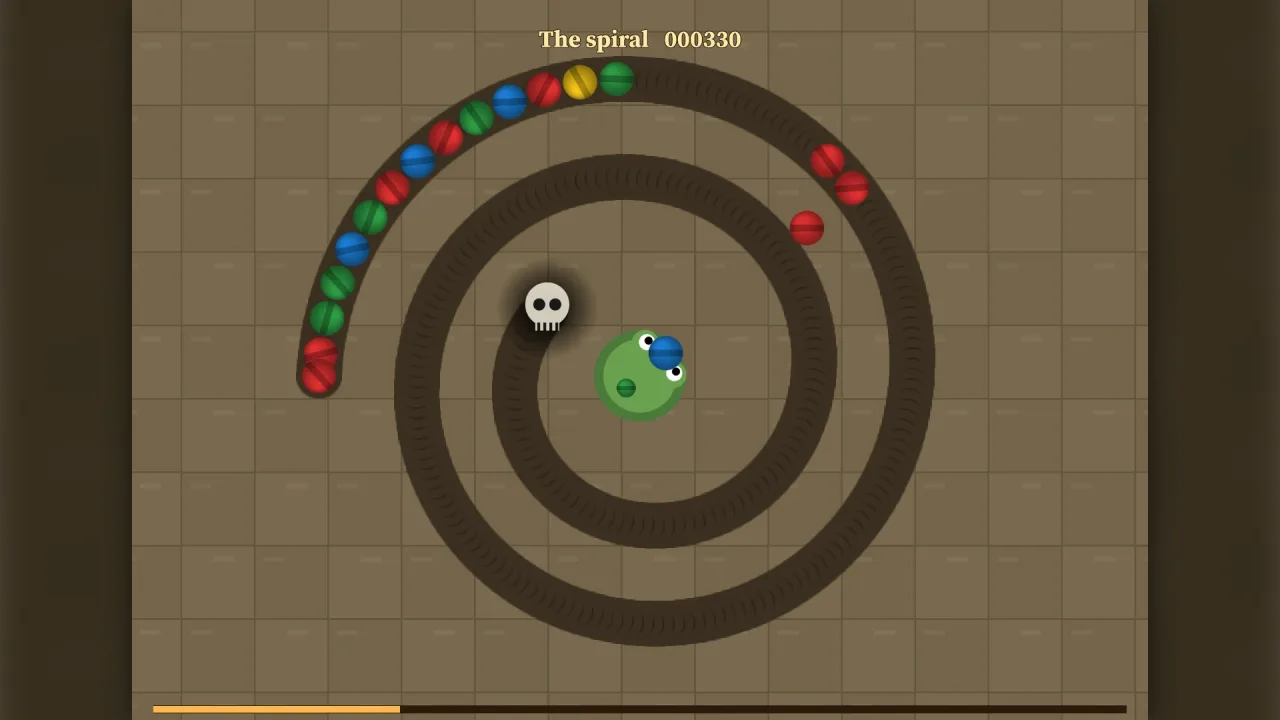
const zumaLevels: ZumaLevel[]The built-in levels: a spiral in to the frog, a serpent across the board and a long spiral of three turns.
Types
Ball
interface BallA ball in the chain: its colour, and how far along the track it is (below 0 it has not come out yet).
id: number— A number unique among the balls and shots of the game, given when the ball enters play and kept for good.colour: number— Its colour, a whole number from 0 to the level'scoloursless 1.s: number— Distance along the track in track units, 0 at the start; below 0 until it has come out.
ChainSegment
interface ChainSegmentA run of touching balls in the chain, as a save holds it.
balls: Ball[]— Its balls, tail first.v: number— The speed it rolls at, track units a second; negative while it rolls back.
RailApi
interface RailApiWhat the rail pack adds to a game: game.rail.
create: typeof createZuma— Start a game.validate: typeof validateZuma— Check a game's options.levels: typeof zumaLevels— The built-in levels.track: typeof makeTrack— A track from its definition.autopilot: typeof createZumaAutopilot— A player for an attract mode or a test.
Track
interface TrackA track: its length, and where a distance along it is and which way it runs there.
readonly length: number— Total length of the track in track units, measured along the polyline.readonly points: readonly Vec[]— The polyline's points in order from the start to the hole.at(s: number): Vec & { angle: number }— The place at distancesalong the track, andangle, the direction it runs there in radians;sis held between 0 andlength.
TrackDef
type TrackDef = { points: [number, number][] } | { spiral: { cx: number; cy: number; outer: number; inner: number; turns: number; start?: number; steps?: number } }How a track is given: points, or a spiral (from outer radius in to inner, turns times round a centre).
Vec
interface VecA point.
x: number— Horizontal coordinate, in track units.y: number— Vertical coordinate, in track units.
ZumaAutopilot
interface ZumaAutopilotA player that aims, swaps and shoots.
act(dt: number): boolean— Advance its clock; when it is ready, aim (and swap) and say whether to shoot.
ZumaEvent
type ZumaEvent = | { kind: 'shoot'; colour: number } | { kind: 'insert'; colour: number } | { kind: 'pop'; count: number; combo: number; score: number } | { kind: 'retract' } | { kind: 'join' } | { kind: 'miss' } | { kind: 'swap' } | { kind: 'danger'; left: number } | { kind: 'won' } | { kind: 'lost' }Something that happened.
ZumaGame
interface ZumaGameA game.
readonly state: ZumaState— Where the game stands; it changes as the game runs.readonly track: Track— The level's track, built from its definition.readonly level: ZumaLevel— The level being played.readonly options: Readonly<{ ball: number; shot: number; retract: number; range: number }>— The options with defaults filled in: a ball's width, and in units a second a shot's speed and a split chain's roll back, and how far a shot flies.aimAt(angle: number): void— Aim, in radians.shoot(): boolean— Shoot the current ball.swap(): void— Swap the current ball and the next.colours(): number[]— The colours still in the chain.step(dt: number): void— Advancedtseconds in fixed steps of 1/120 s, taking at most 0.25 s at a call. Throws ifdtis negative or not a number.view(): ZumaView— What is where, copied.drain(): ZumaEvent[]— Events since the last call; the latest 512 are kept.snapshot(): ZumaSave— The game as plain JSON.restore(save: ZumaSave): void— Pick up a saved game made with the same level and options; pending events are dropped.
ZumaLevel
interface ZumaLevelA level.
name: string— The level's display name.track: TrackDef— The track the chain rolls along: a polyline or a spiral.frog: [number, number]— Where the frog sits.balls: number— Balls in the chain, and colours among them.colours: number— Colours among the balls, a whole number from 1 to 8.speed: number— Units a second the chain is pushed; and while rushing in, until its front isuntilof the way along.rush?: { speed: number; until: number }— Faster entry at the start: the chain rolls atspeedunits a second until its front isuntil(0 to 1) of the way along.
ZumaOptions
interface ZumaOptionsA game's options.
seed?: number— Default 1: the chain's colours and the frog's.level?: ZumaLevel— The level. DefaultzumaLevels[0].ball?: number— A ball's width. Default 32.shot?: number— Units a second a shot flies, and the chain rolls back to close a gap. Default 900 and 220.retract?: number— Units a second a split chain rolls back to close a gap; default 220.range?: number— The furthest a shot flies before it is gone. Default 2000.
ZumaSave
interface ZumaSaveA game saved as plain JSON.
state: ZumaState— The game state.segments: Segment[]— The runs of balls in the chain, back to front: each holds its balls tail first and the speed it rolls at in units a second (negative while rolling back).shots: { id: number; x: number; y: number; vx: number; vy: number; colour: number; flown: number }[]— Shots in flight: place, direction of travel as a unit vector (vx,vy), colour, and the distance flown so far.serial: number— The count of ids handed out to balls and shots so far.carry: number— Seconds ofsteptime not yet spent, less than one fixed step of 1/120 s.rng: RngState— The state of the game's random stream.
ZumaState
interface ZumaStateWhere the game stands.
phase: 'play' | 'won' | 'lost'—'play'while it runs,'won'once every ball has popped,'lost'once the front ball reaches the hole.time: number— Seconds played.score: number— Points: ten a ball, times one more for each step of the combo, and 50 times the streak for each shot that pops from the third in a row.popped: number— Balls popped, the longest combo, and shots in a row that popped something.combo: number— The longest combo so far: the most pops in one chain reaction, a single pop counting 1.streak: number— Shots in a row that popped something; a shot that pops nothing or misses resets it to 0.aim: number— The frog: where it aims, the ball it will shoot and the one after.current: number— Colour of the ball the frog shoots next.next: number— Colour of the ball that comes up after it.
ZumaView
interface ZumaViewWhat is where.
state: ZumaState— A copy of the game state.balls: (Ball & { x: number; y: number; angle: number })[]— Balls on the track, with their place and the way the track runs there.shots: { id: number; x: number; y: number; colour: number }[]— Shots in flight: their id, place and colour.frog: Vec— Where the frog sits: the level'sfrog.front: number— How far along the front ball is, 0 to 1.