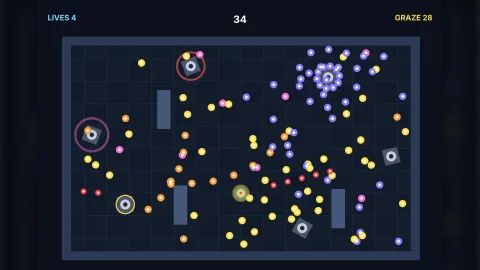

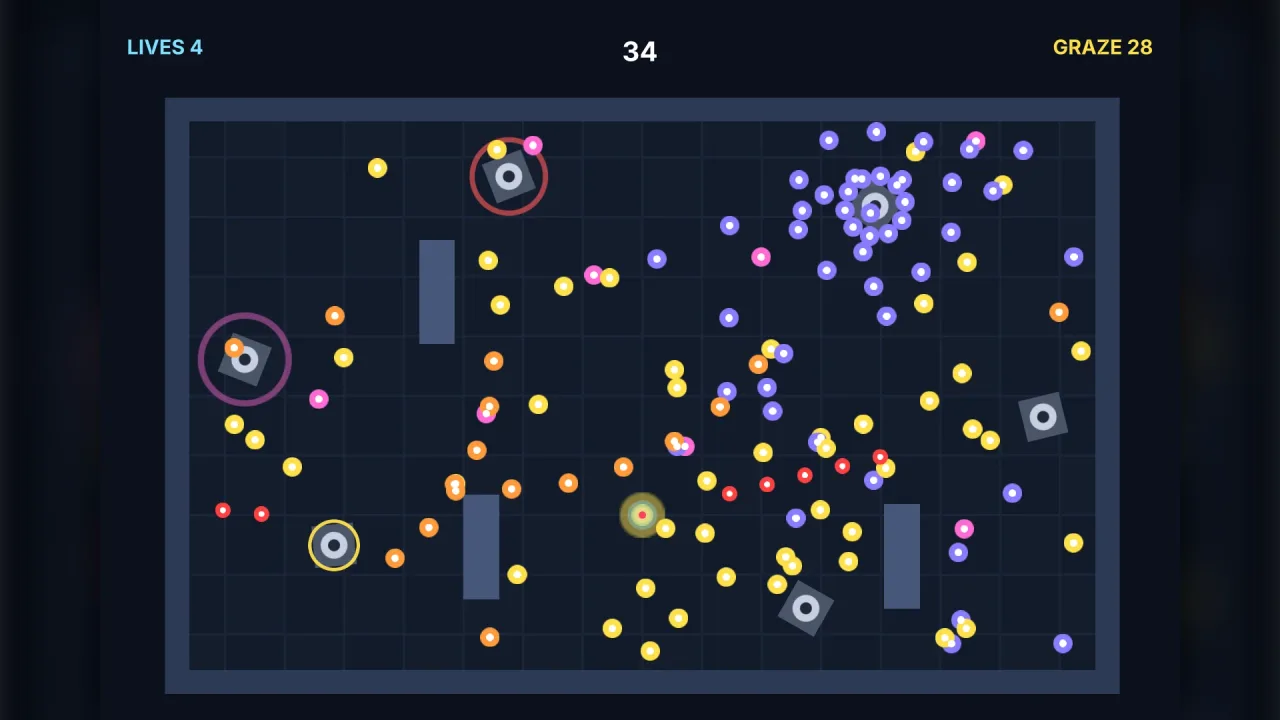
The pack
projectilePatterns
function projectilePatterns():Pack<{projectilePatterns:typeof rules}>Install renderer-independent projectile patterns policies.
Helpers
createProjectiles
function createProjectiles()Create an empty projectile system.
patternShots
function patternShots(p: ProjectilePattern, aim = 0): PatternShot[]Pure pattern schedule, relative to emission. Aim is in radians; angles are never renderer coordinates.
Classes
Projectiles
class ProjectilesOwns emission, swept collisions, lifetime and per-projectile hit/graze sets. Damage is emitted for a combat adapter.
time: number— Seconds elapsed on this projectile clock.shots: Projectile[]— The projectiles in flight; those still waiting to launch are not listed.readonly events: ProjectileEvent[]— Events since the lastdrain, in order.emit(pattern: ProjectilePattern, origin: Point, aim: number, team: string, damage = 1): number[]— Schedule a volley fromoriginalongaim(radians) forteam, each projectile carryingdamage(default 1). Shots with no delay launch at once. Returns the ids of every projectile it schedules. Throws on a pattern value outside its bounds or a non-finitedamage.tick(dt: number, targets: readonly ProjectileTarget[] = [], walls: readonly Rect[] = [], graze = 8)— Advance bydtseconds (0 to 10) in substeps of at most 1/120 s: launch due shots, move them, hit living targets of other teams, stop or bounce them atwalls(rectangles whosex,yare the top-left corner) and expire them. A near miss withingrazeworld units (default 8) of a target's edge raises agrazeevent. Throws whendtis outside 0 to 10 orgrazeis negative.drain()— Take the pending events and clear them.clear()— Remove every projectile, pending launch and event; the clock and id counter keep their values.snapshot()— A plain copy of the clock, the id counter, the projectiles and the pending launches.restore(s: ReturnType<Projectiles['snapshot']>)— Replace the state with a snapshot's and clear the events. Throws when a time, id counter, position or life in it is out of range.
Types
PatternKind
type PatternKind = 'aimed' | 'fan' | 'ring' | 'spiral' | 'burst' | 'staged'How a volley's shots are arranged: aimed (all along the aim), fan (spread across an arc), ring (evenly round a circle), spiral (one at a time, each turned from the last), burst (one at a time along the aim) or staged (several rings in turn).
PatternShot
interface PatternShotOne shot of a volley's schedule, relative to emission.
at: number— Seconds after emission that it launches.angle: number— Launch direction in radians: the velocity is (cos, sin) times the speed, so 0 points along +x.
Projectile
interface Projectile extends PointA projectile in flight; x and y are its position in world units.
id: number— Unique id within itsProjectiles, counting up from 1.team: string— The team that fired it; targets of the same team are ignored.vx: number— Velocity along x, world units a second.vy: number— Velocity along y, world units a second.rot: number— Heading in radians,atan2(vy, vx), for facing a sprite.r: number— Collision radius, world units.life: number— Seconds of life left; it is removed at 0.damage: number— Damage eachhitevent carries.pierce: number— Further targets it can pass through before a hit stops it.ricochet: number— Wall reflections it has left.homing: number— Turn rate towards the nearest living target of another team, radians a second; 0 flies straight.hits: string[]— Ids of the targets it has already hit; each is hit at most once.grazed: string[]— Ids of the targets it has already grazed; each is grazed at most once.
ProjectileEvent
interface ProjectileEventSomething that happened to a projectile, for a combat adapter, sound or effects.
kind: 'spawn' | 'hit' | 'graze' | 'bounce' | 'expired'— What happened:spawn(launched),hit,graze(a near miss),bounce(off a wall) orexpired(life ran out or it was stopped).projectile: number— Id of the projectile.target: string— Id of the target hit or grazed; an empty string for the other kinds.damage: number— Damage dealt by ahit; 0 for the other kinds.time: number— Seconds on theProjectilesclock when it happened.
ProjectilePattern
interface ProjectilePatternA volley: its arrangement, size, speed and what each projectile carries.
kind: PatternKind— The arrangement of the shots.count: number— Shots per volley, or per ring forringandstaged; a whole number from 1 to 256.speed: number— Projectile speed, world units a second; above 0.spread?: number—fanonly: the arc across which the shots spread, in radians from 0 to 2π, centred on the aim. Default 0.7.interval?: number— Seconds between launches forburstandspiral(between shots) andstaged(between rings). Default 0.12.stages?: number—stagedonly: the number of rings, a whole number from 1 to 32. Default 3.rotation?: number— Radians each step turns: between successive shots forspiral(default 0.4) and between rings forstaged(default 0.24). Ignored by the other kinds.radius?: number— Collision radius of each projectile, world units, at least 0.01. Default 4.life?: number— Seconds a projectile lives, from 0.001 to 60. Default 5.pierce?: number— Further targets a projectile passes through after its first hit, a whole number from 0 to 100. Default 0, which stops it at the first.ricochet?: number— Wall reflections a projectile has, a whole number from 0 to 100. Default 0, which stops it at the first wall.homing?: number— Turn rate towards the nearest living target of another team, radians a second; 0 flies straight. Default 0.
ProjectileTarget
interface ProjectileTarget extends PointSomething projectiles can hit: a circle at x, y in world units.
id: string— Unique id, reported in events.team: string— Its team; projectiles ignore targets of their own team.r: number— Collision radius, world units.alive: boolean— Whether it can be hit; a target that is not alive is skipped.