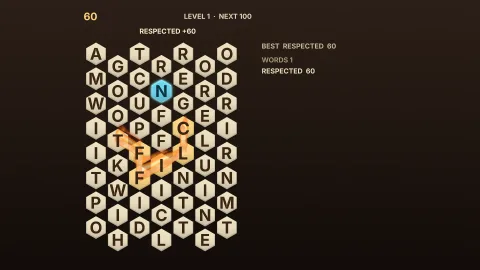

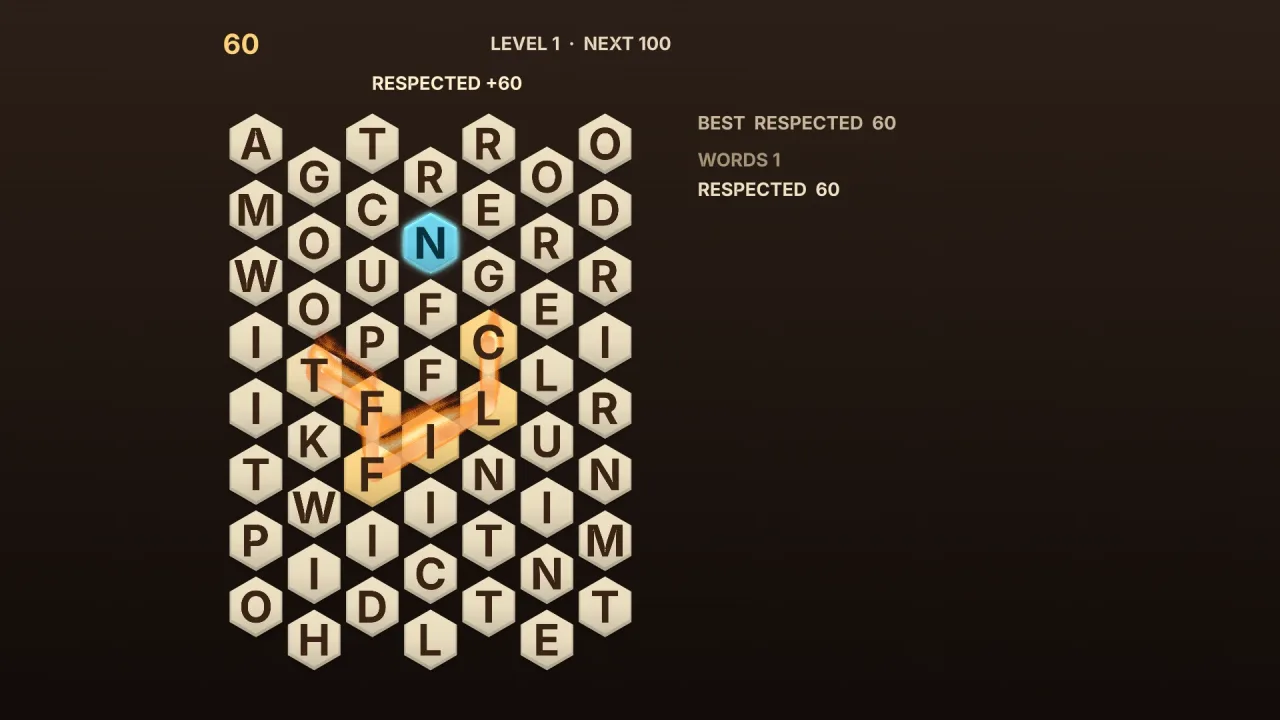
What it does
createLetterCascade deals a board from a seed, seven columns of eight by default with each odd column half a tile
lower, so every tile touches six others. A word is a chain of touching tiles, each used once, of three letters or
more and in the word list; it scores its letter values times a multiplier for its length. The tiles go, the columns
close up and new tiles fall in, drawn by the word list's letter frequency and kept near a third vowels.
Pressure comes from fire. A weak word raises the chance that a burning tile falls in, and the chance climbs with every level. At the end of each turn every burning tile burns the tile below it and drops a row; one on the bottom row ends the game, and the only way to put one out is to use it in a word. Long words bring gold and gem tiles that double and triple the words they are used in, and a scramble deals every ordinary tile a new letter at the cost of more fire.
Every move returns its events in order, each tile with a stable id: the tiles removed, every fall with its rows,
every new tile with the row it lands in, every burn, levels and the end. A game animates exactly that and nothing it
has to work out for itself. The game is a seed and a list of moves on the kernel history, so undo, saves and replays
come with it, and hint searches the board for the best-scoring word.
Features
- Offset columns or squares — hex neighbours with columns half a tile apart, or 8 or 4 neighbours on a square board.
- Gravity and refill — used tiles vanish, columns close up in order and new tiles fall in every gap.
- Burning tiles — a chance that rises with weak words and levels, a tile burnt each turn, the end at the bottom.
- Gold and gems — long words bring tiles that double and triple a word's points.
- Scoring tables — letter values by rarity and multipliers by length, both replaceable.
- Levels — score thresholds that raise the fire as the game goes on.
- Scramble — new letters for every ordinary tile, paid for in fire.
- Ordered events — removals, falls, new tiles, burns, levels and the end, with stable tile ids.
- A solver — the best-scoring word on the board and its path, for hints and self-play.
- Set boards — your own starting letters and special tiles, for tutorials and puzzles.
Good for
- Endless word games that build pressure, in the style of Bookworm.
- Calm word puzzles with fire off and a square board, played for the best score.
- Puzzle levels from a set board, with burning tiles placed where you want them.
- Educational spelling games with a word list of your own and gentle letter values.
- Daily boards, the same seed for every player.
Make it yours
A game takes its columns and rows, neighbours, shortest word, word list, QU tile, letter values, length multipliers, fire (its chance, how it rises with weak words and levels, and how many may burn at once, or none), the word length that brings gold and gems, level thresholds, a scramble's cost, and a set board with special tiles. The pack draws nothing, so the tiles, the trace and every fall are yours.
Two materially different games: the classic seven by eight with offset columns, fire and levels; and a calm five by five square board with corner neighbours, four-letter words and no fire. A third is a tutorial board you set letter by letter, with one burning tile already on it.
A quick look
A turn, and the events to animate:
const game = createLetterCascade({ seed });                 // 7 columns × 8 rows, offset columns, fire
game.canExtend(path, pos);                                  // may a drag go on to this tile?
const r = game.play(path);                                  // positions col * rows + row, row 0 at the top
if (r.ok) for (const e of r.result.events) animate(e);      // remove, fall, spawn, burn, level, over: in order
game.hint();                                                // { word, points, path }: the best word on the board
Works with
english-words— required: the words that count and the letters dealt.letter-tiles— draws the board, follows the drag and drops tiles into place, with burning and golden tiles.letter-grid— the timed alternative: a fixed board and a clock instead of falling tiles and fire.
Good to know
- It is the rules only: the game draws the board and animates the events.
- Nothing promises a word on every board;
hintsays when there is none, and a scramble deals again. - The solver searches within a budget, so on a big board with a long word list it may miss the very best word.
- There are no timers, lives or rewards beyond the score and levels; add them around the turns.