
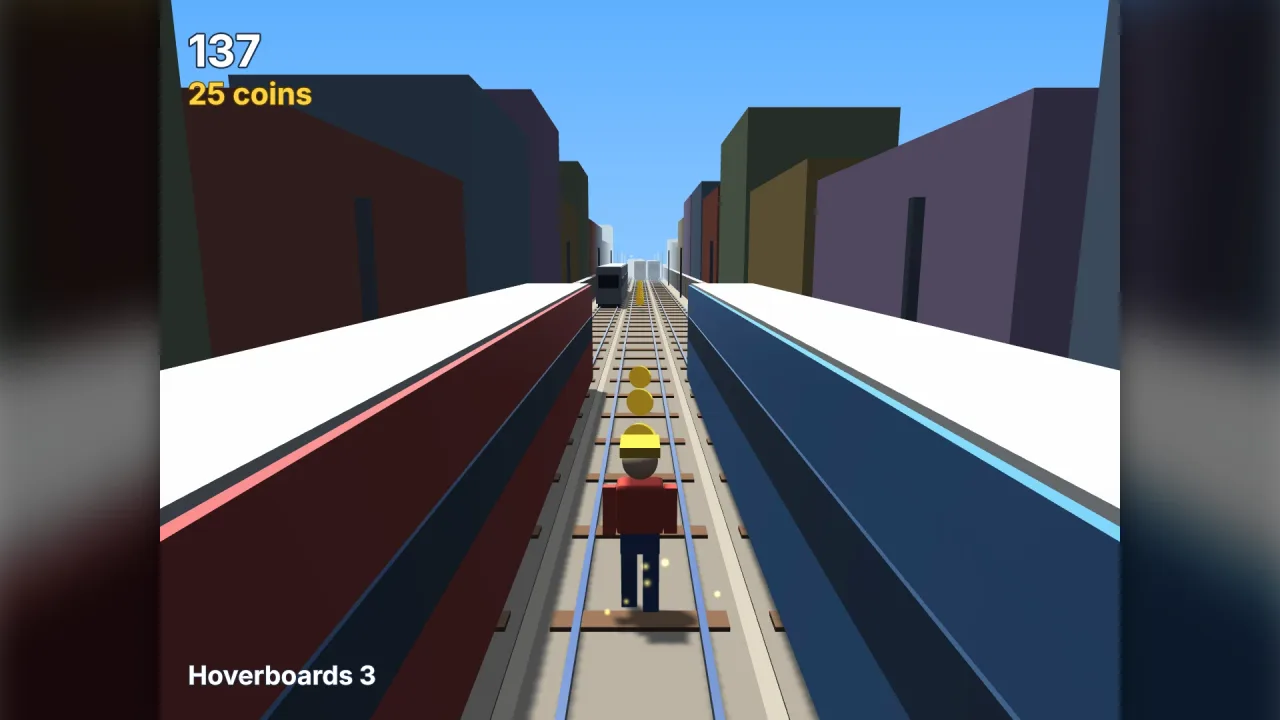
The pack
laneRunner3d
function laneRunner3d(): Pack<{ laneRunner: LaneRunnerApi }>The lane-runner-3d pack: game.laneRunner, Subway Surfers' rules on runner-core. No options.
Helpers
createLaneAutopilot
function createLaneAutopilot(game: LaneRunner, options: LaneAutopilotOptions = {}): LaneAutopilotA lane run's autopilot. It never touches game but to read it; give the moves it returns to game.input.
createLaneRunner
function createLaneRunner(options: LaneRunnerOptions = {}): LaneRunnerStart a lane run. Throws, with every fault, on options validateLaneRunner (or runner-core) refuses.
laneBodyDefaults
const laneBodyDefaults: LaneBodyThe body defaults.
laneRunnerPowerUps
const laneRunnerPowerUps: Record<string, RunnerPowerUp>The built-in power-ups: Subway Surfers' set.
subwayChunks
function subwayChunks(lanes = 3, options: { trainHeight?: number } = {}): RunnerChunk<LaneItem>[]Subway Surfers' track as chunks for any number of lanes: barriers to jump and roll, walls of trains with one lane open, ramps up onto roofs and runs along them, trains that come at the runner, coin runs and power-ups, harder ones further along. Every chunk starts with clear track, so the runner can reach any lane between chunks.
validateLaneRunner
function validateLaneRunner(options: LaneRunnerOptions = {}): string[]Check a lane run's options and chunks. Empty when it can be run.
Types
LaneAutopilot
interface LaneAutopilotA player that picks the next move.
next(): LaneMove[]— The moves to make now (swipes, then a jump or a roll), empty to keep running. Call it before each step; it decides once everyevery.
LaneAutopilotOptions
interface LaneAutopilotOptionsHow the autopilot looks ahead.
horizon?: number— Seconds a plan must live through. Default 1.5.beyond?: number— Seconds it looks on past that, running straight, to choose between plans that live. Default 1.times?: number[]— When a plan's jump or roll can come: now, or this many seconds later. Default[0, 0.2, 0.4].every?: number— Seconds of run between decisions;next()returns no moves in between. Default 0.1.
LaneBarrier
interface LaneBarrierA barrier across a lane: the runner's body must pass above top or below bottom.
kind: 'barrier'— Marks this item as a barrier.lane: number— Its lane.at: number— Where it stands, from the chunk's start.bottom: number— The height of its underside: a runner whose head is below it rolls under.top: number— The height of its top: a runner whose feet are above it jumps over.look?: string— What it is, for the drawing: 'hurdle', 'overhead', 'gate' or a game's own.hit?: 'crash' | 'stumble'— What touching it does. Default'crash'.
LaneBarrierView
interface LaneBarrierViewA barrier, as drawn.
id: string— Unique id in the run:<chunk index>:<item index>.lane: number— Its lane, from 0 on the left.x: number— The x of its lane's middle, world units.z: number— Where it stands along the run, world units.bottom: number— The height of its underside, world units.top: number— The height of its top, world units.look: string— What it is, for the drawing: 'hurdle', 'overhead', 'gate', a game's own, or 'barrier' when the chunk says none.
LaneBody
interface LaneBodyThe runner's body and moves.
height: number— Standing height. Default 1.8.rollHeight: number— Height while rolling. Default 0.7.halfWidth: number— Half its width. Default 0.3.halfDepth: number— Half its depth along the run. Default 0.3.jumpHeight: number— How high a jump goes. Default 1.4.jumpTime: number— How long a jump is in the air, on the flat. Default 0.65 s.rollTime: number— How long a roll lasts. Default 0.55 s.changeTime: number— Seconds to move one lane across. Default 0.18.fastFall: number— The speed a roll in the air drives the runner down at. Default 30.stepUp: number— The height of an edge the runner steps up onto rather than hits (a ramp's start). Default 0.4.
LaneCoins
interface LaneCoinsA run of coins down a lane, straight or arched over something.
kind: 'coins'— Marks this item as a run of coins.lane: number— Its lane.at: number— Where the first coin is, from the chunk's start.count?: number— How many. Default 1.every?: number— The spacing. Default 3.y?: number— The height of the first and last coin. Default 1.arc?: number— How high the middle coins rise above that, in an arch. Default 0: straight.
LaneEvent
type LaneEvent = | RunnerEvent<LaneItem> | { kind: 'jump' } | { kind: 'roll' } | { kind: 'land'; on: string | null } | { kind: 'bump'; side: -1 | 1 } | { kind: 'scrape'; id: string } | { kind: 'crash'; id: string; what: string } | { kind: 'pickup'; id: string; x: number; y: number; z: number; power?: string } | { kind: 'board' }Something that happened in a lane run: runner-core's events, and the motor's own.
LaneItem
type LaneItem = LaneTrain | LaneBarrier | LaneCoins | LanePickupWhat a lane chunk holds.
LaneMove
type LaneMove = 'left' | 'right' | 'jump' | 'roll' | 'board'A move.
LanePickup
interface LanePickupA power-up to pick up, by its name in the run's powerUps.
kind: 'power'— Marks this item as a power-up pickup.lane: number— Its lane.at: number— Where it is, from the chunk's start.power: string— The power-up it starts.y?: number— Its height. Default 1.
LaneRunner
interface LaneRunnerA lane run.
readonly run: Runner<LaneItem>— runner-core's run under it: score, coins, speed, power-ups, stumbles.readonly state: LaneRunnerState— Where the runner is.readonly options: Readonly<{ lanes: number; laneWidth: number; trainHeight: number; trainWidth: number; body: LaneBody; boardPower: string; coinRadius: number }>— The options, defaults filled in.laneX(lane: number): number— The x of a lane's middle.input(move: LaneMove): void— A move, applied on the next step: swipes queue and turn back, jumps and rolls wait for the ground.step(dt: number): void— Advancedtseconds, in fixed steps of 1/120 s.view(): LaneView— What is where.drain(): LaneEvent[]— Events since the last call.snapshot(): LaneRunnerSave— The run as plain JSON.restore(save: LaneRunnerSave): void— Pick up a saved run made with the same options.clone(): LaneRunner— A separate run made with the same options, at the same point: to try moves on without touching this one.
LaneRunnerApi
interface LaneRunnerApiWhat the lane-runner-3d pack adds to a game: game.laneRunner.
create: typeof createLaneRunner— Start a lane run.validate: typeof validateLaneRunner— Check a lane run's options; empty when it can be run.chunks: typeof subwayChunks— The built-in track as chunks, for any number of lanes.powerUps: typeof laneRunnerPowerUps— The built-in power-ups.body: typeof laneBodyDefaults— The runner's body defaults.autopilot: typeof createLaneAutopilot— A player that looks ahead, for an attract mode or a test.
LaneRunnerOptions
interface LaneRunnerOptionsA lane run's options: the track, the body, and runner-core's run.
lanes?: number— How many lanes. Default 3.laneWidth?: number— Their width. Default 2.6.startLane?: number— The lane the runner starts in. Default the middle.trainHeight?: number— A train's roof height, when a train does not say. Default 3.4.trainWidth?: number— A train's width, as a fraction of the lane. Default 0.82.body?: Partial<LaneBody>— The runner's body and moves.chunks?: RunnerChunk<LaneItem>[]— The chunks the run is built from. DefaultsubwayChunks(lanes).opening?: string[]— Chunk ids played first. Default['runway']with the built-in chunks, none otherwise.boards?: number— Hoverboards in hand at the start. Default 3.boardPower?: string— The power-up a hoverboard starts. Default'hoverboard'.powerUps?: Record<string, RunnerPowerUp>— The power-ups, by name. What each does comes from its definition:shield(a hoverboard),multiplier(a doubler), and the motor'sdata:reachpulls in coins that far ahead from every lane (a magnet),flylifts the runner to that height over everything (a jetpack),jumpis the jump height while it runs (super sneakers). DefaultlaneRunnerPowerUps.coinRadius?: number— How far from a coin's centre the runner picks it up. Default 0.9.run?: Omit<RunnerOptions<LaneItem>, 'chunks' | 'opening' | 'powerUps' | 'hits'>— runner-core's options for the run: seed, speed, stumbles, grace, score, milestone, ahead and behind.
LaneRunnerSave
interface LaneRunnerSaveA lane run saved as plain JSON.
run: RunnerSave— runner-core's saved run: score, speed, power-ups and the chunks laid.state: LaneRunnerState— The runner's state.moving: [string, number][]— The fronts of the moving trains, as [train id, front z in world units].taken: string[]— Ids of the coins and pickups already collected.struck: string[]— Ids of the barriers and trains already struck, so each counts once.sky: [number, number][]— The jetpack trail's coins still ahead, as [lane, z in world units].
LaneRunnerState
interface LaneRunnerStateWhere the runner is and what it is doing.
x: number— Across, in world units (0 is the middle of the track).y: number— Height of its feet.z: number— Along the run: runner-core's distance.vy: number— Vertical speed.lane: number— The lane it is in or heading for.from: number— The lane it left, while it changes.grounded: boolean— On something (the ground, a ramp or a roof).on: string | null— What it stands on: a train's id, or null for the ground or the air.rolling: number— Seconds of roll left.rollOnLand: boolean— It will roll when it lands (a roll pressed in the air).flying: boolean— Up on a jetpack.boards: number— Hoverboards in hand.jumps: number— Jumps, rolls and lane changes made.rolls: number— Rolls made.changes: number— Lane changes made.flights: number— Jetpack flights taken.
LaneThingView
interface LaneThingViewA coin or a pickup, as drawn.
id: string— Unique id in the run:<chunk index>:<item index>[:<coin index>], orsky:<flight>:<z>for a jetpack coin.x: number— Across, world units (0 is the middle of the track).y: number— Height above the track, world units.z: number— Along the run, world units.power?: string— A pickup's power-up name; absent on a coin.
LaneTrain
interface LaneTrainA train: a block a lane wide with a roof to run on, standing or coming at the runner, with a ramp up to it.
kind: 'train'— Marks this item as a train.lane: number— Its lane, from 0 on the left.at: number— Where its front is, from the chunk's start. For a moving train, where its front meets the runner.length: number— How long it is.height?: number— Its roof's height. Default the run'strainHeight.speed?: number— Speed towards the runner, units a second. Default 0: standing.ramp?: number— A ramp this long in front of it, up to the roof. Default none.
LaneTrainView
interface LaneTrainViewA train, as drawn.
id: string— Unique id in the run:<chunk index>:<item index>.lane: number— Its lane, from 0 on the left.x: number— The x of its lane's middle, world units.front: number— Where its front is along the run, world units; a moving train's front closes on the runner.length: number— How long it is, world units.height: number— Its roof's height, world units.ramp: number— The length of the ramp in front of it up to the roof; 0 for none.moving: boolean— Whether it comes towards the runner rather than standing.
LaneView
interface LaneViewWhat is where, for a presenter.
runner: LaneRunnerState & { height: number; board: boolean; speed: number }— The runner.trains: LaneTrainView[]— Trains frombehindtoahead.barriers: LaneBarrierView[]— Barriers.coins: LaneThingView[]— Coins not yet taken, the jetpack's trail among them.pickups: LaneThingView[]— Power-ups not yet taken.chaser: number— How close the inspector is, 1 on the runner's heels to 0 gone.