
What it does
A yard is plain data: a text map, stores with capacities, workers and repeatable jobs. A worker with nothing to do
takes, among the jobs their role allows, the highest priority, then the nearest, that nothing blocks. They walk the
map to the job's input store, carry the inputs to its site, work them for the job's time divided by their skill, and
deliver the outputs to another store. Routes are planned over the map by nav.
The part that is hard to write by hand is reservation. Before a worker sets off, the inputs, room at the destination,
a place at the site and any shared tool are all reserved, so two workers never walk to the same last log. If a worker
is called off, stood down or dismissed, unworked inputs go back where they came from and finished outputs go on to
where they were going. whyNot explains in plain words why a job is idle: paused, enough made, waiting for materials,
the saw is in use, the site is busy, no room to deliver, a missing skill, too much to carry or no way there.
Goals turn the yard into a game. A job can stop once enough of its output is stored, and the yard can be won when a store holds an order, optionally before a deadline. A foreman sets priorities from wants that flow back down each production chain: if tools are wanted and the forge is short of iron, smelting becomes wanted too.
Features
- Fetch, work, deliver — jobs with inputs, a site, a work time, outputs and a destination store.
- Reservations — inputs, destination room, site places and tools claimed before anyone moves.
- Roles and skills — workers limited to a role, faster with skill, unable to do jobs they lack the skill for.
- Priorities and pauses — whole-number priorities per job, with 0 pausing it.
- Shared tools — a count of each tool, shared by the jobs that need it while they are worked.
- Goals and deadlines — per-job targets, and an order to fill in a store, against the clock or not.
- A foreman — priorities planned from wants, flowing back down the chain, replanned on a timer.
- Hiring and dismissal — workers come and go during play, a leaver's load put straight back.
- Explanations and events —
whyNotfor idle jobs, and events for assignments, pickups, work, deliveries and results. - Two built-in yards — a lumber and smithy yard loading a wagon, and a quarry and brickworks across a river loading a barge.
Good for
- Colony and settlement sims with hauling and production chains, in the style of The Settlers or Banished.
- Production-chain strategy, where raw materials become goods through several workshops.
- Order-against-the-clock games, where a crew must fill a wagon or a barge before a deadline.
- Management games where the player sets roles and priorities and watches the crew work.
- A labour layer inside a larger game, with your own map and art.
Make it yours
Everything is the yard's definition. The map's rows of characters decide where workers can walk, with blocked characters you choose, and letters can mark where stores and sites stand. Stores, workers (skills, speed, carrying capacity, role), jobs (inputs, outputs, time, tool, priority, goal, places at the site), tools, the win goal and the deadline are all data. Roles and priorities can change in play.
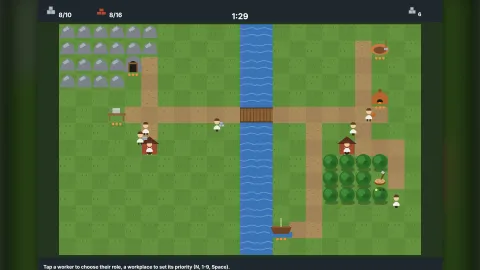
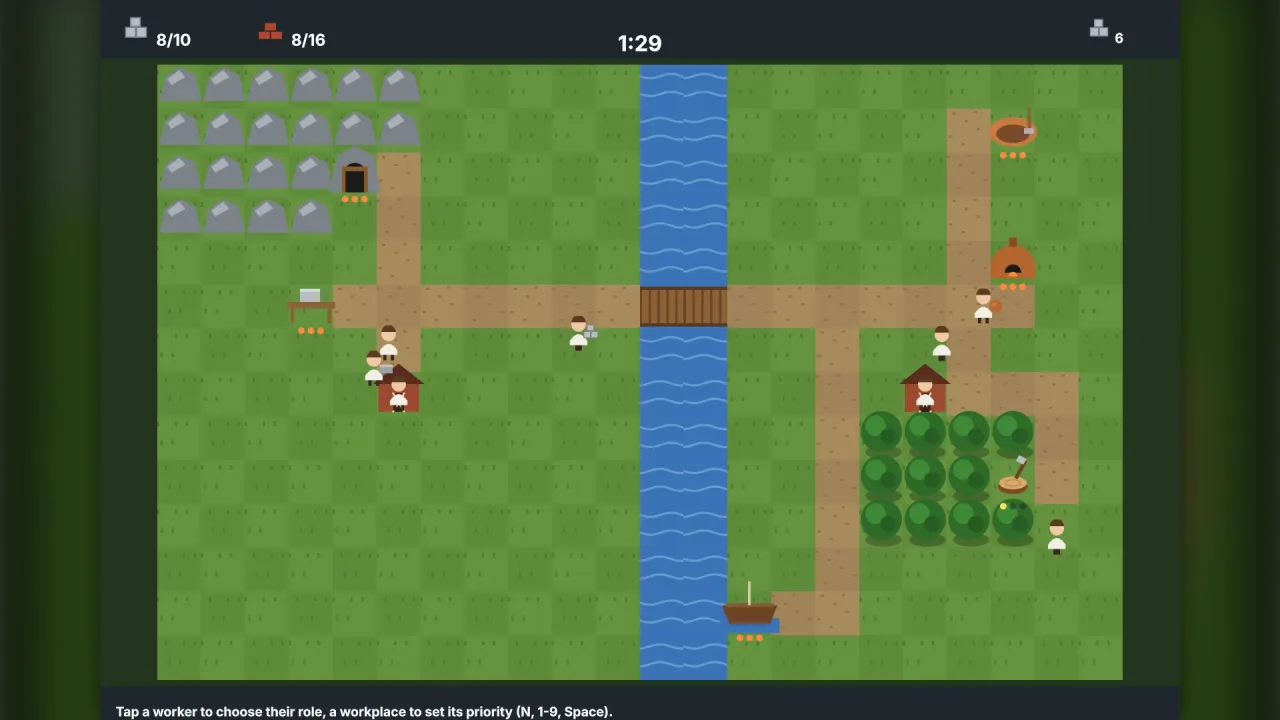
Two very different yards come built in, both plain data to copy and change: Oakshield, where workers do every job at normal pace and share one saw and one hammer to load a wagon with planks and tools; and Greystone, split by a river with one bridge, where only masons cut stone and porters carry more and walk faster.
A quick look
A built-in yard with five workers and a three-minute deadline, retuned and stepped:
const yard = game.jobs.create(game.jobs.presets.oakshield({ workers: 5, deadline: 180 }));
yard.role('w2', 'smith');
yard.priority('forge', 3);
yard.step(dt);
for (const w of yard.state.workers) drawWorker(w.x, w.y, w.task?.cargo);
Works with
nav— required; it plans the walking routes over the yard's map.settlement— villagers who also eat, keep warm, rest, build houses and live through seasons, built on this pack.walk-serve— for a waiter walking a restaurant floor rather than a crew hauling goods.incremental— for an idle economy with no workers walking about.
Good to know
- The map does not change: routes are planned once per pair of cells and kept, up to 8,192 pairs.
- Workers pass through one another; there is no crowding.
- Stock is whole numbers, a store's capacity counts everything in it, and tools are a shared count rather than objects that are carried.
- Events keep the latest 512, so drain them each frame.