
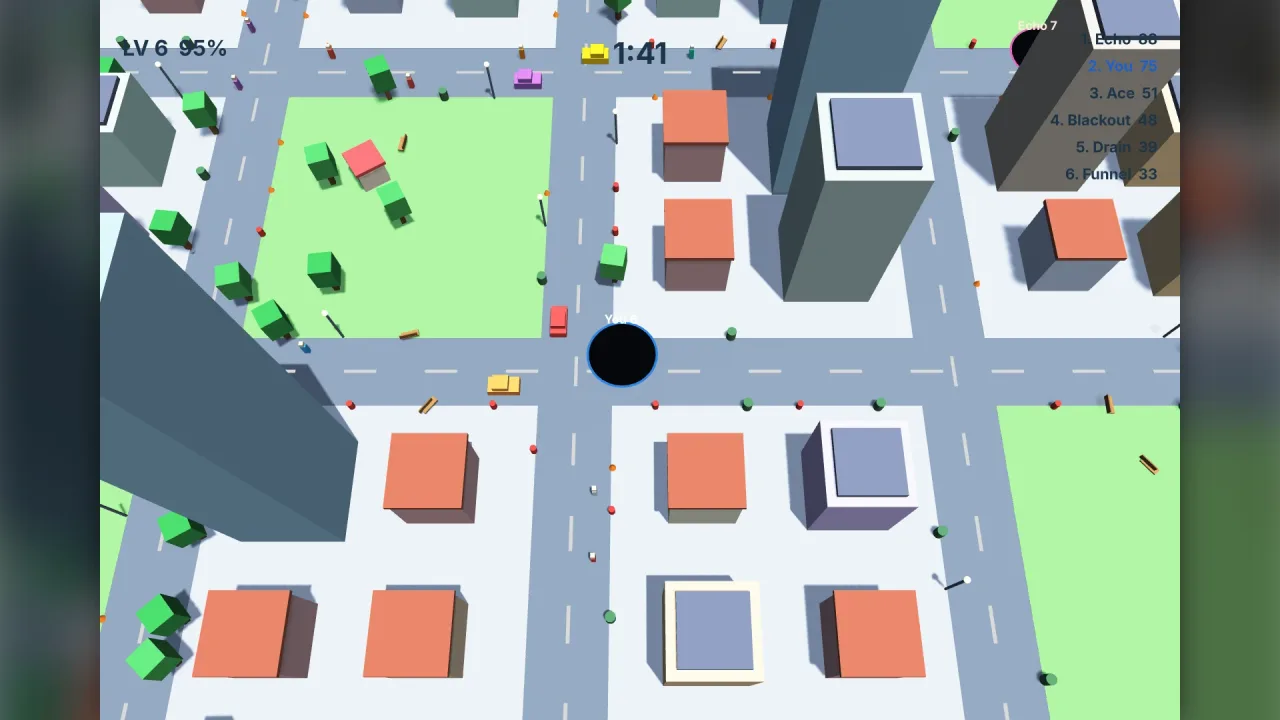
What it does
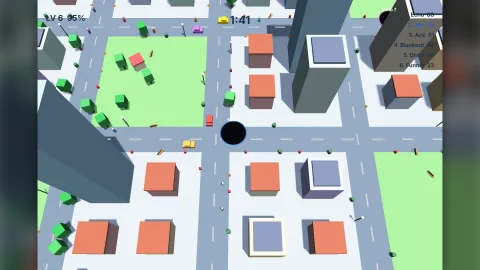
A round starts from a seed. The pack lays out a city of blocks and roads, with buildings on lots, parks, things along the pavements, people walking round the blocks and traffic driving a lane each way. Each thing is a kind with a size, a height and a points value. A thing fits a hole when its size is at most a share of the hole's radius, and it falls in once its middle is far enough over the hole; what does not fit stays put for the hole to pass under. Every thing in the view carries a fall value from 0 to 1 while it drops, so your game can animate it sinking.
Points fill a level bar, and each level widens the hole along a growth curve you can tune. A hole whose radius is enough
bigger than another's swallows it too, and takes a share of its points. Rival holes run from a hole that could swallow
them, chase one they could swallow, and otherwise go for the best points for the distance among what fits, thinking
again as often as their skill says. game.suggest(id) gives the way a rival would go for any hole, and the autopilot
plays the player's hole by it for an attract mode or a test.
Three rounds are built in. Classic is a timed round for the most points, and a swallowed hole comes back after a few
seconds. Solo has no rivals: reach a share of the city's points before the time runs out. Battle is the last hole left,
with swallowed holes out for good. The pack draws nothing; you call move and step and draw from view(), which also
ranks the holes by points for a leaderboard.
Features
- A city from a seed — blocks, roads, parks and lots, things on the pavements, walkers going round the blocks and
traffic on every road, laid out by
planCity. - Swallow what fits — a size test against the hole's radius, a fall from 0 to 1 for the animation, and points awarded as a thing starts to drop.
- Growth by levels — a starting radius, a width step per level, points to the next level rising by a factor, a maximum, and holes that speed up a little each level.
- Holes that eat holes — a hole a set factor wider swallows a smaller one and gains a share of its points.
- Rival holes — up to 31, which flee, chase and forage, with a skill from 0 to 1 and their own names.
- Three round types —
classic,soloandbattle, with the duration, respawn time and solo target as options. - A built-in city set — people, cones, hydrants, bins, benches, lamps, trees, cars, vans, kiosks, buses, houses, shops, towers and skyscrapers, on a six-by-six block layout.
- Events and a ranking —
swallow,level,eat,respawn,outandend, and the holes ranked by points. - Autopilot — plays any hole as the rivals do.
- Snapshot and restore — the round as plain JSON, and a restored round plays on exactly as the original.
Good for
- io-style swallow-and-grow games in the style of Hole.io, with a joystick and a leaderboard of rivals.
- Short timed rounds for mobile, where two minutes and a points race make a session.
- Battle-royale rounds, where the last hole standing wins.
- Solo score-attack levels, with a target share of the city to swallow.
- Themed variants such as a farm, a beach or a kitchen, by swapping the kinds of thing and the layout.
- Attract modes and playtests, driven by the autopilot.
Make it yours
createConsumeGrow takes the seed, the mode, the round's duration, the number of rivals and their names, and the
rivals' skill. The growth curve sets level 1's radius, how much wider each level is, the points to reach level 2, the
factor for each level after, and the maximum. Speed, the speed-up per level, the fit and eat ratios, the share of points
a swallowed hole gives up, the respawn time and the solo target are options too.
The city is data. The layout sets how many blocks it has each way, block size, road width, the share of parks, lots per block, props per pavement side, walkers per block and traffic per road, and the mix of kinds for buildings, parks, streets, walkers and vehicles. A kind is an id, a size, a height, its points, and whether it walks or drives and how fast.
Two quite different games from the same pack: the built-in classic round, eight holes in a city for two minutes with swallowed holes coming back; or a solo farm level with your own kinds, hay bales, sheep and barns on a smaller layout, where you must swallow a set share of the farm before the time runs out.
A quick look
A classic round with seven rivals, steered by a stick and drawn from the view:
const round = game.consumeGrow.create({ seed: 3, mode: 'classic', rivals: 7 });
round.move(stick.x, stick.y);
round.step(dt);
for (const t of round.view().things) drawThing(t.kind, t.x, t.y, t.angle, t.fall);
for (const h of round.state.holes) drawHole(h.x, h.y, h.radius);
Works with
snake— for a game that grows by eating along a body rather than by widening a hole.survivor-rules— for auto-firing weapons against a swarm.collect-build— for a stack-and-build race against coloured rivals.
Good to know
- Things and holes are circles on a flat city: a thing either fits or it does not, and nothing tips over the edge of a hole too small for it.
- Walkers and traffic pass through one another.
- Thousands of things are fine; tens of thousands are not.
- Skins, an online leaderboard and power-ups are not part of the rules.
- The pack draws nothing: your game draws the city, the holes and each thing's fall.