
The pack
boulderDash
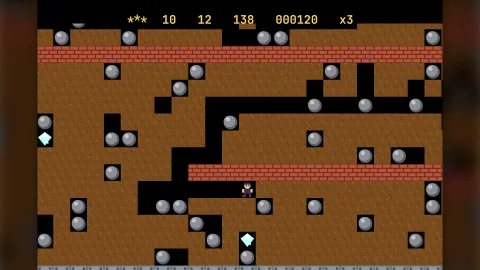
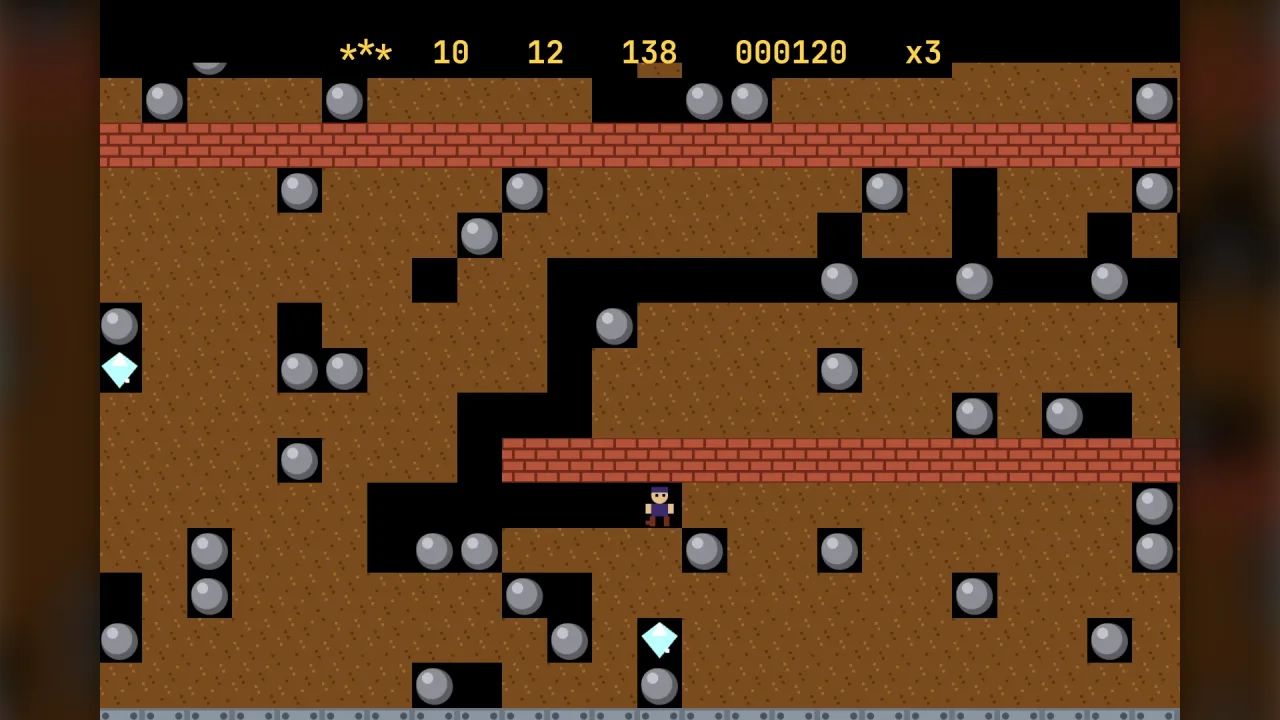
function boulderDash(): Pack<{ boulderDash: BoulderDashApi }>The boulder-dash pack: game.boulderDash, Boulder Dash's rules. No options.
Helpers
caves
const caves: CaveDef[]The built-in caves.
checkBoulderDashSave
function checkBoulderDashSave(save: unknown, caves: readonly CaveDef[] = builtIn): string | nullWhy a save cannot be restored into a game of these caves, or null when it can: the cave must be one of them, every
per-cell list must be that cave's size and hold cells, directions and burn counts, the timers must be finite numbers,
and the random stream a real one. restore throws with this reason.
createBoulderAutopilot
function createBoulderAutopilot(game: BoulderDashGame): BoulderAutopilotThe game's autopilot. It only reads game.
createBoulderDash
function createBoulderDash(options: BoulderDashOptions = {}): BoulderDashGameStart a game. Throws, with every fault, on options validateBoulderDash refuses.
layCave
function layCave(cave: CaveDef): CaveLayout | stringLay a cave out: its map, or its fill and drawing.
validateBoulderDash
function validateBoulderDash(options: BoulderDashOptions = {}): string[]Check a game's options. Empty when it can be played.
Types
BoulderAutopilot
interface BoulderAutopilotA player that picks the way to go.
next(): Dir | null— The way to go now, or null to wait.
BoulderDashApi
interface BoulderDashApiWhat the boulder-dash pack adds to a game: game.boulderDash.
create: typeof createBoulderDash— Start a game.validate: typeof validateBoulderDash— Check a game's options.checkSave: typeof checkBoulderDashSave— Why a save does not fit a game of these caves, or null.caves: typeof caves— The built-in caves.lay: typeof layCave— Lay a cave out.autopilot: typeof createBoulderAutopilot— A player for an attract mode or a test.
BoulderDashEvent
type BoulderDashEvent = | { kind: 'cave'; cave: number; name: string } | { kind: 'born' } | { kind: 'dig' } | { kind: 'collect'; diamonds: number } | { kind: 'push' } | { kind: 'thud'; tile: 'boulder' | 'diamond' } | { kind: 'explode'; cell: number; diamonds: boolean } | { kind: 'open' } | { kind: 'exit'; bonus: number } | { kind: 'die'; cause: 'crushed' | 'creature' | 'explosion' | 'time' } | { kind: 'magic' } | { kind: 'amoeba'; into: 'diamond' | 'boulder' } | { kind: 'over' } | { kind: 'won' }Something that happened.
BoulderDashGame
interface BoulderDashGameA game.
readonly state: BoulderDashState— The live state; read it, do not change it.readonly width: number— Cells across the current cave, the steel border included.readonly height: number— Cells down the current cave, the steel border included.readonly caves: readonly CaveDef[]— The caves in play, in order.move(dir: Dir | null): void— Hold a way to go, or null to stand.snap(on: boolean): void— Hold snap: dig or collect beside him without moving.at(x: number, y: number): Cell— The cell at a column and row.step(dt: number): void— Advances the game bydtseconds, running one cave frame for everyframeseconds; adtover 0.25 counts as 0.25. Throws ifdtis negative or not a number.view(): BoulderDashView— Every cell and a copy of the state, for drawing.drain(): BoulderDashEvent[]— Takes the events since the last call, oldest first, and clears them. Only the latest 512 are kept.snapshot(): BoulderDashSave— The whole game as plain JSON, to save.restore(save: BoulderDashSave): void— Replaces the game with a saved one fromsnapshot()and discards pending events. Throwsboulder-dash.restore: …, changing nothing, on a save that does not fit this game's caves (checkBoulderDashSave).
BoulderDashOptions
interface BoulderDashOptionsA game's options.
seed?: number— Default 1.caves?: CaveDef[]— The caves, in order. Defaultcaves.cave?: number— The cave to start in, from 0. Default 0.lives?: number— Lives. Default 3.frame?: number— Seconds a cave frame takes: the game's speed. Default 0.125.push?: number— The chance a push moves a boulder, each frame. Default 0.25.growth?: [number, number]— An amoeba cell's chance to grow each frame, slow and then fast. Default 0.03 and 0.25.
BoulderDashSave
interface BoulderDashSaveA game saved as plain JSON.
state: BoulderDashState— The game's state.cells: Cell[]— Every cell of the cave, row by row.falling: number[]— Indices intocellsof the boulders and diamonds that are falling.dirs: number[]— Per cell, the way a creature there is heading: 0 up, 1 right, 2 down, 3 left.burn: number[]— Per cell, the cave frames an explosion there has left to burn.product: Cell[]— Per cell, what an explosion there leaves behind: a diamond or space.wait: number— Seconds left of the pause at a cave's start, a death or an exit.carry: number— Seconds of unspent time towards the next cave frame.magicTime: number— Seconds the magic wall stays active, once woken.amoebaTime: number— Seconds since the cave began; the amoeba grows fast once this passes its slow period.rng: RngState— The random stream's state.
BoulderDashState
interface BoulderDashStateWhere the game stands.
phase: 'start' | 'play' | 'dead' | 'exit' | 'over' | 'won'—startwhile Rockford arrives,play,deadafter a death,exitafter leaving a cave,overwith no lives left,wonafter the last cave.cave: number— Index of the current cave in the game'scaves, from 0.lives: number— Lives left, including the one in play.score: number— Points scored so far.diamonds: number— Diamonds collected in this cave.needed: number— Diamonds this cave requires before its exit opens.time: number— Seconds left in the cave.open: boolean— The exit is open.rockford: number— Rockford's cell (row * width + column), the way he faces, and whether he lives.facing: Dir— The way Rockford last moved or faced.alive: boolean— Whether Rockford is alive.magic: 'dormant' | 'active' | 'expired'— The magic wall:dormantuntil a boulder or diamond wakes it,activefor the cave's magic seconds, thenexpired.frame: number— Cave frames run since the game began, one perframeseconds of play.
BoulderDashView
interface BoulderDashViewWhat is where.
state: BoulderDashState— The game's state when the view was taken; a copy.width: number— Cells across the cave, the steel border included.height: number— Cells down the cave, the steel border included.cells: Cell[]— The cell at each position, row by row:width * heightlong. Rockford's cell readsrockfordwhile he is in play.falling: number[]— Cells whose boulder or diamond is falling.
CaveDef
interface CaveDefA cave.
name: string— The cave's name, shown by the game and used in error messages.diamonds: number— Diamonds to collect before the exit opens; points for each, and for each after that.value: number— Points for each of the firstdiamondsdiamonds collected.extra: number— Points for each diamond collected after the firstdiamonds.time: number— Seconds to finish it in.map?: string[]— A map in text (rows of the same length):Wsteel,wbrick,.dirt,rboulder,ddiamond,qfirefly,Bbutterfly,aamoeba,Mmagic wall,Xthe exit,PRockford. Or the fill and drawing below.size?: [number, number]— Width and height, the steel border included. Default 40 by 22.seed?: number— The fill's seed and its chances of each tile (the rest is dirt).fill?: Partial<Record<'boulder' | 'diamond' | 'space' | 'firefly' | 'butterfly', number>>— Chance, 0 to 1, that each cell of the fill is a boulder, diamond, space, firefly or butterfly; the rest is dirt. The chances should total no more than 1.draw?: CaveDraw[]— Lines, boxes and single tiles drawn over the fill, in order. They stay inside the steel border.start?: [number, number]— Column and row of the cell Rockford starts in, counted from the top left. Default [3, 2]. Loose objects in the cells around it are turned to dirt.exit?: [number, number]— Column and row of the exit's cell. Default [width - 3, height - 2]. Loose objects in the cells around it are turned to dirt.amoeba?: { slow?: number; max?: number }— Seconds the amoeba grows slowly before it grows fast; cells at which it turns to boulders. Default 20 and 200.magic?: number— Seconds a magic wall stays active once a boulder wakes it. Default 15.
CaveDraw
type CaveDraw = | { kind: 'line'; tile: Tile; from: [number, number]; to: [number, number] } | { kind: 'box'; tile: Tile; from: [number, number]; to: [number, number]; fill?: boolean } | { kind: 'point'; tile: Tile; at: [number, number] }Something drawn over the fill: a line or box of a tile, or one tile at a cell.
CaveLayout
interface CaveLayoutA cave laid out: width, height and the tiles, row by row; where Rockford starts and where the exit is.
width: number— Cells across, the steel border included.height: number— Cells down, the steel border included.tiles: Tile[]— The tile in each cell, row by row:width * heightlong. Rockford's cell is space.start: number— Index intotilesof the cell Rockford starts in.exit: number— Index intotilesof the exit's cell.
Cell
type Cell = Tile | 'explosion'A cell: a tile, or an explosion burning out.
Dir
type Dir = 'up' | 'right' | 'down' | 'left'A way to go.
Tile
type Tile = 'space' | 'dirt' | 'brick' | 'steel' | 'boulder' | 'diamond' | 'firefly' | 'butterfly' | 'amoeba' | 'magic' | 'exit' | 'rockford'What can be in a cell.