
The pack
walkServe
function walkServe(): Pack<{ walkServe: WalkServeApi }>The walk-serve pack: game.walkServe, Diner Dash's rules. No options.
Helpers
createDiner
function createDiner(options: DinerOptions = {}): DinerOpen a diner. Throws, with every fault, on options validateDiner refuses.
createDinerAutopilot
function createDinerAutopilot(diner: Diner): DinerAutopilotThe diner's autopilot.
dinerFloor
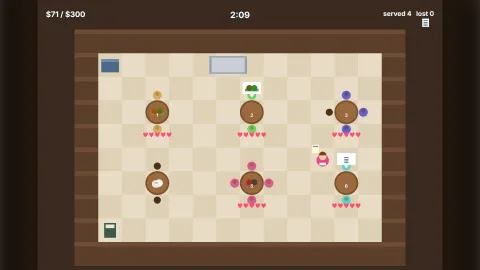
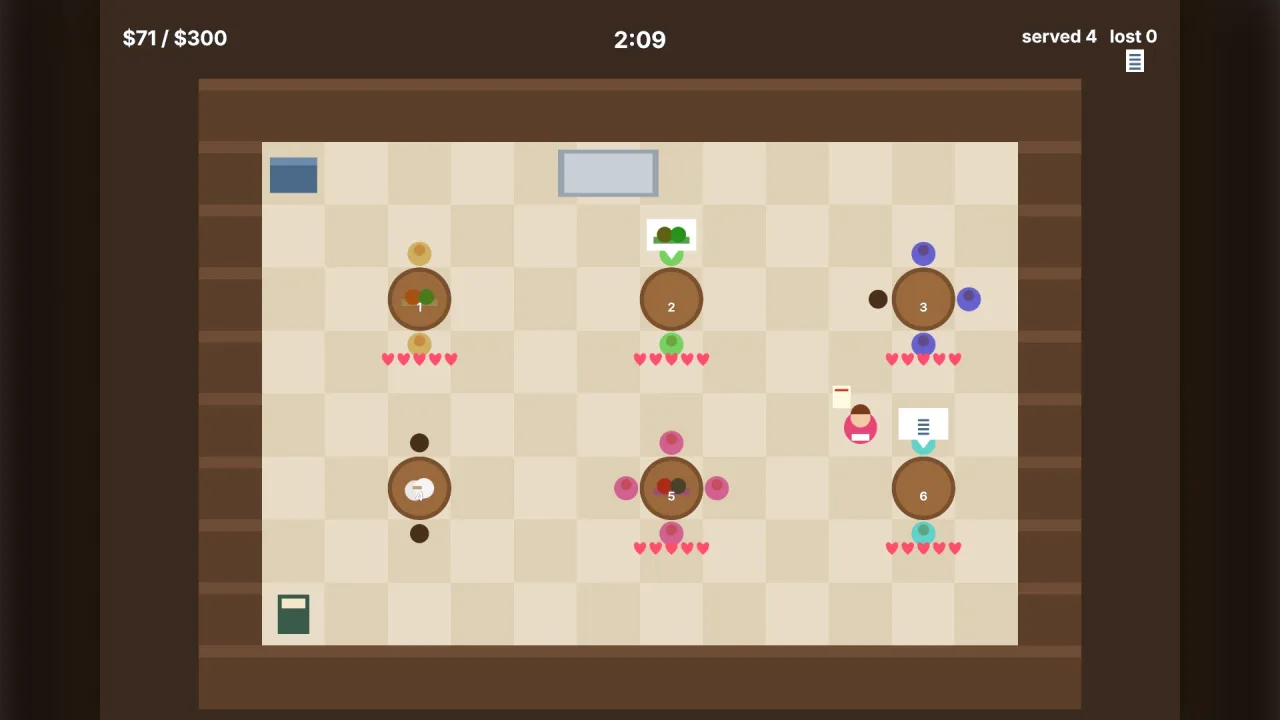
const dinerFloor: string[]The built-in floor: # wall, . floor, a digit a table with that many seats, K the kitchen window, B the bus tub,
P the podium where the queue waits, S where the server starts.
readFloor
function readFloor(plan: string[]): DinerFloor | stringRead a floor plan.
validateDiner
function validateDiner(options: DinerOptions = {}): string[]Check a diner's options. Empty when it can be played.
Types
Diner
interface DinerA diner.
readonly state: DinerState— The live server, task list, kitchen queue and combo; read it freely, but change it only through the methods.readonly service: Service— The guests' shift (thecustomerspack): parties, patience and money.readonly floor: DinerFloor— The parsed floor plan.readonly options: Readonly<{ hands: number; tasks: number; speed: number }>— The settings in force: hands carried, longest task list, and walking speed in cells a second.seat(party: string, table: string): Refusal— Seat a waiting party at a table, at once.queue(task: Task): Refusal— Add a task to the end of the server's list.partyAt(table: string): ServiceState['parties'][number] | undefined— The party at a table.step(dt: number): void— Advances the diner and the shift bydtseconds in fixed 1/60 s ticks, counting at most 0.25 s per call; does nothing once the shift is over. Throws ifdtis negative or not a number.drain(): DinerEvent[]— Returns and clears the events since the last drain; only the latest 512 are kept.snapshot(): DinerSave— Saves the whole diner and its shift as plain JSON (a deep copy).restore(save: DinerSave): void— Loads a save made bysnapshot, replacing the diner and shift and discarding undrained events.
DinerAutopilot
interface DinerAutopilotA player that runs a diner.
act(): Task | null— Seat parties and, when the server's list is empty, give it the next task.
DinerEvent
type DinerEvent = { kind: 'arrived'; task: Task['kind'] } | { kind: 'skip'; task: Task['kind']; why: string } | { kind: 'combo'; count: number; bonus: number } | { kind: 'cooked'; party: string } | ServiceEventSomething that happened in the diner, or with the guests.
DinerFloor
interface DinerFloorThe floor's fixed parts.
cols: number— Width of the plan in cells.rows: number— Height of the plan in cells.tables: { id: string; col: number; row: number; seats: number }[]— The tables in reading order (top to bottom, left to right): id (t1,t2...), cell and seat count.kitchen: { col: number; row: number }— Cell of the kitchen window (K).bus: { col: number; row: number }— Cell of the bus tub (B).podium: { col: number; row: number }— Cell of the podium (P) where the queue waits.walls: { col: number; row: number }[]— Cells that are wall (#).
DinerOptions
interface DinerOptionsA diner's options.
seed?: number— Default 1.floor?: string[]— The floor plan. DefaultdinerFloor.speed?: number— Cells a second the server walks; seconds a task takes once there. Default 4 and 0.35.act?: number— Seconds a task takes once the server is at it. Default 0.35.cook?: number— Seconds a ticket cooks, and more for each item on it. Default 3 and 0.8.perItem?: number— Extra seconds a ticket cooks for each item on it. Default 0.8.hands?: number— Hands. Default 2.tasks?: number— The most tasks waiting. Default 8.combo?: number— Bonus for each task in a combo of the same task. Default 5.service?: Omit<ServiceOptions, 'places' | 'flow' | 'seed'>— The guests' shift (kinds, menu, arrivals, duration, goal...): the places are the floor's tables.
DinerSave
interface DinerSaveA diner saved as plain JSON.
diner: DinerState— The server, tasks, kitchen queue and combo.service: ServiceSave— The guests' shift, as saved by thecustomerspack.carry: number— Seconds ofsteptime not yet spent, under one 1/60 s tick.
DinerState
interface DinerStateWhere the diner stands.
server: Server— The server's position, route, current task and load.tasks: Task[]— Tasks waiting, in order, not counting the one in progress; at mostoptions.tasks.cooking: { party: string; items: string[]; t: number; time: number }[]— Tickets cooking, and food cooked waiting at the window.ready: { party: string; items: string[] }[]— Food cooked and waiting at the kitchen window for apickuptask.combo: { kind: Task['kind'] | null; count: number }— The combo running: its task, length and the bonus so far.bonus: number— Combo points earned so far; kept apart from the shift's money.
Hand
type Hand = { kind: 'food'; party: string; items: string[] } | { kind: 'dishes'; table: string }What the server carries in a hand: a table's food, or its dirty dishes.
Server
interface ServerThe server.
x: number— Horizontal position in floor cells, fractional; a cell's centre is its column plus 0.5.y: number— Vertical position in floor cells, fractional; a cell's centre is its row plus 0.5.path: { x: number; y: number }[]— Waypoints still to walk to, in floor cells, nearest first; empty when not walking.task: Task | null— The task being walked to or done, or null when idle.busy: number— Seconds left on the task being done, once the server has reached it; 0 while walking.hands: Hand[]— What is being carried, at mostoptions.handsitems.tickets: string[]— Ids of the parties whose orders have been taken but not yet dropped at the kitchen.
Task
type Task = | { kind: 'order'; table: string } | { kind: 'drop' } | { kind: 'pickup'; party: string } | { kind: 'deliver'; table: string } | { kind: 'check'; table: string } | { kind: 'clear'; table: string } | { kind: 'bus' }Something to do. Tables are by id (t1, t2... in reading order).
WalkServeApi
interface WalkServeApiWhat the walk-serve pack adds to a game: game.walkServe.
create: typeof createDiner— Open a diner.validate: typeof validateDiner— Check a diner's options.floor: typeof dinerFloor— The built-in floor plan.autopilot: typeof createDinerAutopilot— A player for an attract mode or a test.