
The pack
track
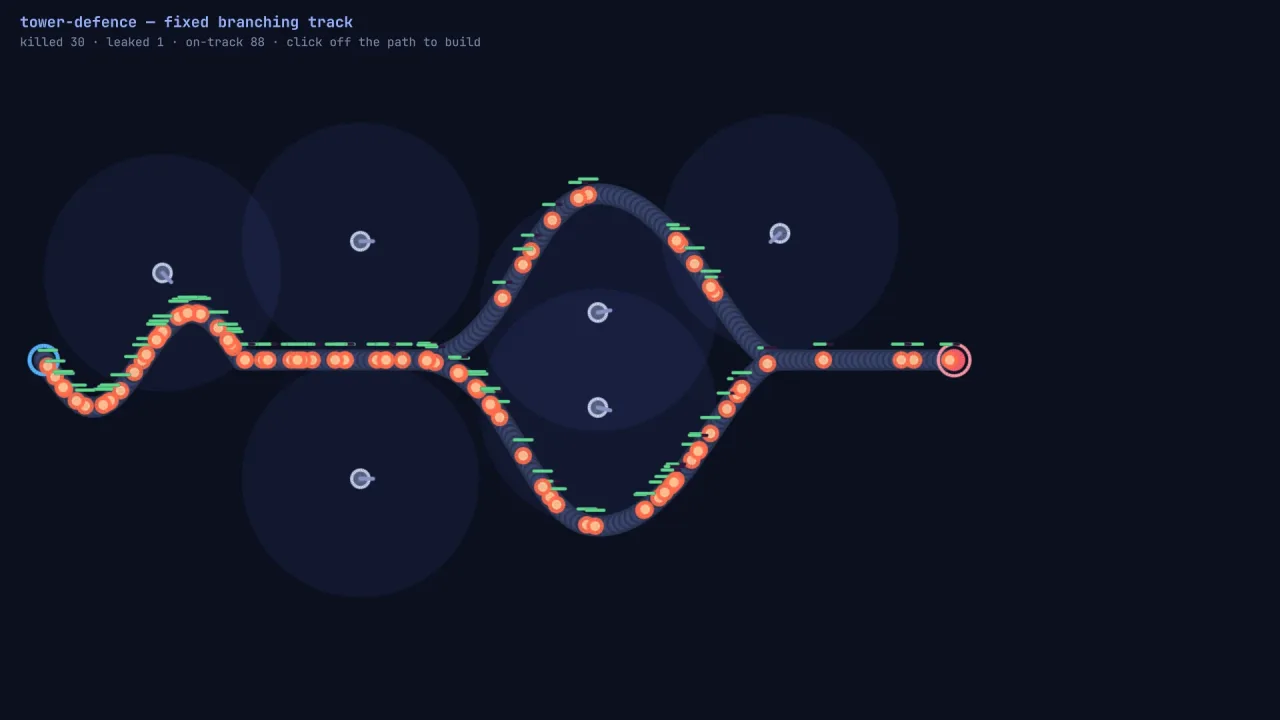
function track(): Pack<{ track: TrackApi }>The track pack: a node-and-edge network of curves, with walkers that travel it and branch by weight.
Pure maths, so it needs no backend and runs headless.
Classes
Track
class TrackA network of authored path segments that enemies follow. Build it once, then
spawn() walkers and advance them each frame. Throws when an edge names an unknown node.
const track = new Track({
  nodes: { in: [0, 300], fork: [400, 300], top: [800, 120], bot: [800, 480], out: [1200, 300] },
  edges: [
    { from: 'in', to: 'fork' },
    { from: 'fork', to: 'top', via: [{ quad: [[600, 120], [800, 120]] }] },   // branch A
    { from: 'fork', to: 'bot', via: [{ quad: [[600, 480], [800, 480]] }] },   // branch B
    { from: 'top', to: 'out' }, { from: 'bot', to: 'out' },                    // merge
  ],
});
const w = track.spawn(140);                    // 140 units/s
// per frame: w.advance(dt); sprite.x = w.x; sprite.y = w.y;  if (w.done) leak();
readonly edges: TrackEdge[]— All baked edges.readonly spawns: string[]— Spawn node names.readonly goals: string[]— Goal node names.constructor(data: TrackData, options: TrackOptions = {})nodeAt(name: string): Vec2 | null— The world position of a named node, ornullif unknown.get length(): number— The total length of the track (sum of all edges).spawn(speed: number, opts: TrackSpawnOptions = {}): TrackWalker— Create a follower. It enters atfrom(or a random spawn node) and picks a branch at each junction withchoose, else by the edge weights drawn fromrng(default the track's stream).speedis world units per second;startDiststaggers a stream by starting it that far along. Throws when the track has no spawn node._pickEdge(node: TrackNode, rng: () => number, walker?: TrackWalker, choose?: TrackChooser): TrackEdge | null_toGoal(name: string): number_node(name: string): TrackNode | undefineddistanceToTrack(x: number, y: number): number— Shortest distance from world point(x, y)to the track centre-line — for validating tower placement ("must be off the path bymargin") and for range-of-track checks. ReturnsInfinityfor an empty track.
TrackWalker
class TrackWalkerA single follower walking a Track. Construct via track.spawn();
call advance(dt) each frame and read x / y / angle / done.
snapshot() and restore() save and rewind it; save its branch stream with it.
x: number— Current world X.y: number— Current world Y.angle: number— Heading in radians (direction of travel).done: boolean—trueonce a goal node is reached (the enemy "leaked").travelled: number— Total distance travelled along the track so far.speed: number— Travel speed in world units per second — mutate live (slows, boosts).constructor(private track: Track, start: TrackNode, speed: number, private rng: () => number, private choose?: TrackChooser)— Enters atstart, choosing its first edge there. Usetrack.spawn()rather than calling this.get edge(): TrackEdge | null— The edge it is on, ornullonce done. Itsfromandtoname the nodes either side.get along(): number— How far along the current edge it is, in world units (0 once done).snapshot(): TrackWalkerState— Its state as plain data, for a save or a rewind. Save the branch stream (rng.snapshot()) with it.restore(state: TrackWalkerState): void— Puts it back where asnapshotof a walker on this track was taken. Throws on an edge index this track does not have.get distanceToGoal(): number— Remaining along-track distance to the nearest goal — SMALLER means FURTHER along (use it to target the "first" enemy: the one closest to leaking).advance(dt: number): boolean— Advance bydtseconds, carrying across junctions and choosing branches. Returnsdone.
Types
TrackApi
type TrackApi = typeof kitgame.track — every function and class this pack carries, as one namespace.
TrackChooser
type TrackChooser = (edges: readonly TrackEdge[], walker: TrackWalker) => TrackEdge | null | undefinedA branch policy: given the edges leaving the junction a walker has reached (more than one), return the one to take, or nothing to fall back to the weighted draw. A switchable junction, a player's choice or "always the shortest route" are each one of these.
TrackData
interface TrackDataThe plain-data track notation — JSON-friendly, author it inline.
nodes: Record<string, PathPoint>— Named node positions,name: [x, y].edges: TrackEdgeData[]— The directed edges connecting them.spawns?: string[]— Entry node names (default: every node with no incoming edge).goals?: string[]— Exit node names — reaching one ends the run / "leaks" (default: every node with no outgoing edge).
TrackEdge
interface TrackEdgeA baked edge: its Path, endpoints, length and a sampled polyline. The graph is fixed once built; only weight may be changed.
from: string— Node name this edge leaves.to: string— Node name this edge arrives at.path: Path— The arc-length curve for this edge.length: number— Geometric length in world units.weight: number— Branch weight at thefromnode. Mutable: change it to bias the draw at that junction from now on.points: Vec2[]— A sampled polyline of the edge, for drawing + nearest-point queries.
TrackEdgeData
interface TrackEdgeDataOne directed edge of the track in the data notation.
from: string— Name of the node this edge leaves.to: string— Name of the node this edge arrives at.via?: PathSegmentData[]— Optional curve geometry (anyPathSegmentDatachain, continuing fromfrom's point). Omit for a straight line between the two nodes.weight?: number— Relative likelihood of taking this edge at a branching node (default1).
TrackOptions
interface TrackOptions extends PathOptionsOptions for a Track: the parse-time transform of PathOptions, plus the default branch stream.
rng?: TrackRng— The stream walkers draw branch choices (and an unnamed spawn) from whenspawnis given none. DefaultcreateRng(0), so a track is deterministic on its own; passgame.rng.fork('track')so the game's seed decides it. Shared by every walker that has no stream of its own.
TrackRng
type TrackRng = Rng | (() => number)A random source for branch choices: a kernel Rng (such as game.rng.fork('track')), or a function returning 0..1.
TrackSpawnOptions
interface TrackSpawnOptionsOptions for Track.spawn.
from?: string— The spawn node to enter at. Default (or when the name is not a spawn): one picked at random fromspawns.rng?: TrackRng— This walker's own branch stream. Default the track's (TrackOptions.rng).startDist?: number— Start this far along the route, in world units, as if it had already travelled it (staggers a stream). Default 0.choose?: TrackChooser— A branch policy consulted at every junction before the weighted draw. Default none: weights only.
TrackWalkerState
interface TrackWalkerStateA walker's saved state, from TrackWalker.snapshot: plain data, JSON-safe.
edge: number— Index of the current edge intrack.edges, or -1 once done.along: number— Distance along the current edge, world units.travelled: number— Total distance travelled, world units.speed: number— Speed, world units per second.done: boolean— Whether it has reached a goal.x: number— World X at the save.y: number— World Y at the save.angle: number— Heading at the save, radians.