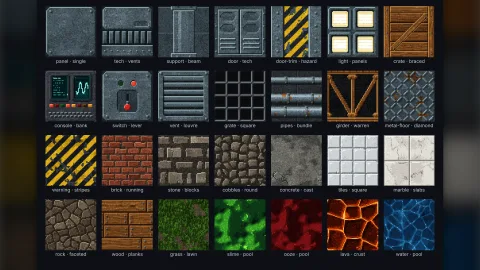

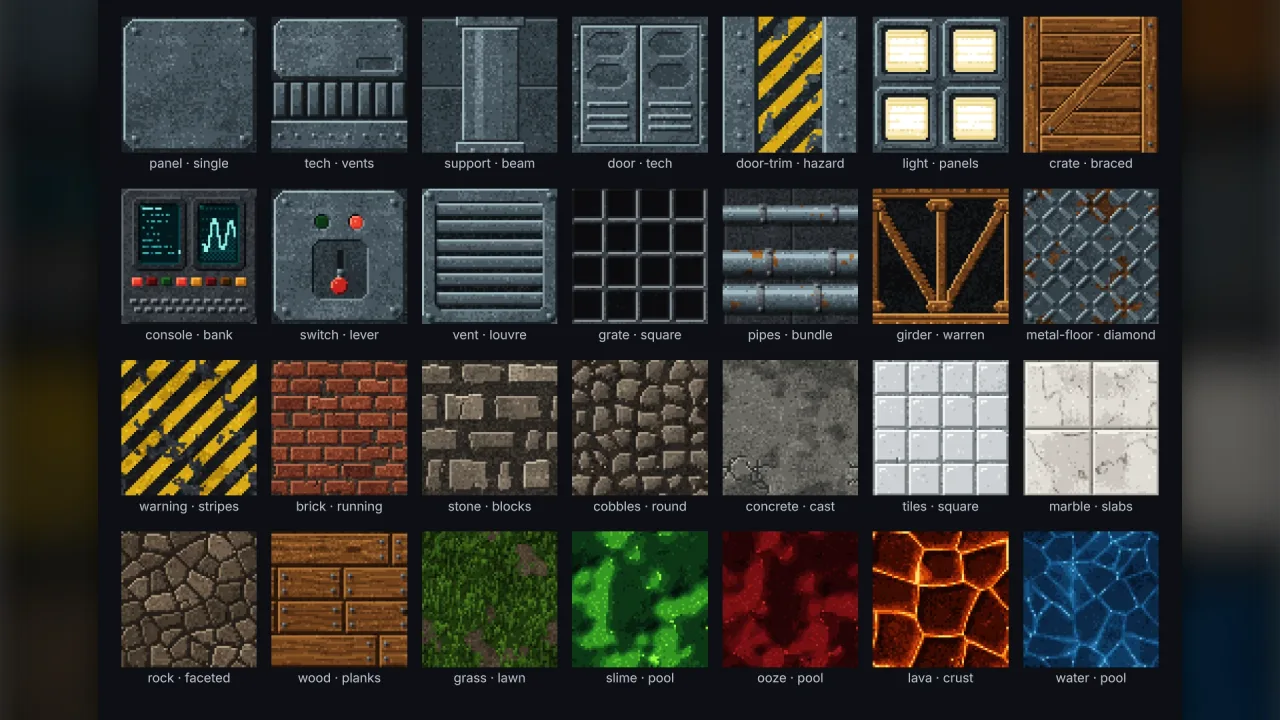
The pack
retroTextures
function retroTextures(): Pack<{ retroTextures: RetroTexturesApi }>Compose the retro texture generator under game.retroTextures. No options; every texture takes its own spec.
Helpers
normalMap
function normalMap(source: RetroHeightSource, options: RetroNormalOptions = {}): Uint8ClampedArray<ArrayBuffer>A tangent-space normal map from a height map, as RGBA bytes in the source's strip layout. Each pixel's slope is the
central difference of its neighbours' heights, wrapping at the frame's edges so the map tiles as the texture does.
Red is +x (right), green is +y up the image (OpenGL convention; flipY for DirectX), blue is out of the surface,
each 128 + 127 × n: a flat height is (128, 128, 255). Throws on a size that does not match its heights, a frame
out of range or a strength out of range.
paintRetroTexture
function paintRetroTexture(ctx: RetroCanvasContext, texture: RetroPixels, options: number | RetroPaintOptions = {}): booleanPaint one frame of a texture (or a normal map in the same shape) into a 2D canvas context at (x, y), pixel for
pixel. Where OffscreenCanvas exists the frame goes through one and drawImage, so a kernel paint callback's
scale and frame offset apply and the pixels stay sharp; otherwise putImageData writes them unscaled. Headless,
with no ImageData, it does nothing. Returns whether it painted. A number in place of the options is the frame.
RAMP_SHADES
const RAMP_SHADES: 8How many shades every resolved ramp has.
RETRO_KIND_NAMES
const RETRO_KIND_NAMES: readonly ["panel", "tech", "support", "door", "door-trim", "light", "crate", "console", "switch", "vent", "grate", "pipes", "girder", "metal-floor", "warning", "brick", "stone", "cobbles", "concrete", "tiles", "marble", "rock", "wood", "grass", "slime", "ooze", "lava", "water", "glass", "fabric", "plaster", "rack"]Every kind of texture, in the order retroKinds lists them.
retroKinds
const retroKinds: Readonly<Record<RetroKind, RetroKindInfo>>Every kind with its look, defaults, variants and options, by name.
retroPalettes
const retroPalettes: Readonly<Record<RetroPaletteName, readonly string[]>>The built-in ramps by name: eight CSS colours each, darkest first. The shades step evenly in lightness and shift hue as they go (darks cooler, lights warmer, except the steels, whose highlight is a cool cyan), the way hand-made palettes of the period did, so the ramps sit together in one level.
retroTexture
function retroTexture(spec: RetroTextureSpec): RetroTextureMake a texture. Pure and deterministic: the same spec gives the same pixels, with no clock and no Math.random.
Throws, naming the field, on an unknown kind, variant or option, a size that is not a multiple of 8 from 16 to 256,
a non-finite seed, an option out of its range, or a colour the kernel's parser cannot read.
retroTextureFor
function retroTextureFor(name: string, options: RetroTextureForOptions = {}): RetroTextureSpecA texture recipe for a surface name: the recipe of the first theme that has the name (the ones asked for first, then
tech, industrial, castle, neon, crypt and office), else one guessed from its words (door-red is a door with a red key
stripe, old-brick is brick, slime-pit is slime), else a steel panel seeded from the name, so two unknown names
differ. Always returns a fresh spec for retroTexture; throws on a theme that does not exist.
retroThemes
const retroThemes: Readonly<Record<RetroThemeName, RetroTheme>>The built-in themes. Every recipe has a fixed seed, so a level always wears the same walls.
Types
RetroCanvasContext
interface RetroCanvasContextThe part of a 2D canvas context paintRetroTexture uses; a CanvasRenderingContext2D, an offscreen one, or a painter's.
putImageData(image: ImageData, x: number, y: number): void— Write pixels, ignoring the context's transform.drawImage?(image: OffscreenCanvas, x: number, y: number, w: number, h: number): void— Draw an image through the context's transform (how a scaled painter's context is honoured).imageSmoothingEnabled?: boolean— Smoothing for scaled draws; turned off while the pixels are drawn.
RetroHeightSource
interface RetroHeightSourceAnything with a height map in strip layout: a RetroTexture, or your own heights.
readonly width: number— One frame's width in pixels.readonly height: number— One frame's height in pixels.readonly heights: ArrayLike<number>— Heights 0..1,width * frames×height, row by row.readonly frames?: number— Frames side by side; default 1.
RetroKind
type RetroKind = typeof RETRO_KIND_NAMES[number]A kind of texture: one of RETRO_KIND_NAMES.
RetroKindInfo
interface RetroKindInfoOne kind as retroKinds describes it.
readonly name: RetroKind— Its name, as the spec'skind.readonly about: string— What it looks like.readonly palette: RetroPaletteName— The palette it uses when the spec names none.readonly accent: RetroPaletteName— The accent ramp it uses when the spec names none.readonly animated: boolean— Whether it has frames that loop.readonly emissive: boolean— Whether its emissive mask is lit.readonly variants: readonly RetroVariantInfo[]— Its layout presets; the first is the default.readonly options: Readonly<Record<string, RetroOptionInfo>>— Every option it takes, with its default, range and meaning (the commongrainincluded).
RetroNormalOptions
interface RetroNormalOptionsHow normalMap works.
strength?: number— How steep a height step looks, 0 to 64; default 2. A step from 0.5 to 0.75 tilts about 27° at 2.frame?: number— Only this frame (0-based); default every frame, side by side as in the source.flipY?: boolean— Green points down the image (the DirectX convention) instead of up (the OpenGL convention); default false.
RetroOptionInfo
interface RetroOptionInfoOne option of a kind, as retroKinds lists it.
readonly default: RetroOptionValue— What it is when neither the spec nor the variant sets it.readonly about: string— What it changes, in a sentence, with its units.readonly min?: number— The smallest number it takes (numbers only).readonly max?: number— The largest number it takes (numbers only).readonly values?: readonly string[]— The words it takes (choices only).readonly ramp?: boolean— True when it takes a ramp: a palette name or an array of CSS colours.
RetroOptionValue
type RetroOptionValue = number | boolean | string | readonly string[]A value an option takes: a number, a switch, a choice, or a ramp (a palette name or a list of CSS colours).
RetroPaintOptions
interface RetroPaintOptionsWhere and what paintRetroTexture paints.
frame?: number— The frame to paint (wrapping); default 0.x?: number— Left edge in the context's units; default 0.y?: number— Top edge in the context's units; default 0.layer?: 'color' | 'emissive' | 'height'— What to paint: the colours (default), the emissive mask or the height map, as grey.
RetroPaletteName
type RetroPaletteName = | 'steel' | 'gunmetal' | 'lab' | 'stone' | 'brick' | 'rust' | 'hazard' | 'toxic' | 'concrete' | 'wood' | 'brass' | 'alien' | 'lava' | 'water' | 'marble' | 'grass' | 'rock' | 'phosphor' | 'amber' | 'lamp' | 'red' | 'blue' | 'blood' | 'glass' | 'carpet' | 'wine' | 'leather' | 'plaster'The names of the built-in ramps, each eight CSS colours from near-black to a highlight.
RetroPixels
interface RetroPixelsAnything with RGBA pixels in strip layout: a RetroTexture, or { width, height, rgba: normalMap(t), frames }.
readonly width: number— One frame's width in pixels.readonly height: number— One frame's height in pixels.readonly rgba: ArrayLike<number>— RGBA bytes,width * frames×height.readonly frames?: number— Frames side by side; default 1.readonly emissive?: ArrayLike<number>— Emission 0..255 per pixel, forlayer: 'emissive'.readonly heights?: ArrayLike<number>— Heights 0..1 per pixel, forlayer: 'height'.
RetroRamp
type RetroRamp = RetroPaletteName | readonly string[]A ramp: a built-in name, or 2 to 16 CSS colours ordered dark to light (any form the kernel's colour parser reads). A list of any other length than eight is resampled to eight shades, blending neighbours in sRGB.
RetroTexture
interface RetroTextureA made texture: colour, height and emission for each pixel of each frame. Frames sit side by side, so every array
is a strip width * frames pixels wide and height tall, row by row: pixel (x, y) of frame f is at index
y * width * frames + f * width + x. That is the layout raycast-view's texturePixels and the kernel's painted
strips use.
readonly kind: RetroKind— The kind it was made as.readonly width: number— One frame's width in pixels.readonly height: number— One frame's height in pixels.readonly frames: number— Frames in this strip: 1 for a still kind or a singleframe, else the loop.readonly loop: number— Frames in the full loop (1 for a still kind); frameloopis frame 0 again.readonly rgba: Uint8ClampedArray<ArrayBuffer>— Colour, RGBA bytes; alpha is 255 except where a see-through option clears it, and a glass pane's opacity.readonly heights: Float32Array<ArrayBuffer>— Height per pixel, 0 (deepest: seams, mortar, holes) to 1 (highest: rivet heads); 0.5 is the surface.readonly emissive: Uint8Array<ArrayBuffer>— Emission per pixel, 0 to 255: non-zero only on lights, screens, lit lamps and buttons, slime and lava.
RetroTextureForOptions
interface RetroTextureForOptionsOptions for retroTextureFor.
themes?: RetroThemeName | readonly RetroThemeName[]— Themes to look in first, in order; afterwards every theme is tried. Default none.overrides?: Partial<RetroTextureSpec>— Fields laid over the recipe found (size,seed,palette…);optionsmerge with the recipe's. Default none.
RetroTexturesApi
interface RetroTexturesApigame.retroTextures: make textures, their normal maps, and paint them; the palettes and kinds to choose from.
make: typeof retroTexture— Make a texture from a spec:make({ kind: 'panel', size: 64, seed: 3, variant: 'quad' }). SeeretroTexture.normalMap: typeof normalMap— A texture's normal map as RGBA bytes:normalMap(texture, { strength }). SeenormalMap.paint: typeof paintRetroTexture— Paint a frame into a 2D canvas context, such as agame.paintcallback's. SeepaintRetroTexture.palettes: typeof retroPalettes— The built-in ramps by name.kinds: typeof retroKinds— Every kind with its look, defaults, variants and options.forName: typeof retroTextureFor— A recipe for any surface name, from the themes or a guess:make(forName('door-red', { themes: 'tech' })). SeeretroTextureFor.themes: typeof retroThemes— The built-in themes: recipes by surface name for a tech base, an industrial plant, a castle, a neon arena, a crypt and an office block.
RetroTextureSpec
interface RetroTextureSpecWhat to make. Only kind is needed; everything else has a default.
kind: RetroKind— The kind of texture (retroKindslists them with their options).size?: number— Width and height in pixels, a multiple of 8 from 16 to 256; default 64.width?: number— Width in pixels, overridingsizefor a non-square texture (a door 64 × 128); a multiple of 8 from 16 to 256.height?: number— Height in pixels, overridingsize; a multiple of 8 from 16 to 256.seed?: number— Chooses the noise and layout; default 1. A whole number (others are rounded). The same seed gives the same texture.palette?: RetroRamp— The main ramp: aretroPalettesname or 2 to 16 CSS colours dark to light; default the kind's (or variant's).accent?: RetroRamp— The second ramp, for stripes, lights, screens, rust, moss, mortar and so on; default the kind's (or variant's).variant?: number | string— A layout preset of the kind, by number from 0 or by name; default 0. Its options are overridden byoptions.frames?: number— Animated kinds: frames in one loop, 1 to 64; default 8. Still kinds always have one frame.frame?: number— Animated kinds: make only this frame of the loop (wrapping, soframesis frame 0 again); default every frame.options?: Readonly<Record<string, RetroOptionValue>>— The kind's options by name (and the commongrain); unknown names and out-of-range values throw.
RetroTheme
type RetroTheme = Readonly<Record<string, RetroTextureSpec>>A theme: a recipe for each surface name it knows.
RetroThemeName
type RetroThemeName = 'tech' | 'industrial' | 'castle' | 'neon' | 'crypt' | 'office'A theme's name.
RetroVariantInfo
interface RetroVariantInfoA named layout of a kind: a preset of its options, chosen with the spec's variant.
readonly name: string— Its name, usable as the spec'svariantin place of its number.readonly about: string— What it looks like.readonly set: Readonly<Record<string, RetroOptionValue>>— The options it sets; the spec's ownoptionsoverride them.readonly palette?: RetroPaletteName— The palette it uses when the spec names none; default the kind's.readonly accent?: RetroPaletteName— The accent ramp it uses when the spec names none; default the kind's.