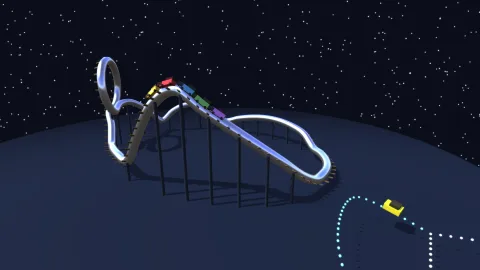

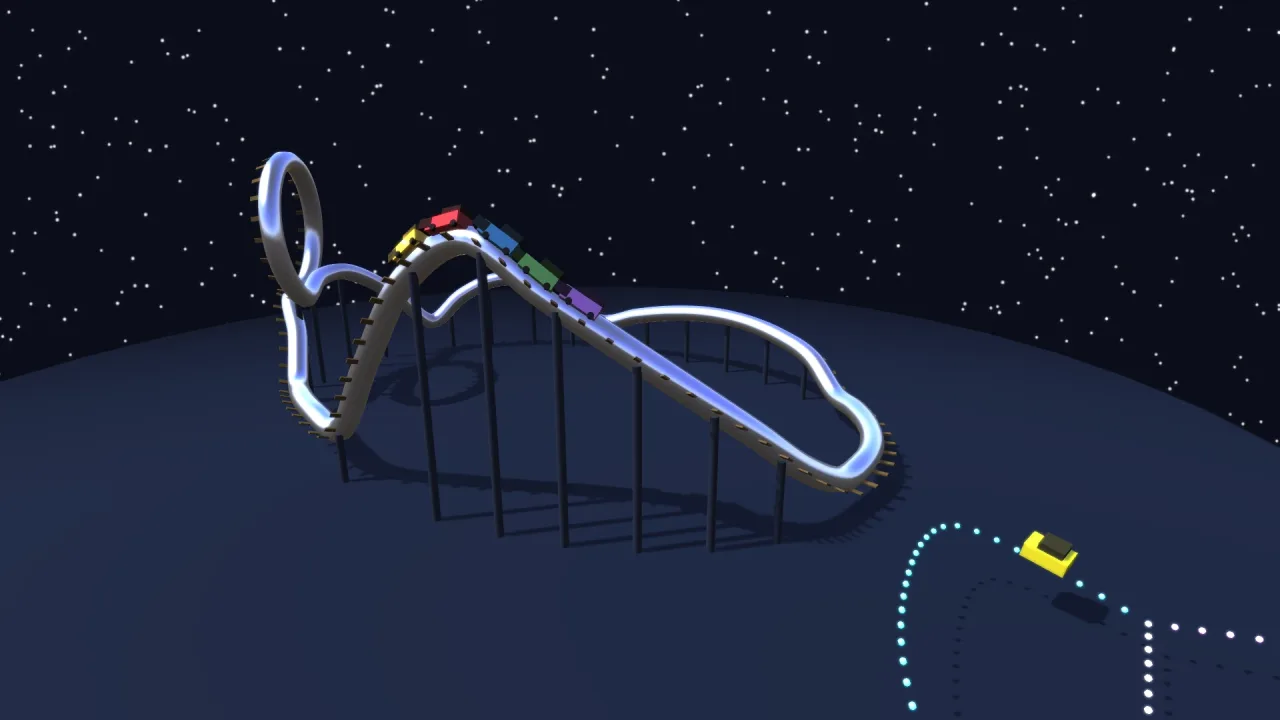
The pack
path3d
function path3d(): Pack<{ path3d: Path3dApi }>The path-3d pack: rides, rails and camera paths through 3D points, at even speed and without twisting.
Classes
DynamicPath3d
class DynamicPath3dA path as a rolling window: add waypoints ahead, trim behind, and ride by absolute distance forever.
constructor(opts: { samplesPerSegment?: number } = {})get start(): number— Distance at the START of the ridable window (advances with trim()).get head(): number— Distance at the END of the ridable window (grows with add()). Keep adding whilehead - riderDistshrinks — the rider must never catch the head. 0 until three waypoints exist.get ready(): boolean— Ridable yet? (needs 3 waypoints for the first baked segment).add(x: number | { x: number; y: number; z: number }, y = 0, z = 0): void— Append a waypoint AHEAD. Bakes every segment that just became stable and drops control points the baker no longer needs.trim(d: number): void— Drop everything WHOLLY behind distance d (keeps the bracketing sample so frameAt(d) still interpolates). Distances stay absolute.at(d: number): { x: number; y: number; z: number }— Position at ABSOLUTE distance d (clamped to [start, head]).frameAt(d: number): PathFrame— Full frame at ABSOLUTE distance d — same contract as Path3d.frame.pointsBetween(d0: number, d1: number, n: number): Array<[number, number, number]>— n points between two absolute distances — draw the plotted route.
Path3d
class Path3dA baked Catmull-Rom curve through 3D points, sampled by arc-length fraction with a no-twist frame.
readonly length: number— Total arc length (world units).readonly closed: boolean— True when the path joins the last point back to the first.constructor(points: Array<[number, number, number]> | P3[], opts: Path3dOptions = {})at(t: number): P3— Position at arc-length fraction t (0..1; closed paths wrap).atDist(d: number): P3— Position at a distance in world units along the path.frame(t: number): PathFrame— Full frame at t: position + tangent + parallel-transported normal + binormal (all unit) — orient a cart, bank a camera, place a rail tie.points(count: number): Array<[number, number, number]>— n points evenly spaced by ARC LENGTH — feed world.tube({ path }) or a vector polyline directly. Closed paths omit the duplicate end point.
Types
Path3dApi
interface Path3dApigame.path3d: 3D splines with frames.
Path3d: typeof Path3d— A baked Catmull-Rom curve through 3D points, by arc length, with a no-twist frame.DynamicPath3d: typeof DynamicPath3d— A rolling 3D path: waypoints added ahead, trimmed behind, ridden by distance.
Path3dOptions
interface Path3dOptionsOptions for the Path3d constructor.
closed?: boolean— Join the last point back to the first (loops: coasters, patrols).samplesPerSegment?: number— Samples baked per segment (default 24; more = smoother frames).
PathFrame
interface PathFrameOne sampled point on a path: position plus a unit tangent/normal/binormal frame. Returned by Path3d.frame.
x: number— The position on the path, in world units.y: number— The y position on the path, in world units.z: number— The z position on the path, in world units.tx: number— Unit tangent — the travel direction.ty: number— The y part of the unit tangent.tz: number— The z part of the unit tangent.nx: number— Parallel-transported unit normal (no roll flips around loops).ny: number— The y part of the unit normal.nz: number— The z part of the unit normal.bx: number— Binormal = tangent × normal.by: number— The y part of the binormal.bz: number— The z part of the binormal.