
The pack
englishWords
function englishWords(options: EnglishWordsOptions = {}): Pack<{ words: WordsApi }>The english-words pack: game.words, the Common English Lexicon (69,223 words) and lists of your own, with exact,
pattern, prefix, anagram and fuzzy search. Headless; needs no world or renderer.
Helpers
ALPHABET
const ALPHABET: "abcdefghijklmnopqrstuvwxyz"The 26 letters every word is made of, in order.
CEL_COMMIT
const CEL_COMMIT: "5836e959e56bac99547345837aacbde8f2a623b8"The CEL commit these words come from.
CEL_COUNTS
const CEL_COUNTS: Readonly<Record<number, number>>How many words of each length, 69223 in all.
createWordList
function createWordList(source: Iterable<string> | string, options: WordListOptions = {}): WordListA list of your own words: an array, or text as parseWords reads it. Each entry is normalised as normaliseWord
does (so "Tyrannosaurus Rex" becomes tyrannosaurusrex) and duplicates are kept once. Throws a RangeError for an
entry that is not a word, unless options.invalid is 'skip'.
editDistance
function editDistance(a: string, b: string): numberThe fewest single-letter edits that turn a into b: an insertion, a deletion, a change, or two neighbouring
letters swapped (hte → the is 1). Case and the characters normaliseWord drops are ignored. This is the
distance the fuzzy search ranks by.
englishLexicon
function englishLexicon(options: EnglishOptions = {}): WordListThe Common English Lexicon: 69,223 English words of 2 to 45 letters, chosen as common for word games, by Eric Smith
and Kenji Matsumoto (MIT licence). By default the 86 rated offensive (slurs, strong swearing, explicit terms) are
left out; rating: 'family' leaves out 147 milder ones too, and 'unfiltered' keeps all. Shared and decoded a length
at a time, the first time a length is asked for. With options, a list narrowed to min..max letters with
include added and exclude taken out.
normaliseWord
function normaliseWord(text: string): string | nullA word's letters as they are stored: lower case, a-z only. Spaces, hyphens, apostrophes and full stops are dropped
and accents taken off ("T. Rex" → trex, "café" → cafe). Null when anything else is left or nothing is.
parseWords
function parseWords(text: string): string[]The words in text: one entry per line, or separated by commas or semicolons. Blank entries and lines starting
with # are skipped. Entries are not normalised; createWordList does that.
word
function word(text: string): WordA word from text: word('Crane').at(2) → 'a'. Throws a RangeError for anything but letters. Not checked against any list.
Functions
wordRating
function wordRating(word: string): WordRating | nullA lexicon word's rating: 'offensive' (slurs, strong swearing, explicit terms), 'mature' (milder swearing, sex,
the body, crime), or null for every other word. Rated for the words of the Common English Lexicon; any other text is
null. Case does not matter.
Classes
Word
class WordOne word, with questions about its letters: what is at a position, how often a letter appears, whether a partly
traced word is on its way to this one, and whether its letters can make another word. Make one with word(text)
or take one from a list (pick, sample, list.word). Immutable.
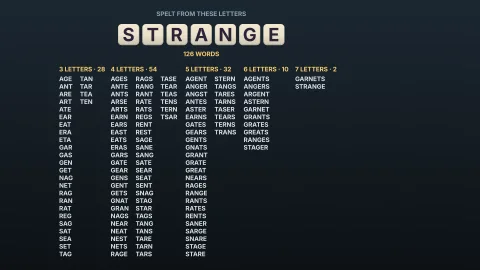
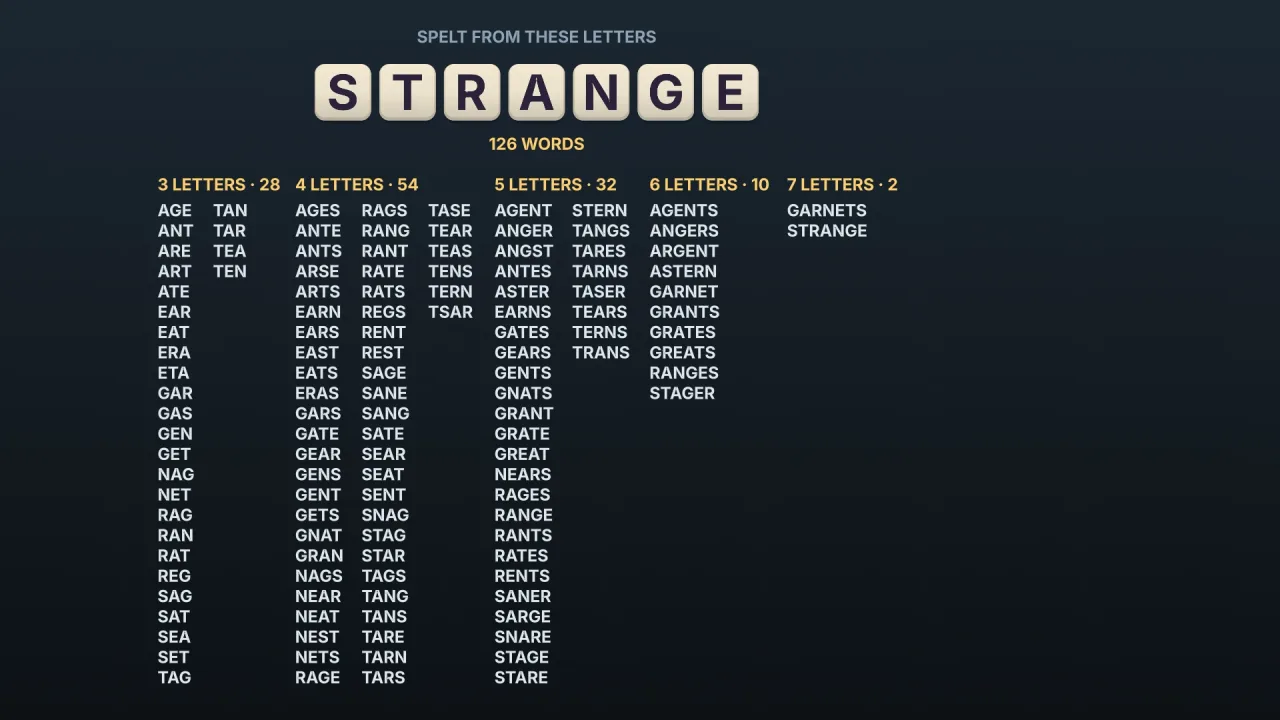
readonly text: string— The word in lower case, a-z only.constructor(text: string)— NormalisestextasnormaliseWorddoes. Throws a RangeError when it holds anything but letters.get length(): number— How many letters.get first(): string— The first letter.get last(): string— The last letter.get upper(): string— The word in capitals, as most word games show it.get letters(): ReadonlyArray<string>— The letters in order, one string each.get sorted(): string— The letters in alphabetical order, as one string: two words are anagrams when these are equal.at(index: number): string— The letter atindex, counting from 0; a negative index counts back from the end (-1 is the last letter). Throws a RangeError outside the word.is(index: number, letter: string): boolean— Isletteratindex(from 0; negative from the end)? False outside the word. Case does not matter.has(letter: string): boolean— Does the word containletter?count(letter: string): number— How many timesletterappears. Throws a RangeError for anything but one letter.positions(letter: string): number[]— Every position ofletter, from 0, in order.startsWith(part: string): boolean— Does the word start withpart? A traced or typed word that is still on its way to this one does.endsWith(part: string): boolean— Does the word end withpart?includes(part: string): boolean— Doespartappear anywhere in the word?next(part: string): string | null— The letter that comes afterpartwhenpartis the start of this word, else null (also whenpartis the whole word). What a hint shows a player halfway through tracing it.matches(pattern: string): boolean— Does the word fitpattern??,.or_is any letter,[abc]any of those,[^abc]any but those.canMake(other: string | Word): boolean— Canotherbe spelt with this word's letters, each used no more often than it appears here?listencan makesilent,tinandlest, nottilt. What a letter-wheel puzzle asks of its base word.isAnagramOf(other: string | Word): boolean— Isotherthe same letters in another order? A word is not an anagram of itself.equals(other: string | Word): boolean— The same word, ignoring case and the charactersnormaliseWorddrops?toString(): string— The word, lower case.toJSON(): string— The word, lower case, so a Word goes into a save as a plain string.
WordList
class WordListA list of words, any size, from the English lexicon (englishLexicon) or your own (createWordList). Every word
is lower case, a-z only; every lookup ignores case. Immutable: filter, with and without return new lists.
readonly name: string— A name for messages and for telling lists apart.readonly size: number— How many words.readonly lengths: ReadonlyArray<number>— The lengths that have words, shortest first.constructor(name: string, counts: ReadonlyMap<number, number>, private readonly group: (length: number) => ReadonlyArray<string>)— UsecreateWordListorenglishLexiconrather than this.countsgives each length's word count andgroup(length)that length's words, sorted, when first asked for.ofLength(length: number): ReadonlyArray<string>— Every word oflengthletters, in alphabetical order. Empty for a length the list has none of.words(): string[]— Every word, shortest first, alphabetical within a length.has(text: string): boolean— Istextin the list? Case and the charactersnormaliseWorddrops do not matter.word(text: string): Word | null—textas aWordwhen it is in the list, else null.find(query: WordQuery = {}, limit = Infinity): string[]— Every word that matches, shortest first and alphabetical within a length, at mostlimitof them.count(query: WordQuery = {}): number— How many words match.first(query: WordQuery = {}): Word | null— The first word that matches, infind's order, as aWord, or null.isPrefix(prefix: string): boolean— Does any word start withprefix(or equal it)? What a grid solver asks before it goes a letter deeper, and what a game asks of a word the player is still tracing.completions(prefix: string, limit = Infinity): string[]— Words that start withprefix, in alphabetical order (not by length), at mostlimit.anagrams(letters: string): string[]— Words made of exactlyletters, rearranged (anagrams('least')→slate,stale,steal,tales…);lettersitself is left out.near(text: string, distance = 1, limit = Infinity): string[]— The words withindistanceedits oftext(an insertion, deletion, change or swap of two neighbours each), nearest first, then shortest, then alphabetical;textitself first when it is a word. What a "did you mean" needs. Default distance 1.closest(text: string, distance = 2): string | null— The nearest word totextwithindistanceedits (default 2), or null.textitself when it is a word.pick(rng: Rng, query: WordQuery = {}): Word— One matching word, chosen byrng. Throws a RangeError when nothing matches, naming the list and the query.sample(rng: Rng, count: number, query: WordQuery = {}): Word[]— Up tocountdifferent matching words, chosen byrng, in the order drawn. Fewer only when fewer match.filter(query: WordQuery, name = \${this.name} (filtered)`): WordList` — A new list of the words that match.with(words: Iterable<string>, name = this.name): WordList— A new list withwordsadded, normalised asnormaliseWorddoes. Throws a RangeError for an entry that is not a word.without(words: Iterable<string>, name = this.name): WordList— A new list withoutwords(any case).letterFrequency(): Readonly<Record<string, number>>— How often each letter appears across the list, a to z, as fractions that add up to 1. A letter grid that wants playable letters draws by these. Worked out once, the first time it is asked for.
Types
EnglishOptions
interface EnglishOptionsWhat englishLexicon and the pack's options take.
min?: number— Shortest word, in letters. Default 2, the shortest in the lexicon.max?: number— Longest word, in letters. Default 45, the longest in the lexicon.include?: ReadonlyArray<string>— Words to add (a game's own slang, names it allows). Normalised asnormaliseWorddoes.exclude?: ReadonlyArray<string>— Words to leave out (any case).rating?: RatingFilter— Which rated words to keep (seewordRating):'standard'(the default) leaves out slurs, strong swearing and explicit terms;'family'leaves out milder swearing and words about sex, the body and crime as well;'unfiltered'keeps every word of the lexicon.
EnglishWordsOptions
type EnglishWordsOptions = EnglishOptionsManifest options: the game's own word list, game.words.lexicon, is the lexicon narrowed by these.
RatingFilter
type RatingFilter = 'standard' | 'family' | 'unfiltered'Which words a list keeps: standard drops the offensive, family the mature too, unfiltered none.
WordListOptions
interface WordListOptionsHow createWordList reads its words.
name?: string— A name for messages and for telling lists apart. Default'custom'.invalid?: 'throw' | 'skip'— What to do with an entry that is not a word of the letters a-z once normalised:'throw'(the default) or'skip'.rating?: RatingFilter— Leave out rated words (seewordRating):'standard','family', or'unfiltered'(the default: your list as given).
WordQuery
interface WordQueryWhat to find in a list. Every field narrows it; leave a field out to ignore it. Letters may be given in either case. Results come in length order, then alphabetical.
length?: number— Exactly this many letters.min?: number— At least this many letters.max?: number— At most this many letters.startsWith?: string— Starts with these letters.endsWith?: string— Ends with these letters.contains?: string— Has these letters together somewhere.pattern?: string— Fits this pattern, which also fixes the length:?,.or_is any letter,[abc]any of those,[^abc]any but those (c?a[^s]e).from?: string— Can be spelt from these letters, each used no more often than it appears here: a letter rack or wheel (from: 'listen').only?: string— Uses no letters but these, as often as it likes (only: 'abcde').uses?: string— Contains every one of these letters at least once.without?: string— Contains none of these letters.exclude?: Iterable<string>— Leave these words out (any case).where?: (word: string) => boolean— Any other test, given the lower-case word.
WordRating
type WordRating = 'offensive' | 'mature'How suitable a word is for a game's audience.
WordsApi
interface WordsApigame.words: the game's word list, lists of your own, and seeded picks from the game's random source.
readonly lexicon: WordList— The game's word list: the English lexicon within the manifest'smin..maxletters,includeadded,excludetaken out.english(options?: EnglishOptions): WordList— The English lexicon narrowed differently fromlexicon(english({ min: 3, max: 8 })). The full lexicon with no options.list(source: Iterable<string> | string, options?: WordListOptions): WordList— A list of your own, from an array or from text (one word a line, or separated by commas). SeecreateWordList.loaded(key: string, options?: WordListOptions): WordList— A list from a file the loader fetched underkey: atextitem read aslistreads text, or ajsonitem holding an array of strings. Headless, where the loader fetches nothing, the list is empty. Throws for an unknown key or a JSON value that is not an array of strings.has(text: string): boolean— Istextinlexicon? Case does not matter.word(text: string): Word—textas aWord, whether or not any list holds it. Throws a RangeError for anything but letters.find(query?: WordQuery, list?: WordList): string[]— Every word inlist(defaultlexicon) that matches, shortest first, alphabetical within a length.pick(query?: WordQuery, list?: WordList): Word— One matching word fromlist(defaultlexicon), chosen by the game's random source. Throws a RangeError when nothing matches.sample(count: number, query?: WordQuery, list?: WordList): Word[]— Up tocountdifferent matching words fromlist(defaultlexicon), chosen by the game's random source.distance(a: string, b: string): number— The fewest single-letter edits between two words; seeeditDistance.readonly rng: Rng— The random sourcepickandsampledraw from: the game's, forked as'words'.